Quick Answer
Before upgrading to 250Hz in South Africa, confirm your GPU can consistently deliver 200-plus fps in your main game, that you play a motion-sensitive title where crosshair clarity matters, and that your current monitor is the bottleneck. If all three apply, the upgrade from 144Hz to 250Hz delivers a real, perceptible improvement. If any one does not apply, a GPU upgrade is likely the smarter first step.
The GPU Check: Most Important Step 🔧
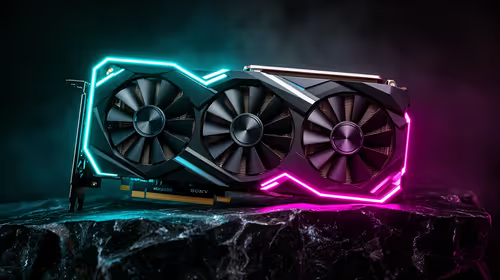
The most common mistake South African gamers make when upgrading to 250Hz is buying the panel before confirming the GPU can feed it. Run your main game at typical settings and record average and minimum fps using AMD Adrenalin's built-in performance monitor or NVIDIA's in-game overlay. If your average fps in competitive titles sits at 180 to 220fps consistently on an RTX 4070 or RX 7900 GRE at 1080p, the 250Hz upgrade will be immediately useful. If your average is 110 to 140fps on an RTX 4060 or RX 7600 in demanding titles, a 144Hz monitor captures all available frames and a 250Hz panel offers no visible advantage over it until a GPU upgrade follows.
Cable and Port Requirements 🖥️
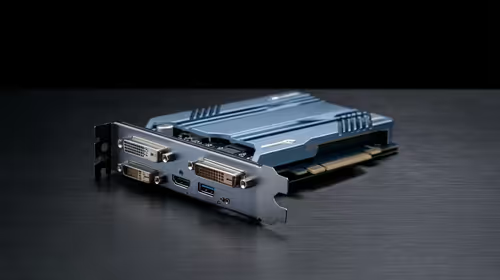
Running 1920x1080 at 250Hz requires DisplayPort 1.4. Confirm both your GPU and the target monitor have DisplayPort 1.4 or higher. HDMI 2.0 supports up to 240Hz at 1080p in some implementations but is not the recommended cable for 250Hz operation; use DisplayPort as the default. Many older cables physically labelled as DisplayPort are version 1.2, limited to 165Hz at 1080p. A certified DisplayPort 1.4 cable costs R150 to R350 at local retailers and is a necessary part of the upgrade if your current cable is older.
What Visually Changes at 250Hz 🎮
The most consistently reported improvement when moving from 144Hz to 250Hz in competitive play is crosshair motion smoothness. At 250Hz, a crosshair moving rapidly across the screen traces a cleaner, more linear path with less visible smear between positions. This is particularly noticeable in Valorant, CS2, and Apex Legends where crosshair control is a core mechanical skill. South African players competing in online leagues and local LANs report this as a meaningful improvement once they have experienced both refresh rates side by side with a matching GPU. The improvement sharpens the precision ceiling for already-skilled players rather than creating new capability from scratch.
Benchmark Your GPU Before Ordering ⚡
Before ordering a 250Hz monitor, open your GPU overlay in your main competitive game during a live match and note the minimum and average fps. If your minimum fps is consistently above 180 in that title, the 250Hz upgrade will feel smooth and fully used. If your minimum dips regularly below 150fps, wait until a GPU upgrade follows before investing in 250Hz.
FAQ
Is 250Hz worth it for Apex Legends and Valorant in South Africa?
For SA players on local servers with sub-20ms ping and GPUs sustaining 200-plus fps, yes. Both titles are highly optimised and deliver very high frame rates at FHD on mid-to-high-tier GPUs. Apex Legends at 200fps on a 250Hz panel produces noticeably smoother tracking compared to 144Hz, which experienced SA ranked players consistently report as a genuine competitive improvement.
Does 250Hz help with South African internet lag or ping?
No. 250Hz reduces display-side latency but has no effect on network latency or server ping. SA players on local servers with Vumatel or Openserve fibre see pings of 5 to 20ms to Johannesburg-hosted servers regardless of monitor refresh rate.
What is the correct DisplayPort cable version for 250Hz?
DisplayPort 1.4 supports 1080p at 240Hz and higher with uncompressed signal. For 250Hz at FHD, a DisplayPort 1.4 certified cable is the minimum. Standard DP 1.4 cables are widely available locally at R150 to R350 and are the correct purchase for a 250Hz setup.
Ready to make the move to 250Hz with the right GPU behind it?
Evetech stocks 250Hz gaming monitors alongside a full range of compatible GPUs, all available with local warranty.