Quick Answer
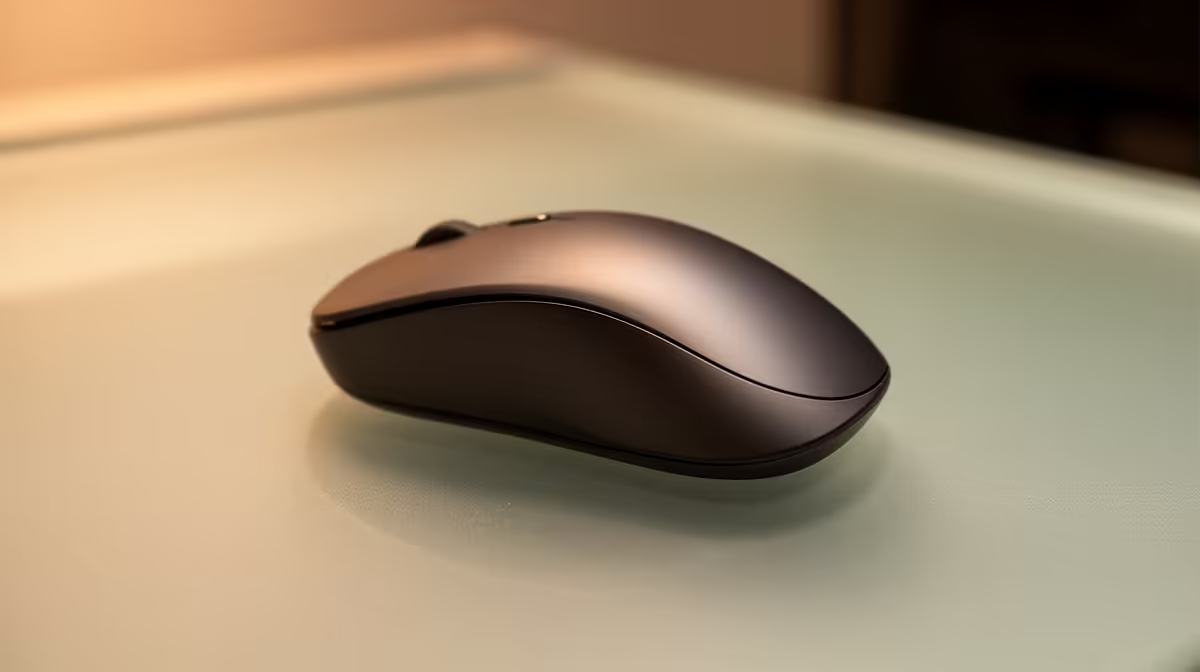
South African students and remote workers should prioritise a wireless mouse with USB-C charging, a reliable 2.4 GHz connection, silent switches, and at least two programmable side buttons. A battery life of 40-plus hours per charge and multi-device Bluetooth are strong bonuses if you move between a university laptop and a home setup.
Why Portability and Power Matter Most in SA 🎒
Students commuting between res, home, and campus libraries carry their setup constantly. A compact wireless mouse under 100 grams that fits in a laptop bag without adding bulk is a genuine advantage. USB-C charging is critical: it means the same cable used for your phone and laptop works for your mouse, eliminating the need to hunt for Micro-USB cables that are increasingly rare. For remote workers in cities like Cape Town, Joburg, or Durban operating out of shared offices or coffee shops, a 2.4 GHz nano dongle is more reliable than Bluetooth in RF-dense environments, and a 12-month or longer battery life (with AA batteries) or a 60-hour rechargeable keeps you working without interruption.
Silent Clicks and Sensor Accuracy for Study and Work 📚
Library and lecture etiquette matters. Silent-switch mice suppress the click sound to near-inaudible levels (typically under 20 dB) without changing the tactile feel significantly. Sensor accuracy between 1,000 and 4,000 DPI is more than enough for spreadsheets, slides, and coding environments; you do not need a 25,600 DPI gaming sensor for productivity. A mid-range PixArt sensor in a R600 to R900 mouse will track perfectly on desk mats, wooden tables, and even the slightly textured surfaces common in SA university study halls.
Ergonomics for Long Study and Work Sessions 🖥️
Carpal tunnel risk increases with poor grip positions over long hours. For students spending four to eight hours a day on assignments and remote workers doing the same on projects, a mouse with a defined right-handed ergonomic sculpt or a neutral ambidextrous shape (for left-handers) reduces wrist strain. Full-sized ergonomic mice (120 mm to 130 mm) suit most adult hands; compact travel mice (100 mm) are better for students with small bags. Multi-device switching lets you pair to both your student laptop and a home desktop with one button press, which is genuinely useful for UNISA students or those doing remote internships alongside coursework.
Nano Dongle Storage Tip ⚡
Store the USB nano dongle inside the mouse's battery compartment or designated slot when travelling so it doesn't get lost in your bag. Many mid-range wireless mice include this built-in storage feature and it prevents the most common accessory loss.
FAQ
What wireless mouse battery life should I look for as a student?
Aim for at least 40 hours of use per charge for rechargeable models, or a minimum 12-month estimate for AA-battery models. This means you charge or swap batteries monthly at most, not weekly.
Is multi-device Bluetooth switching useful for students?
Yes, especially if you use a university-issued desktop in a lab and your own laptop at home. One button switches the mouse between paired devices without re-pairing, saving time and avoiding dongle juggling.
Do I need a mousepad if I'm working in different locations?
A small portable mouse mat (around 250 x 200 mm) helps on uneven or reflective surfaces like glass tables. Optical sensors in sub-R1,000 mice can struggle on high-gloss or transparent surfaces without a mat.
Need a mouse that keeps up with student and remote-work life?
Evetech carries a wide range of wireless mice built for portability and long sessions, stocked locally and ready to ship across South Africa.