Quick Answer
Only three categories of PC build genuinely need a 512-bit PCIe 5.0 graphics card: 4K high-refresh-rate gaming rigs, professional GPU-compute and AI inference workstations, and content creation systems handling 8K video or massive 3D scenes. For 1080p or 1440p gaming alone, a narrower bus and PCIe 4.0 interface delivers equivalent real-world results at a fraction of the cost.
What 512-Bit Memory Bus and PCIe 5.0 Actually Deliver 🖥️
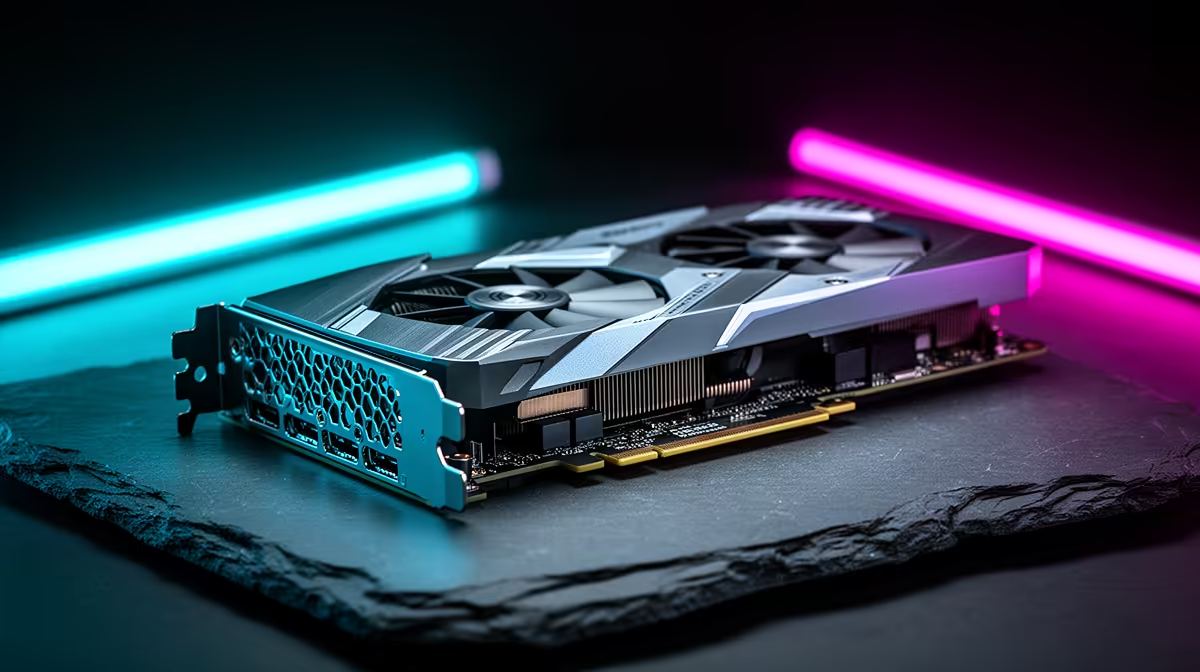
The 512-bit memory bus on the RTX 5090 provides over 1.7TB/s of VRAM bandwidth. The RTX 5070 Ti has a 256-bit bus delivering around 896GB/s, while the RTX 5080 sits at 960GB/s. The wider bus becomes advantageous when the GPU simultaneously reads textures, writes frame buffers, and runs shader workloads at resolutions where data throughput rather than compute becomes the bottleneck. At 4K native with full ray tracing, the bandwidth advantage is measurable in titles that stream large asset sets. At 1440p or 1080p, the GPU's compute units saturate long before the bus limits performance.
Workloads That Fully Exploit 512-Bit Bandwidth 🔧
GPU compute tasks differ from rasterised gaming in their memory access patterns. AI model training and inference involve repeated large tensor operations where bandwidth determines how quickly weights move between compute engines and VRAM. A 32GB GDDR7 card with 1.7TB/s bandwidth sustains inference on a 20-billion-parameter model at full speed without bandwidth-induced latency. GPU-accelerated fluid simulation and path tracing in professional rendering tools also saturate memory bandwidth before compute, making the wider bus directly translatable to faster render times for South African VFX and engineering visualisation professionals.
Builds That Do Not Need a 512-Bit Card 💰
For a 1080p or 1440p gaming build targeting 144 to 240fps in competitive titles, an RTX 5070 or RX 9070 XT class card provides more than sufficient bandwidth alongside the compute to handle modern game engines. At around R12,000 to R18,000, these cards sit at the performance-per-rand sweet spot. The additional R30,000 to R40,000 cost of a 512-bit flagship would be better directed toward a higher-refresh monitor, better peripherals, or a capable CPU cooler in a competitive gaming build.
Match Your Monitor Before Your GPU ⚡
Before deciding between a 256-bit and 512-bit GPU, confirm your target resolution and refresh rate. A 1440p 165Hz monitor extracts full value from a 256-bit card, currently stocked at Evetech from around R5,500 to R12,000. Spending an additional R35,000 on bus width for a display that cannot use it inverts the correct investment priority.
FAQ
Does PCIe 5.0 vs PCIe 4.0 matter for gaming performance today?
For most gaming scenarios including 4K, the difference between PCIe 5.0 x16 and PCIe 4.0 x16 is under 5 percent in frame rate. PCIe 5.0 becomes more relevant for GPU-compute workloads involving large data transfers between system RAM and VRAM.
Can I use a 512-bit PCIe 5.0 card in an older PCIe 4.0 motherboard?
Yes, PCIe is backward-compatible. The card operates at PCIe 4.0 x16 speeds, sufficient for 4K gaming with a minor performance penalty. For GPU-compute workloads where bandwidth is critical, the PCIe 4.0 slot introduces a meaningful bottleneck.
Is a 512-bit GPU worth buying on a Ryzen 9000 platform?
Yes. AMD's AM5 platform with X670E and X870E chipsets supports PCIe 5.0 x16, enabling full bandwidth access for the GPU slot and making AM5 the natural platform for a 512-bit flagship build.
Building a system that truly needs 512-bit bandwidth?
Evetech stocks the RTX 5090 and supporting PCIe 5.0 platform components with local warranty and authorised distributor pricing.