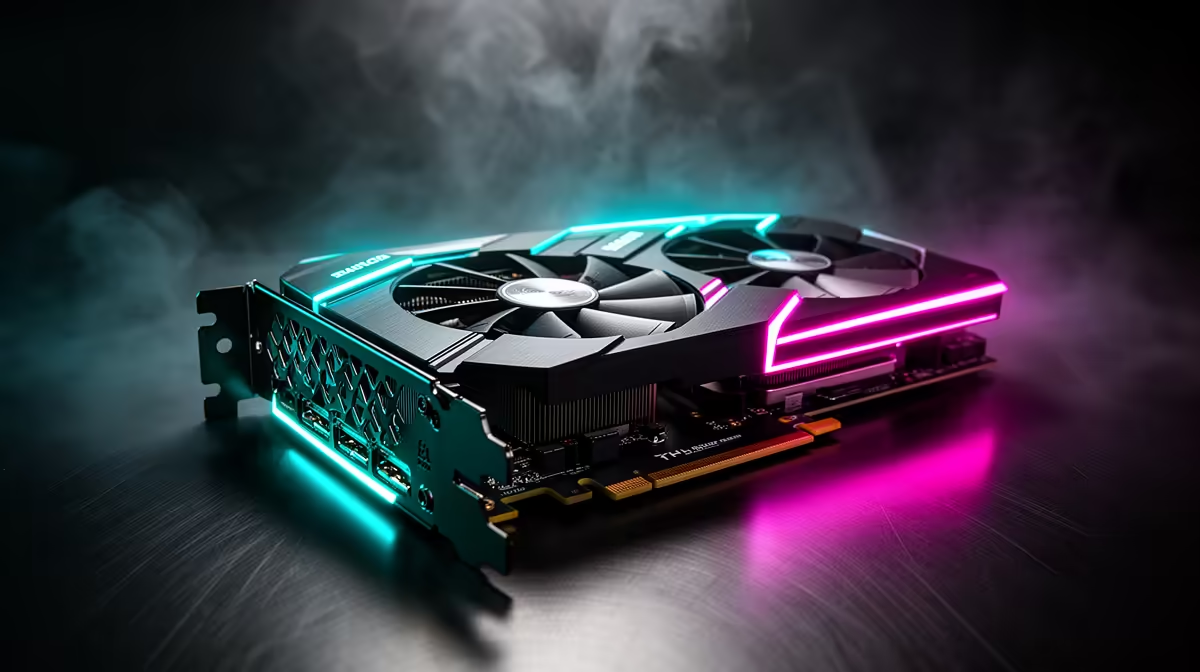
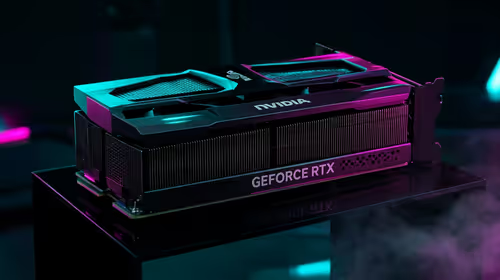
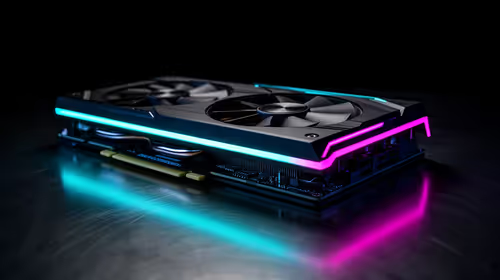
Render times in Blender live or die on your GPU, and the best RTX GPU for Blender is the one that matches your scene complexity and your budget rather than simply the most expensive card on the shelf. Blender's Cycles engine has a dedicated OptiX backend that runs only on NVIDIA RTX hardware, using the RT cores to accelerate ray tracing in a way that older GTX cards and integrated graphics simply cannot touch. For South African artists, the question is how far up the RTX ladder your work actually needs you to climb.
Quick Answer
For most hobbyists and freelancers, an RTX 4060 Ti or RTX 5060 Ti class card with 16GB of VRAM is the practical sweet spot in Rand terms. Step up to a 4070 or 5070 tier when scenes get heavy, and reserve the 4080, 5080 and 5090 cards for full-time studio work where render hours translate directly into money.
Why OptiX Makes RTX the Only Real Choice
Cycles offers several compute backends, but OptiX is the one built around NVIDIA's RT cores. These are fixed-function units that calculate ray-triangle intersections in hardware, the single most expensive operation in path tracing. On a comparable AMD or integrated setup running a generic backend, the same frame can take several times longer to resolve.
That is why this guide is RTX-specific. The moment your workflow involves Cycles rather than the real-time Eevee engine, the GPU brand stops being a preference and becomes a performance requirement. An RTX card also doubles as your Eevee and viewport accelerator, so you benefit whether you render path-traced stills or animate in real time.
VRAM Decides What You Can Even Open
Raw speed is only half the story. VRAM is the ceiling on scene size, because the entire scene, its textures, and the render data have to fit in graphics memory at once. Overflow that ceiling and Cycles falls back to system RAM, which collapses your render speed advantage entirely.
8GB Cards: Fine for Learning, Tight for Production
An 8GB RTX card handles tutorials, product shots, and simple interior scenes comfortably. The constraint shows up with 4K texture sets, dense foliage, or heavy displacement, where 8GB fills fast. If your work is studying the software or doing light freelance, 8GB is a sensible entry point that keeps the Rand cost down.
12GB to 16GB: The Freelancer Sweet Spot
This band is where most serious hobbyists and working freelancers should aim. A 16GB card swallows large texture libraries, character scenes, and moderate environments without spilling to system memory. The 4060 Ti 16GB, 4070 tier, and their 50-series successors live here, and they offer the best balance of OptiX speed, memory headroom, and price for South African buyers.
24GB and Beyond: Studio and Heavy Simulation
The 4090, 5090, and workstation-class cards exist for archviz at scale, complex fluid and smoke sims, and animation studios billing by the render hour. If a single overnight render saves you a working day, the premium pays for itself. For everyone else it is more card than the workload demands.
The RTX 50 Series in SA Context
NVIDIA's Blackwell-based RTX 50 series arrived in South Africa in 2025, giving local artists a fresh ladder to climb. The RTX 5060 Ti 16GB sits at a more accessible price band than previous 16GB options and runs on an improved Tensor and RT core architecture. The RTX 5070 adds a further speed step for freelancers rendering client work regularly. Benchmark data on Blender Open Data shows the newer generation RT cores deliver measurably shorter OptiX render times than equivalent Ada Lovelace predecessors at similar price points, making it worth comparing current 40-series and 50-series stock rather than defaulting to the previous generation name alone.
Local pricing varies with exchange rates and import margins, so checking current stock at Evetech is the most reliable way to judge what the actual Rand cost is for each tier right now, rather than relying on international price guides.
Matching the Card to Your Actual Work
Be honest about what you render. A content creator producing weekly product visualisations has very different needs from a student working through beginner tutorials. Faster cards shorten the feedback loop, but a mid-tier RTX card with ample VRAM will out-deliver a faster card that keeps running out of memory on real projects.
It is also worth pairing the GPU sensibly. A strong RTX card wants enough system RAM to stage scenes and a CPU that does not bottleneck asset loading. If your creative work spills into physical prototyping, the same NVIDIA-accelerated machine drives slicing and design tools for the Evetech 3D printer range without breaking stride. Round out the bench with quality peripherals from the Evetech accessories best-sellers so colour-critical work has a calibrated, comfortable setup behind it.
SA Buying Considerations
Local warranty and immediate stock matter more than chasing a marginal benchmark. A card you can return in Cape Town beats a slightly faster import with no local support. Watch the VRAM figure on the box rather than the model name alone, since some tiers ship in both 8GB and 16GB variants at very different real-world ceilings for Cycles.
Frequently Asked Questions
Does Blender really need an RTX card specifically?
For Cycles with OptiX, yes. OptiX uses the RT cores found only on RTX hardware, and it delivers a large ray-tracing speedup over generic backends. Older GTX cards run Cycles but without that acceleration.
How much VRAM should I budget for serious work?
Aim for 16GB if you work with 4K textures, character scenes, or detailed environments. 8GB is fine for learning and simple scenes, while 24GB and up is studio territory for heavy simulation and large archviz.
Is a 4060 Ti 16GB better than a 4070 with less memory for Blender?
It depends on your scenes. The 4070 renders faster per sample, but if your scene exceeds the 4070's memory you lose far more time to overflow than the extra VRAM cost you. Memory-heavy work favours the larger buffer.
Will a faster GPU speed up Eevee too?
Yes. Eevee and the viewport are GPU-accelerated, so a stronger RTX card improves real-time shading and animation playback alongside Cycles renders. The benefit applies across the whole Blender workflow.
Does the CPU still matter if the GPU does the rendering?
It matters for scene preparation, simulation baking, and asset loading rather than the final path trace. Pair a strong GPU with enough RAM and a capable CPU so the card is never waiting on the rest of the system.
Is the RTX 50 series worth it over the 40 series in SA?
If you are buying new, yes for the 16GB 50-series tiers where pricing is competitive. The improved RT and Tensor cores give you better future proofing for both Cycles renders and AI-assisted workflows. If the 40 series is significantly cheaper on current stock, it remains strong value for Blender work.
Pick the RTX tier that matches your scenes, not the biggest number on the shelf. Browse current NVIDIA stock and full creator-ready systems, then explore the Evetech 3D printer range if your art reaches off the screen and into the real world.