



PCIe 5.0 vs PCIe 4.0 for Video editing in 4k in SA
PCIe 5.0 vs PCIe 4.0 for video editing in 4k is mainly about fit, features, compatibility, cost, and upgrade path, not one automatic winner. SA buyers should match the choice to the setup.
Read moreWood-fill PLA contains real wood particles that can be sanded and stained like timber but are mildly abrasive and can clog nozzles smaller than 0.4mm. The result is a warm, natural-looking print that takes paint and stain far better than standard PLA.
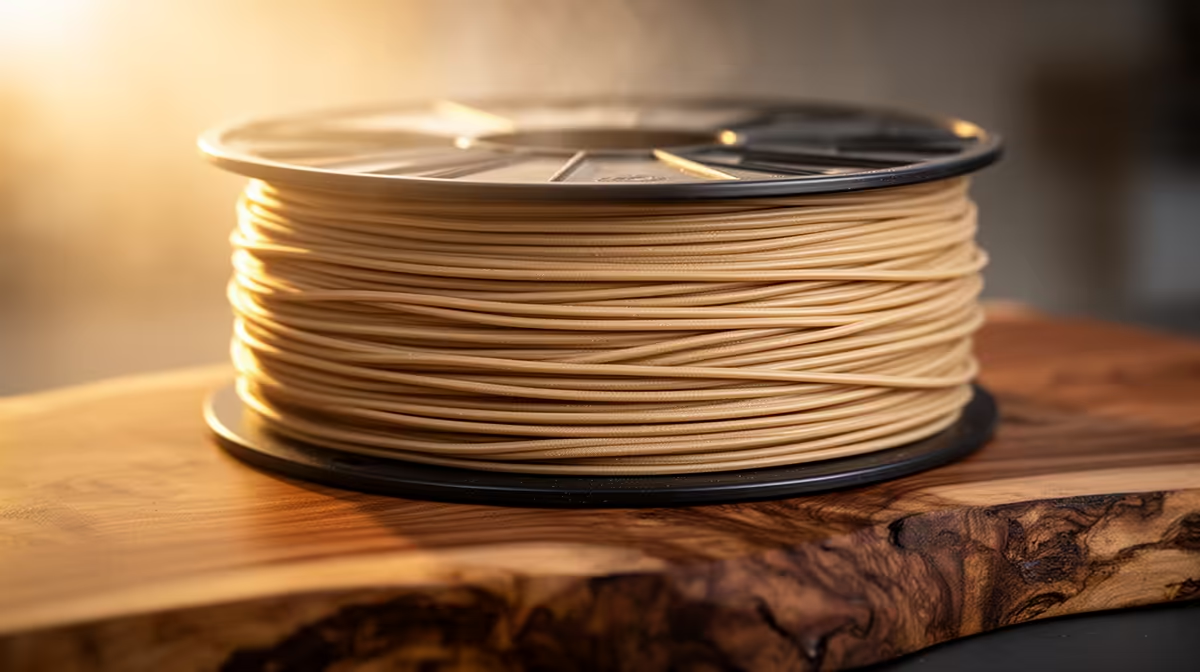
Drop a printed bookend, a chess piece or a small bust into your hand after it has been sanded and oiled, and most people assume it was turned from timber rather than squeezed out of a hot nozzle. That is the appeal of wood-fill filament: a PLA base loaded with 20 to 40 percent real wood particles, usually pine, birch or bamboo dust, so the finished part smells faintly of sawdust and behaves like soft wood under sandpaper. The trade-off is that those same particles are mildly abrasive and unforgiving of narrow nozzles.
Wood-fill filament is PLA mixed with roughly 30 percent fine wood fibre. It sands and stains like real timber and prints at around 190 to 220 degrees Celsius, but the wood grit wears brass nozzles over time and clogs anything below a 0.4mm opening. Use a 0.5mm or larger hardened steel nozzle and slow the print to 30 to 50mm per second for clean decorative results.
A wood-fill spool is not wood that melts. It is standard PLA acting as the binder, with finely milled wood powder suspended through it. Most blends sit around 30 percent wood content by weight, though some run as low as 20 and others push toward 40. The higher the wood loading, the more convincing the timber look and the rougher the surface straight off the bed, but also the higher the clog risk and the more brittle the part becomes.
Because the wood content is real organic material, colour varies slightly from batch to batch and even within a single print. That inconsistency is a feature here, not a fault. It is what gives wood-fill its irregular, natural grain instead of the flat uniform tone of dyed PLA. If you want a printer that handles composite filaments comfortably, the 3D printers stocked at Evetech cover entry units through to enclosed machines suited to longer decorative runs.
This is the whole reason to reach for wood-fill over standard PLA on a display piece. The embedded wood fibres mean the surface accepts treatment the way an offcut of pine would.
Start coarse to knock down the layer lines, around 120 to 150 grit, then step up through 220 and finer to bring the surface to a smooth finish. The dust that comes off is genuinely wood dust mixed with PLA, so a mask is sensible. Sanding also exposes more wood fibre at the surface, which deepens the grain effect. Some makers prefer wet sanding for the finer stages to avoid locally melting the PLA base through friction heat; a light mist from a spray bottle is enough.
A standard wood stain takes to the sanded surface and pulls out the grain in a way that reads as real timber. Follow with a varnish or an oil and the part looks like a turned or carved object rather than a 3D print. Tung oil preserves the natural colour well and keeps a matte, tactile finish, while polyurethane delivers a glossier seal suited to items that get handled regularly. You can also scorch the surface lightly or rub a darker stain into raised areas to fake age and depth on busts, plaques and signage. A single spool can produce a wide range of timber shades by varying post-processing alone.
Many wood-fill users exploit the fact that printing hotter darkens the material. Running at the upper end of the temperature window, 220 to 230 degrees, produces a deeper brown similar to walnut or cedar, while staying near 190 to 200 degrees keeps a lighter pine tone. Because the same spool changes colour with heat, you can produce warm gradient effects mid-print by slowly adjusting temperature, creating a subtle dark-to-light banding that mimics natural wood grain direction.
Wood particles are hard. As the filament is forced through the nozzle, those particles slowly scour the inside of a brass nozzle, widening the bore and degrading print quality over dozens of hours. A standard brass nozzle will survive a few decorative jobs, but if wood-fill becomes a regular material, swap to a hardened steel or ruby-tipped nozzle and treat the brass one as a consumable.
The second risk is clogging. The fibres can bridge and jam in a narrow channel, which is why a 0.4mm nozzle is the practical minimum and a 0.5mm or 0.6mm nozzle is far safer. Print hot enough to keep flow easy, around 200 to 220 degrees, and keep the speed down so the molten material has time to move through cleanly. Retraction distance should be kept short, around 1 to 2mm, to avoid pulling partially cooled wood fibres back into the heat break where they can snag and cause a jam.
Wood-fill belongs on the shelf, not in a load-bearing bracket. The wood content interrupts layer bonding, so parts are weaker and more brittle than plain PLA. For figurines, ornaments, picture frames, coasters, planters, plaques and architectural models it is ideal because appearance is the entire point. For functional gears, clips, mounts or anything that takes stress or impact, reach for standard PLA, PETG or a tougher engineering material instead.
When rounding out your consumables supply, a hardened nozzle, finer sandpaper and a small tin of stain are the upgrades that pay off most here. The best-selling accessories at Evetech are worth checking when you place your printer or filament order, since many of the right finishing tools show up there.
Like most PLA it prints fine on a bed at around 50 to 60 degrees with good adhesion. It is not as fussy as ABS, but a clean surface and a slightly higher first-layer temperature help the initial layers grip.
Only the nozzle, and only over time. The wood grit gradually wears a brass nozzle wider. Nothing else in the hot end is at risk, and switching to a hardened steel nozzle removes the concern entirely.
Yes. Many users vary the print temperature to shift the colour, since hotter printing tends to darken wood-fill. Combined with staining after the fact, a single spool can produce a surprising range of timber shades.
Weaker. The wood particles disrupt how cleanly the PLA layers fuse, so parts are more brittle and snap more easily. Use it where looks matter and keep load-bearing prints in a proper structural material.
0.5mm or larger, in hardened steel. A 0.4mm nozzle works but clogs more readily, and anything below 0.4mm is asking for a jam mid-print.
Planning a decorative print project and need a machine that takes composite filaments in its stride? Compare the current lineup of 3D printers at Evetech and pair it with a hardened nozzle so wood-fill works for you, not against your hot end.
Like most PLA it prints fine on a bed at around 50 to 60 degrees with good adhesion. It is not as fussy as ABS, but a clean surface and a slightly higher first-layer temperature help the initial layers grip.
Only the nozzle, and only over time. The wood grit gradually wears a brass nozzle wider. Nothing else in the hot end is at risk, and switching to a hardened steel nozzle removes the concern entirely.
Yes. Many users vary the print temperature to shift the colour, since hotter printing tends to darken wood-fill. Combined with staining after the fact, a single spool can produce a surprising range of timber shades.
Weaker. The wood particles disrupt how cleanly the PLA layers fuse, so parts are more brittle and snap more easily. Use it where looks matter and keep load-bearing prints in a proper structural material.
0.5mm or larger, in hardened steel. A 0.4mm nozzle works but clogs more readily, and anything below 0.4mm is asking for a jam mid-print.
PCIe 5.0 vs PCIe 4.0 for video editing in 4k is mainly about fit, features, compatibility, cost, and upgrade path, not one automatic winner. SA buyers should match the choice to the setup.
Read more
Wi-Fi 7 vs Wi-Fi 6e for competitive esports comes down to router support, latency goals, device compatibility, and coverage. SA buyers should match the choice to the real network setup.
Read more
ATX 3.1 vs ATX 3.0 for mMO and live-service games buyers - what changes is mostly about compatibility, budget, upgrade path, and setup fit. SA buyers should check device support and real needs before expecting a clear win from either option.
Read more
LGA 1851 vs LGA 1700 can affect Twitch and YouTube streaming when gaming and encoding share CPU resources. For SA creators, the real-world difference depends on encoder choice, memory support, motherboard cost, thermals, and upgrade plans.
Read more
X870E vs X670E for aaa single-player gaming is mainly about fit, features, compatibility, cost, and upgrade path, not one automatic winner. SA buyers should match the choice to the setup.
Read more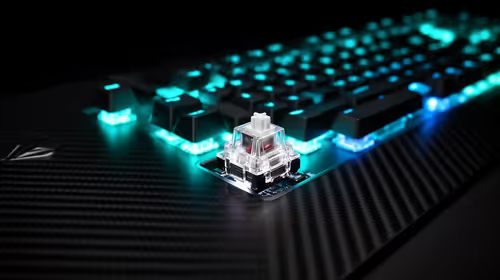
Hall Effect switches vs Mechanical switches for mMO and live-service games is mostly about compatibility, budget, upgrade path, and setup fit. SA buyers should check device support and real needs before expecting a clear win from either option.
Read more
A fake 113GB GTA VI ISO reportedly used empty padding around a small malware payload. SA gamers should delete unofficial builds, keep Windows security active and wait for official channels.

Wi-Fi 6E vs Wi-Fi 6 matters for 4K video editing when files move across a network. The real-world difference between Wi-Fi 6E and Wi-Fi 6 for video editing in 4K depends on NAS access, cloud uploads, router range, and SA creator workflows.

The difference between PCIe 5.0 and PCIe 4.0 for SA gamers is mostly bandwidth headroom. Compare GPU slot needs, NVMe speed, motherboard support, and upgrade timing before paying extra for a newer platform.

Gaming PC stuck pixel checks in South Africa should confirm the monitor fault first. Use colour tests, screenshot comparison, cable swaps, display menu checks, and clear photos before deciding on support.

Shokz OpenFit Air 2 earbuds weigh 7.2g each and use a redesigned dual-driver open-ear layout. SA buyers should choose them for comfort and awareness, not maximum isolation.

AMD's current driver now lists a Radeon RX 9050 4GB, while product coverage details a narrowed memory system. SA buyers should weigh the low VRAM ceiling against current local Radeon options.

Samsung Display has demonstrated a 16-inch 2.5K OLED laptop panel running at 300Hz. SA buyers should wait for a named notebook, full panel specifications and a local price before planning an upgrade.

Microsoft says some Windows 11 game crashes after recent updates are linked to RGB-related drivers. Affected SA gamers should confirm the update and driver before using the published registry workaround.
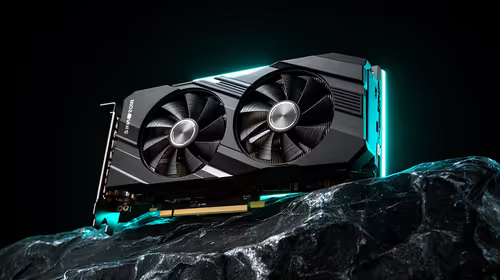
RTX 5090 on a 650W PSU is a tight pairing with very limited headroom. For SA gaming PCs, focus on total system draw, PSU quality, connector support, CPU choice, and avoid OC plans unless the full build is carefully power-limited.
PCIe 5.0 vs PCIe 4.0 for video editing in 4k is mainly about fit, features, compatibility, cost, and upgrade path, not one automatic winner. SA buyers should match the choice to the setup.
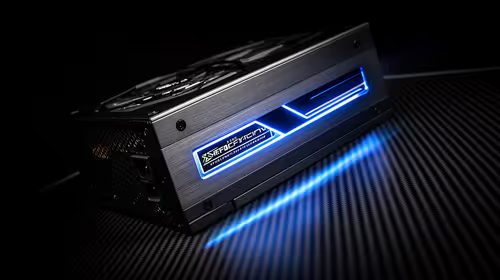
850W PSU safety for RTX 5090 is plausible with a quality unit and balanced parts. In SA, confirm connector support, CPU power draw, case airflow, PSU age, and spare capacity before building around 850W.
Wi-Fi 7 vs Wi-Fi 6e for competitive esports comes down to router support, latency goals, device compatibility, and coverage. SA buyers should match the choice to the real network setup.