



Marvel Rivals launch in South Africa
Marvel Rivals launch needs a balanced parts plan, not a random basket. Map the CPU, GPU, RAM, SSD, cooling, and monitor target to the budget so SA builders know where to spend first.
Read moreMost SA buyers should target the right SDXC speed class keeps 4K capture from stuttering. For the underlying spec usually explains the symptom you are seeing. Speed classes, capacity, and offload tips walked through.
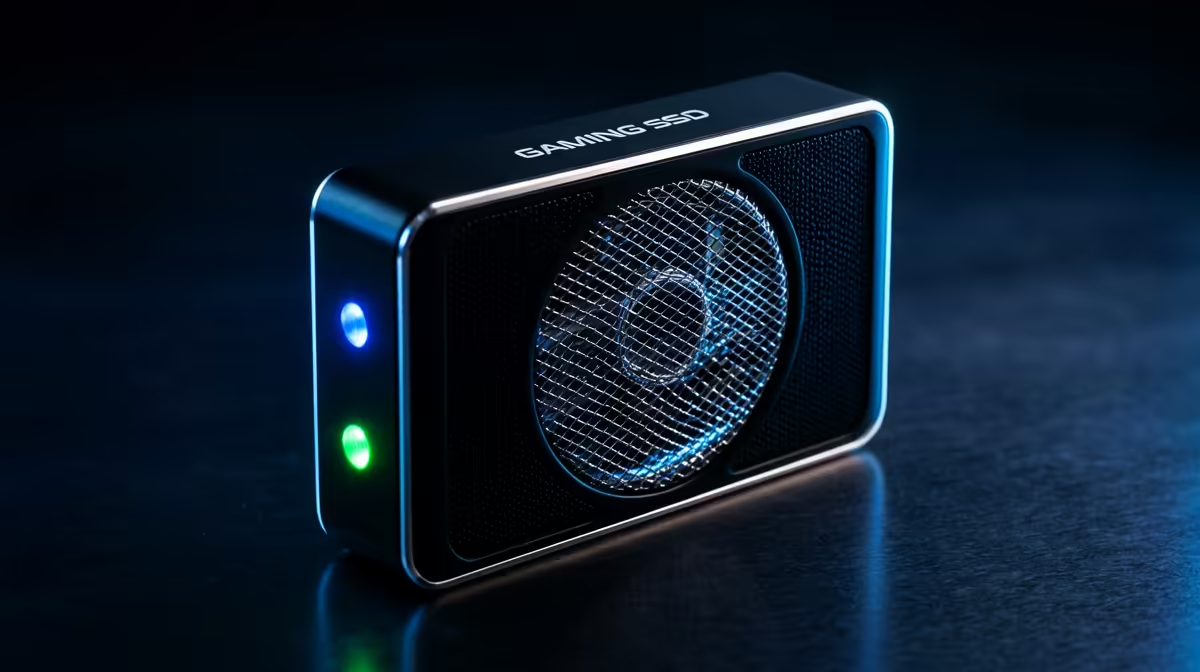
Burst photography generates data far faster than any SD card can write continuously. Your camera absorbs this data in an internal RAM buffer, then drains it to the card between bursts. A fast card drains that buffer quicker, letting you shoot another burst sooner. A slow card keeps you locked out for seconds at a time while the buffer clears.
When you hold the shutter button down on a modern mirrorless body, the sensor fires at rates between 10fps and 30fps. Each RAW frame from a 24-megapixel sensor is roughly 25MB to 35MB. A 10fps burst for 3 seconds produces 30 frames, around 900MB of data. That data pours into the camera's RAM buffer, then drains to the SD card at the card's sustained write speed. A card writing at 60MB/s needs about 15 seconds to clear 900MB. A card writing at 120MB/s cuts that to 7.5 seconds. During drain, most cameras either block further burst shooting entirely or significantly reduce burst depth. For sports and wildlife photographers shooting at Kruger or a motorsport event, those seconds of lockout are missed shots.
V30 cards guarantee 30MB/s minimum write and clear a 900MB buffer in roughly 30 seconds at that floor. For casual burst at 5fps to 10fps with short sequences, V30 is workable. V60 cards sustain 60MB/s minimum, halving that drain time. V90 cards (90MB/s guaranteed minimum) are the professional standard for high-megapixel burst on bodies like the Sony A9 III or Canon R3. UHS-II V90 cards typically cost R2,000 to R4,000 for 128GB in South Africa, but for professional sports and wildlife photographers they are the correct tool. UHS-I V30 covers most photographers shooting at 10fps or below on 24-megapixel or smaller sensors.
Manufacturers quote peak sequential write speed. Burst photography stresses rapid successive write performance. Some cards with excellent sequential numbers perform poorly when frames arrive in rapid succession. The best approach is to look at third-party camera-specific benchmarks rather than box numbers. Sony and Nikon publish recommended card lists for their professional bodies; these reflect real in-camera testing. For South African photographers buying locally in the R800 to R2,000 range, checking those lists before purchasing prevents an expensive mistake.
If your camera allows simultaneous JPEG and RAW capture, setting the JPEG to medium quality reduces total buffer size per burst, because the JPEG writes faster. Some photographers keep a fast card in Slot 1 for RAW and a second card in Slot 2 for JPEG backup, splitting the write load and extending effective burst depth.
Slot 1 should hold your fastest card. In relay mode, the camera fills Slot 1 then switches to Slot 2, keeping you shooting longer. In backup mode, both cards receive identical data simultaneously, which halves effective write speed and can slow buffer drain. For burst work, relay mode is generally preferred.
Only near full. When an SD card is more than 90% full, write performance can degrade. Keep cards under 90% full for consistent burst performance, especially on high-megapixel bodies.
Yes, significantly. CFexpress Type A and B cards reach sustained writes of 700MB/s to 1,700MB/s, versus 250MB/s for the best UHS-II SD cards. But CFexpress is only useful if your camera has the appropriate slot; most consumer mirrorless cameras still support UHS-I or UHS-II SD.
Shooting sport, wildlife, or action in South Africa? Browse fast V30 and V60 SD cards at Evetech to find a card that keeps up with your camera's burst depth and clears the buffer fast enough for the next sequence.
Marvel Rivals launch needs a balanced parts plan, not a random basket. Map the CPU, GPU, RAM, SSD, cooling, and monitor target to the budget so SA builders know where to spend first.
Read more
Path of Exile 2 launch needs a balanced parts plan, not a random basket. Map the CPU, GPU, RAM, SSD, cooling, and monitor target to the budget so SA builders know where to spend first.
Read more
Black Myth Wukong launch needs a balanced parts plan, not a random basket. Map the CPU, GPU, RAM, SSD, cooling, and monitor target to the budget so SA builders know where to spend first.
Read more
Hollow Knight PC requirements should be mapped to resolution, settings and upgrade budget before choosing a tier. Verify current requirements, then balance GPU, CPU, RAM and SSD around SA pricing.
Read more
Hollow Knight build planning should focus on the target resolution, settings and total system balance. Treat launch wording as time-sensitive, then verify requirements before choosing SA PC parts.
Read more
Fallout 4 PC requirements should be mapped to resolution, settings and upgrade budget before choosing a tier. Verify current requirements, then balance GPU, CPU, RAM and SSD around SA pricing.
Read more
Best Value Laptops South Africa 2026 — Find top picks, local prices and buy tips to maximise performance per rand. Compare deals for students, creators and gamers. 🔎💸
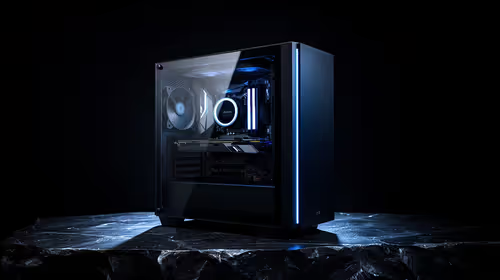
Struggling with a weak Desktop PC Wi-Fi signal? 📶 Discover expert tips on positioning your tower and external antennas to eliminate lag and maximize your internet speeds for gaming and streaming. 🚀
Tired of loadshedding router restarts killing your Wi-Fi? ⚡ Discover why power cuts disrupt your connection and learn expert tips to get back online faster after the lights return. 🌐
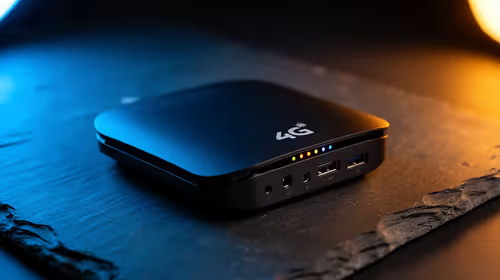
Master using a Nano SIM 4G router as your primary internet solution. Get stable speeds and seamless connectivity for gaming and streaming at home! 🌐🚀
Gauteng r30 000 needs practical checks before you choose. Compare fit, workload, support, setup needs, timing, and delivery expectations without relying on live availability or fixed 2026 claims.

Gauteng r40 000 needs practical checks before you choose. Compare fit, workload, support, setup needs, timing, and delivery expectations without relying on live availability or fixed 2026 claims.

Gauteng r50 000 needs practical checks before you choose. Compare fit, workload, support, setup needs, timing, and delivery expectations without relying on live availability or fixed 2026 claims.
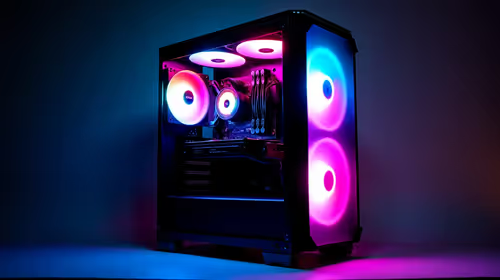
Gauteng r60 000 needs practical checks before you choose. Compare fit, workload, support, setup needs, timing, and delivery expectations without relying on live availability or fixed 2026 claims.
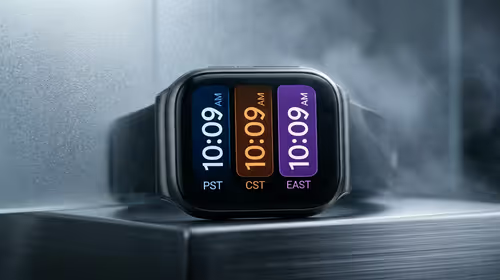
Three-tier smart watch plan for commuting should be shortlisted around the job it must do. South African buyers should compare fit, performance, compatibility, and upgrade room, warranty path, and upgrade room before treating any pick as best.
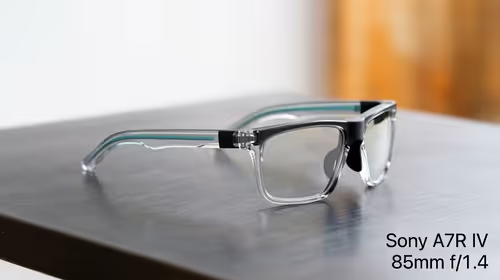
AR Glasses buying order for commuting students should be shortlisted around the job it must do. South African buyers should compare fit, performance, compatibility, and upgrade room, warranty path, and upgrade room before treating any pick as best.

Smart Watch buying order for commuting should be shortlisted around the job it must do. South African buyers should compare fit, performance, compatibility, and upgrade room, warranty path, and upgrade room before treating any pick as best.
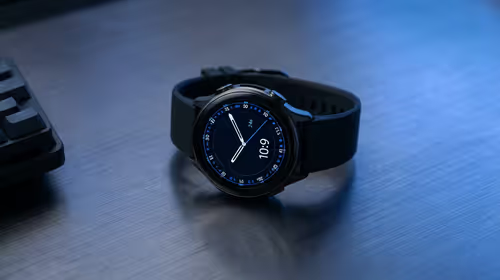
Smart Watch buying order for quiet PC builds needs a balanced parts plan, not a random basket. Map the CPU, GPU, RAM, SSD, cooling, and monitor target to the budget so SA builders know where to spend first.