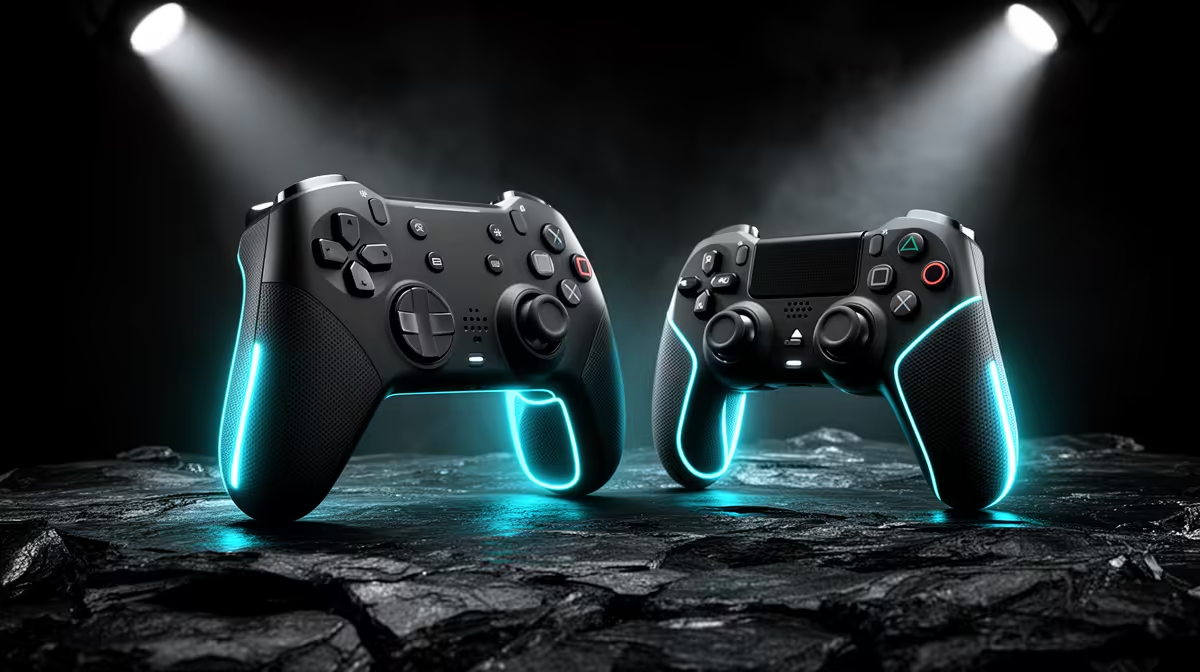
Competition rewards a link that behaves the same through every round. Wired vs wireless controllers should be compared through measured latency, radio stability, cable freedom and the rules of the event you enter.
Quick Answer
For competitive play, a cable gives you predictable power and removes radio conditions from the setup. That makes wired mode a safe tournament choice. It does not guarantee lower latency than every wireless controller. A well-designed 2.4GHz link can deliver fast, stable input, while performance through Bluetooth varies across the controller, host adapter and software path. Compare the exact model in the exact connection mode you plan to use. Your practical choice also includes battery life, cable drag, receiver placement and venue rules.
Why the connection label cannot settle the debate
Controller latency is a chain. The pad scans its buttons and sticks, processes the input, sends a report, and waits for the game to sample it. A USB cable changes the transport section of that chain. It cannot repair a slow scan loop, a low report rate or extra processing inside the controller.
Wireless adds a radio link and its management. A dedicated 2.4GHz receiver can be designed around one controller family, which gives the maker control over both ends. Bluetooth has to work through a broader host stack. That can add variation, though a strong Bluetooth implementation may still feel responsive in many games.
This is why broad claims such as "wired always wins" or "2.4GHz matches USB" need a model name and a test method. The same controller can report at different intervals over USB, receiver and Bluetooth. Firmware can change the result as well.
What wired mode gives you
A wired controller draws power from the PC or console, so a long session cannot end because the battery is empty. Pairing is removed from the pre-match routine. At a shared venue, a cable also makes it clear which controller belongs to which station.
Cable quality and layout still matter. A loose USB port can disconnect when you move. A heavy cable rubbing across the desk can pull against your hands. Route enough slack from the PC, secure the first section away from your mouse space, and avoid a connector that carries the cable's weight.
Some wireless controllers support play over a USB cable but continue to communicate wirelessly, while others switch to USB data. Confirm the behaviour for the model. A charging cable alone does not prove that the input is travelling through it.
What 2.4GHz wireless gives you
A dedicated receiver offers freedom from cable drag and can keep the connection path focused on gaming input. It suits a lounge setup, a PC connected to a television, or a desk where the tower sits beyond a comfortable cable run.
Receiver placement matters. Plugging a small receiver into the back of a metal PC case can put the antenna behind a shield and next to busy USB devices. Use the supplied extension or a front port when the maker allows it, keep a clear line to the controller, and separate it from other radio receivers. If the pad stutters only when an external drive is active or the receiver sits behind the case, fix the placement before blaming the controller.
Battery planning is the trade. Know the rated life, how the warning appears and whether the battery can be replaced or charged during play. For a competition day, start charged and carry the approved cable or spare power option for that model.
Where Bluetooth fits
Bluetooth is convenient because many laptops and handheld PCs have it built in. It also lets one controller move between devices without keeping track of a receiver. That convenience does not give you one universal latency figure.
The host adapter, antenna, driver and local radio traffic all affect the link. A desktop antenna left folded behind the case can create a poor result. So can switching the same paired controller between several hosts without clearing an old connection.
Bluetooth is fine for plenty of games when the connection is stable. For a reaction-heavy title, test repeated inputs and frame timing on your own setup. If you feel intermittent delay, check the signal path and compare USB before buying anything.
Polling rate is only one part
A higher report rate can shorten the interval between USB reports, but controller firmware, game sampling and display latency remain in the chain. Advertised polling figures may apply to one connection mode. They may also describe a configured ceiling rather than a measured end-to-end response.
Look for independent tests that identify firmware, platform, connection and sample method. Average latency matters, and consistency matters too. A connection with rare large spikes can feel worse than one with a slightly slower but tight result.
Avoid unsupported USB driver tweaks on a tournament machine. They can cause stability, security and compatibility problems, and the event may require standard drivers. Use the controller's supported settings and verify them before match day.
Choose for your actual environment
For an event, read the organiser's current equipment and wireless rules. Some venues restrict radios or require a cable; others allow approved receivers. Bring what the rules allow, label your receiver, and remove old pairings before you sit down. A backup cable is useful only if the controller supports data through that cable and the connector is in good condition.
At home, run a repeatable comparison. Use the same game, display mode and controller profile. Test USB, 2.4GHz and Bluetooth one at a time. Include rapid button taps, small stick corrections and a thirty-minute session that exposes power or interference problems.
The current PC controller range lets you compare connection options and layouts. You can also scan popular peripherals when the controller has to fit into a wider desk or lounge setup.
Pick the connection you have tested and can support through the whole session. Predictability comes from the complete setup, rather than the word printed on the box.
FAQ
Is a wired controller always faster?
No. Input scanning, firmware and report behaviour differ by model. Compare measured results for the exact controller and connection mode.
Can 2.4GHz wireless suit competitive play?
Yes, when the receiver link is stable and the controller tests well. Confirm venue rules and plan for battery life.
Does a USB cable always carry controller data?
No. Some cables charge only, and some pads may retain a wireless input path. Check the model documentation and test it.
Compare wired and wireless controllers for the connection, layout and session length you need.