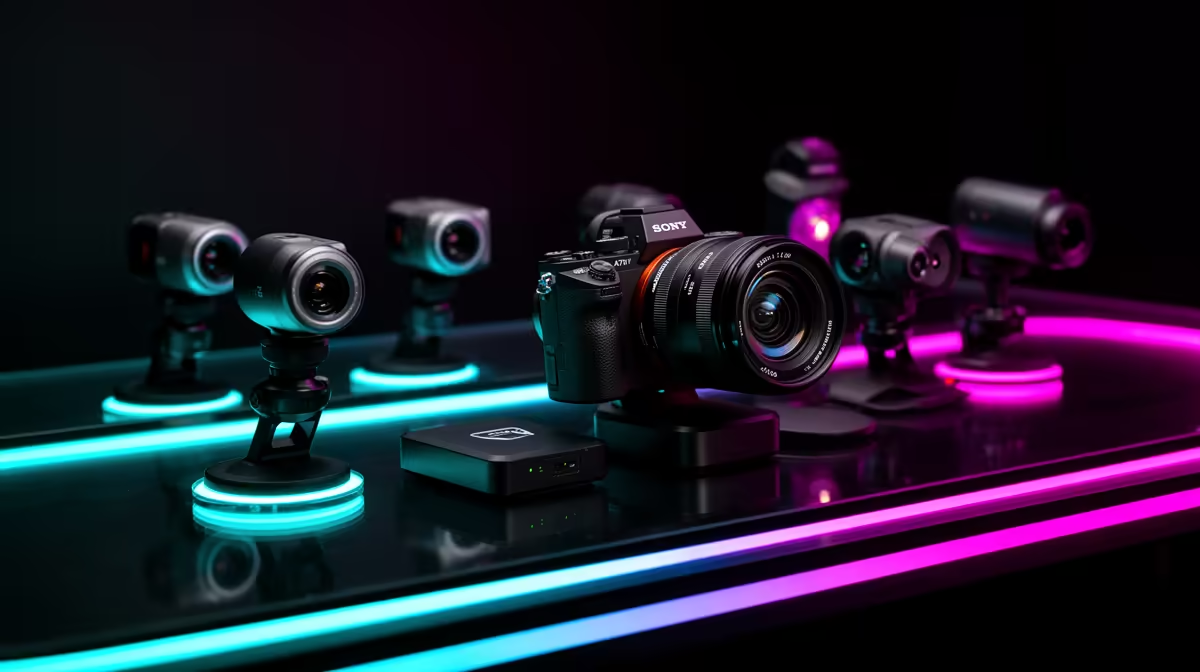
Cable has one enormous virtue: when it is connected, it stays connected. A multi-camera broadcast over HDMI and capture cards holds a locked signal from source to encoder, frame after frame, for as long as the hardware is powered. Wireless multi-cam streaming trades that certainty for something different -- the freedom to place cameras where running cable is genuinely impractical, which at real-world events covers a large part of every interesting angle. Neither approach dominates; the right choice depends on what the shoot actually demands.
Quick Answer
Wired multi-cam delivers lower latency and rock-solid reliability for studio and fixed-position setups. Wireless multi-cam wins at events where placing cameras 10 or more metres apart without dragging HDMI runs is the real constraint. Most serious productions eventually mix both: wired hero angles plus a wireless roaming camera for coverage that the fixed rig cannot reach.
🔌 The Case for Wired: Reliability and Latency
A wired camera pipeline over HDMI into a capture device gives the encoder a predictable, consistent signal. Frame delivery is deterministic -- the hardware clock drives the capture, not a network scheduler -- and the latency from camera sensor to encoder input is measured in milliseconds rather than hundreds of milliseconds. For a studio setup where cameras are within a few metres of the switcher, wired is the logical default.
The reliability argument matters most in single-operator scenarios. A solo broadcaster running a wired three-camera rig in a fixed studio can trust that the connection holding at 9pm will still hold at 11pm. Wireless introduces variables the operator cannot fully control: Wi-Fi interference from other devices in the building, competing transmissions on shared channels, and signal degradation if a person or object moves between camera and access point during a take.
Wired infrastructure also scales in a linear, predictable way. A fourth camera means a fourth HDMI cable and a capture card input. The network does not get more congested; the capture device adds one more feed. For large fixed installations, that predictability is worth the cabling cost.
SDI-based wired setups, used in professional broadcast, extend range beyond HDMI's practical limits while keeping the low-latency, locked-signal characteristics. Consumer creators typically work with HDMI, but the reliability principle applies across both standards.
🌐 The Case for Wireless: Placement Freedom
Wired logistics at a live event are a project in themselves. Three cameras positioned at a venue -- one at the back covering the wide shot, one to the left on the stage, one on a riser to the right for reaction shots -- need three HDMI cable runs to the switcher. In a conference centre or outdoor event space those runs can be 20 to 40 metres each, requiring infrastructure cabling, cable management, and a plan for everyone who will trip over them.
Wireless cameras eliminate all of that. Each camera encodes and streams its feed over the venue's network -- ideally a dedicated 5GHz access point for the broadcast -- and the switcher ingests those feeds as RTSP or RTMP streams alongside any wired inputs. Placing a third angle up on a balcony or 30 metres across a hall takes minutes instead of a cabling session.
This is the scenario where wireless genuinely wins. The freedom is not just convenience; it is operationally significant. An angle you cannot cable in the time available is an angle you do not have. A wireless camera that takes two minutes to set up means a three-camera show instead of a two-camera show.
Latency in Practice
Wireless multi-cam adds latency that wired does not. Over a well-configured dedicated 5GHz network, expect 150 to 300 milliseconds of end-to-end delay per wireless camera. That figure matters for audio sync: if a wireless camera's video arrives 200 milliseconds after the wired hero camera's audio track, the lip sync error on the switched cut is visible.
Most modern switchers and streaming software include per-input delay compensation. The practical workflow is to measure the offset during pre-show setup and dial in matching delays across inputs. It is one extra step, and once configured it holds for the event. On a wired setup the latency is near-zero across all inputs and the step is unnecessary.
⚡ Mixed Approaches and Scaling
The cleanest production answer for most non-studio broadcasts is a mixed rig: wired cameras on the primary and most-used angles, wireless on the positions where cabling is impractical. The hero shot from the production desk -- often a wide or mid-stage frame -- runs wired for maximum reliability. A roaming camera or a high-position angle that cannot be cabled runs wireless.
Many hardware and software switchers accept RTSP streams alongside HDMI inputs without any special configuration. This means a three-angle show can have one wired fixed camera, one wired close camera, and one wireless roaming camera all arriving at the switcher simultaneously. The operator switches between them exactly as they would a three-HDMI rig, with compensation applied to the wireless feed.
For a growing South African creator building toward larger productions, the wireless infrastructure investment pays back across many events. A dedicated 5GHz access point at around R1,000 to R2,000 and cameras with built-in Wi-Fi streaming capability remove the cabling constraint from future productions. The upfront cost is modest relative to what it enables on a venue that would otherwise require a significant cabling investment per show.
Network Planning for Three Wireless Cameras
Three cameras each pushing a 1080p30 stream at modest bitrates require roughly 15 to 25 Mbps aggregate. A clean 5GHz channel with a dedicated access point handles that comfortably. The problem is shared venue Wi-Fi, which can be heavily congested and uncontrolled during an event. Using your own access point and keeping the broadcast network separate from guest devices is the single most important step in making wireless multi-cam reliable.
If the venue has restrictions on personal access points, a battery-powered portable router with its own mobile data connection achieves the same isolation. The cameras connect to the portable router; the broadcast traffic never touches the venue network.
Frequently Asked Questions
Which approach fails more visibly when something goes wrong?
Wireless can drop frames or stutter if the network degrades mid-broadcast, which viewers see immediately. Wired typically either works or completely fails -- a pulled cable drops the feed entirely, but partial degradation is rare. For a high-stakes broadcast where a stutter is worse than a brief dropout, this distinction matters.
Does wireless multi-cam work on a mobile hotspot in a venue with no Wi-Fi?
Yes, with the right setup. A mobile hotspot or dedicated portable router creates the local network the cameras and switcher communicate over. The cameras stream to the access point; the encoder pushes the final mixed output to the internet separately. Three cameras on a 5GHz portable router is a workable solution for venues with unreliable or restricted Wi-Fi.
Can I mix cameras from different manufacturers in a wireless rig?
If they support standard protocols like RTSP or RTMP, yes. The switcher ingests the stream by protocol rather than by brand. The complication is configuration: each camera will have its own app and network settings, so the pre-show setup takes longer than a matched set. Once configured, the feeds behave identically to the switcher.
Is the latency gap between wired and wireless closing with newer hardware?
Gradually. Wi-Fi 6 and dedicated streaming chipsets have reduced wireless latency, and some current cameras advertise sub-100ms end-to-end delay over optimised networks. In practice the 150 to 300ms range is realistic on typical event networks. Wired HDMI into a capture device is still lower latency by a large margin, but the gap is less dramatic than it was a few years ago.
When should a solo creator with a limited budget choose wired over wireless?
When all cameras will always be within 10 metres of the encoder and the setup is fixed. A studio or home broadcast desk where the rig does not move between shows benefits from wired simplicity and zero network variables. Wireless pays off when the use case includes location events, long camera distances, or frequent repositioning between shows.
Ready to build a multi-camera broadcast rig that fits your shoot?
Browse the streaming camera range and find the cameras, switchers, and accessories that cover your angles -- wired, wireless, or both.