


PCIe 5.0 vs PCIe 4.0 for Video editing in 4k in SA
PCIe 5.0 vs PCIe 4.0 for video editing in 4k is mainly about fit, features, compatibility, cost, and upgrade path, not one automatic winner. SA buyers should match the choice to the setup.
Read moreX870E is a motherboard category, while power design, connectivity and compatibility depend on the exact board. The kit uses a Crosshair X870E Extreme WiFi model from ASUS ROG; inspect detailed features directly.

An X870E label is the beginning of a motherboard comparison, not the final feature list. This X870E motherboard guide turns power, connectivity and processor support into model-specific checks for a premium AM5 build.
X870E identifies a board category; electrical design, connections, expansion, networking and support depend on the exact model. For R65,999, ASUS ROG supplies Crosshair X870E Extreme WiFi. Confirm its implementation against the intended 9950X3D2 system.
Power delivery cannot be generalised from X870E alone. Start with the precise motherboard and processor, then add the graphics card, cooling, storage, fans and every powered accessory. Use current model guidance to calculate requirements and choose suitable margin for the complete computer.
This board must serve a Ryzen 9 9950X3D2. Processor resources cannot define motherboard phase count, temperature or electrical performance, so those remain exact-board questions.
Inspect the case airflow around the board and account for neighbouring components. Electrical capability in isolation does not promise a particular sustained clock or temperature. Measure the finished system under a repeatable target workload rather than manufacturing a board-level outcome.
Evetech's AMD barebone-kit category provides other complete platform groups for comparison.
Before installation, document the board's power connections and the chosen supply's matching cables. Keep that verification tied to exact models. Similar connector shapes or broad platform names are not enough for an assembly decision.
List every internal and external device: graphics, storage, capture hardware, audio, displays, network equipment and everyday peripherals. Translate the list into required slots and connectors, including which devices must operate simultaneously.
The model name explicitly contains WiFi, so wireless networking belongs to the board identity. Determine the required wireless generation, antenna arrangement, range and throughput as separate network-plan checks.
Port counts and types also require exact-model inspection. Avoid carrying a feature from another X870E motherboard into this one. A spreadsheet that maps each device to a verified connection is more reliable than a chipset-level assumption.
Physical access matters alongside presence. A graphics card, radiator, cable or case panel can obstruct a connection that exists. Draw the board inside the intended enclosure and review likely conflicts before purchasing the surrounding parts.
Do not treat X870E as automatic proof of readiness. Match Ryzen 9 9950X3D2 to the Crosshair board and determine its required firmware state before building.
Memory support needs equal care. The component group uses 96GB DDR5 at a 5600MHz rating. Confirm timings, firmware interaction and stability on the final configuration rather than guessing.
Cooling uses a RYUO IV SLC 360. Review radiator placement, fan space, tube path, memory clearance and graphics area together; component names cannot guarantee case acceptance.
Create a first-boot checklist covering firmware, recognised processor identity, full memory capacity, storage visibility and essential devices. After basic operation, run sustained application tests while monitoring system behaviour. This staged approach makes diagnosis clearer if a problem appears.
Evetech's Ryzen 9 upgrade-kit category can be revisited once the support chain is documented.
At R65,999, the component group sits in a high-end tier. Board value should come from verified features that the PC will use: required connections, expansion arrangement, wireless networking or a layout that suits the component plan. An unused capability should not be counted as a benefit.
Compare alternatives by preserving processor, memory and cooling requirements wherever possible. If another board meets the connection map, account for the difference without assuming identical support or physical behaviour. Each candidate still needs its own model-level audit.
Keep benchmarks out of the board decision until a controlled test exists. Processor, memory, graphics, storage, settings and software can affect the same result. A platform label cannot isolate the motherboard's contribution.
Finish with an acceptance sheet: successful support verification, every required device connected at once, unobstructed assembly, stable target workloads and acceptable observed cooling. That turns a broad X870E question into a decision the actual PC can answer.
Build a diagram of traffic rather than a decorative component sketch. Draw each storage device, graphics card, external peripheral and network path, then label the verified connection it needs on the Crosshair model. Mark devices that operate concurrently. The exercise exposes conflicts that a simple inventory misses and keeps assumptions about unspecified port counts out of the decision.
Create a physical rehearsal before installation. Place the case, board outline, radiator plan and graphics dimensions into one layout, then trace cable access and future service points. A connection that becomes unreachable after assembly has less practical value than one that remains usable. Include the 96GB memory area because cooler and cable routes can affect nearby access.
For first boot, separate support verification from performance testing. Confirm the intended processor identity and complete memory capacity before loading the normal application environment. Then add devices in stages and record which point changes behaviour. This order produces a useful diagnostic history if a storage card, peripheral or software layer introduces a problem.
Revisit the requirement map after several weeks of real use. Features initially labelled optional may prove important, while expected expansion might no longer matter. That feedback improves the next motherboard decision and prevents purchase justification from being rewritten after the fact.
Keep a change log for firmware, attached hardware and connection assignments. If stability or access changes later, the log narrows the period and component involved. This is particularly useful in a workstation that evolves over time, because an expansion card or new storage device can alter the original layout. The board should be reviewed as a living platform, not a one-day checklist.
Add a decommissioning path to the motherboard plan. Note which cards, drives and cables can be removed independently, which changes require radiator access, and how the working configuration will be recorded before service. This catches layout problems that a first-build diagram overlooks. A premium connection has less value if routine replacement demands unnecessary disruption. The same map also clarifies which expansion positions remain practical after the system is fully populated.
It identifies the motherboard category, but the implemented connections, layout, support details and electrical design belong to the precise model.
No. Assess the exact board and complete component plan, then measure behaviour under a controlled workload after assembly.
Map every internal and external device to verified ports or slots, including simultaneous use and physical access inside the case.
No. Confirm the exact Ryzen 9 model, motherboard and required firmware state as one support chain before building.
The package contains ASUS ROG's Crosshair X870E Extreme WiFi motherboard.
It establishes that wireless networking belongs to the model identity, not a particular standard, range or measured speed.
Ready to audit an X870E board by exact requirements? Compare Evetech's Ryzen 9 kits after mapping power, every connection, support readiness and the intended component layout.
It identifies the motherboard category, but the implemented connections, layout, support details and electrical design belong to the precise model.
No. Assess the exact board and complete component plan, then measure behaviour under a controlled workload after assembly.
Map every internal and external device to verified ports or slots, including simultaneous use and physical access inside the case.
No. Confirm the exact Ryzen 9 model, motherboard and required firmware state as one support chain before building.
The package contains ASUS ROG's Crosshair X870E Extreme WiFi motherboard.
It establishes that wireless networking belongs to the model identity, not a particular standard, range or measured speed. {{PRODUCTS: { facets: { query: "upgrade kit" }, limit: 6, title: "Explore Ryzen 9 Boards", style: "4" } }}
PCIe 5.0 vs PCIe 4.0 for video editing in 4k is mainly about fit, features, compatibility, cost, and upgrade path, not one automatic winner. SA buyers should match the choice to the setup.
Read more
Wi-Fi 7 vs Wi-Fi 6e for competitive esports comes down to router support, latency goals, device compatibility, and coverage. SA buyers should match the choice to the real network setup.
Read more
ATX 3.1 vs ATX 3.0 for mMO and live-service games buyers - what changes is mostly about compatibility, budget, upgrade path, and setup fit. SA buyers should check device support and real needs before expecting a clear win from either option.
Read more
LGA 1851 vs LGA 1700 can affect Twitch and YouTube streaming when gaming and encoding share CPU resources. For SA creators, the real-world difference depends on encoder choice, memory support, motherboard cost, thermals, and upgrade plans.
Read more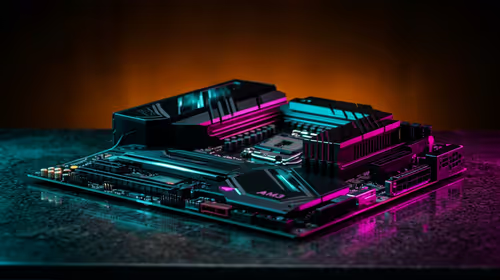
X870E vs X670E for aaa single-player gaming is mainly about fit, features, compatibility, cost, and upgrade path, not one automatic winner. SA buyers should match the choice to the setup.
Read more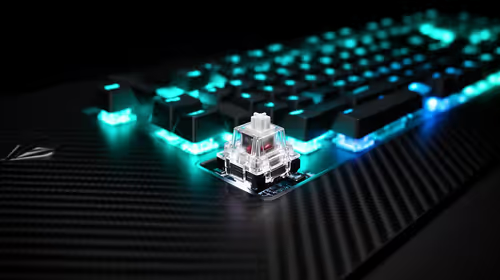
Hall Effect switches vs Mechanical switches for mMO and live-service games is mostly about compatibility, budget, upgrade path, and setup fit. SA buyers should check device support and real needs before expecting a clear win from either option.
Read more
A fake 113GB GTA VI ISO reportedly used empty padding around a small malware payload. SA gamers should delete unofficial builds, keep Windows security active and wait for official channels.

Wi-Fi 6E vs Wi-Fi 6 matters for 4K video editing when files move across a network. The real-world difference between Wi-Fi 6E and Wi-Fi 6 for video editing in 4K depends on NAS access, cloud uploads, router range, and SA creator workflows.

The difference between PCIe 5.0 and PCIe 4.0 for SA gamers is mostly bandwidth headroom. Compare GPU slot needs, NVMe speed, motherboard support, and upgrade timing before paying extra for a newer platform.

Gaming PC stuck pixel checks in South Africa should confirm the monitor fault first. Use colour tests, screenshot comparison, cable swaps, display menu checks, and clear photos before deciding on support.

Shokz OpenFit Air 2 earbuds weigh 7.2g each and use a redesigned dual-driver open-ear layout. SA buyers should choose them for comfort and awareness, not maximum isolation.

AMD's current driver now lists a Radeon RX 9050 4GB, while product coverage details a narrowed memory system. SA buyers should weigh the low VRAM ceiling against current local Radeon options.

Samsung Display has demonstrated a 16-inch 2.5K OLED laptop panel running at 300Hz. SA buyers should wait for a named notebook, full panel specifications and a local price before planning an upgrade.

Microsoft says some Windows 11 game crashes after recent updates are linked to RGB-related drivers. Affected SA gamers should confirm the update and driver before using the published registry workaround.
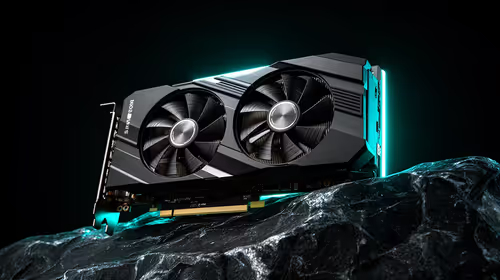
RTX 5090 on a 650W PSU is a tight pairing with very limited headroom. For SA gaming PCs, focus on total system draw, PSU quality, connector support, CPU choice, and avoid OC plans unless the full build is carefully power-limited.
PCIe 5.0 vs PCIe 4.0 for video editing in 4k is mainly about fit, features, compatibility, cost, and upgrade path, not one automatic winner. SA buyers should match the choice to the setup.
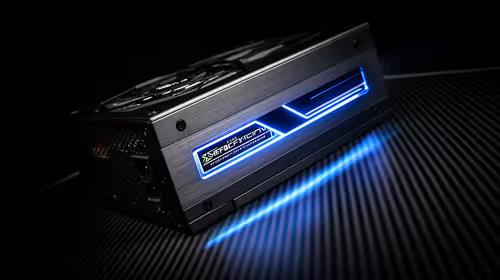
850W PSU safety for RTX 5090 is plausible with a quality unit and balanced parts. In SA, confirm connector support, CPU power draw, case airflow, PSU age, and spare capacity before building around 850W.
Wi-Fi 7 vs Wi-Fi 6e for competitive esports comes down to router support, latency goals, device compatibility, and coverage. SA buyers should match the choice to the real network setup.