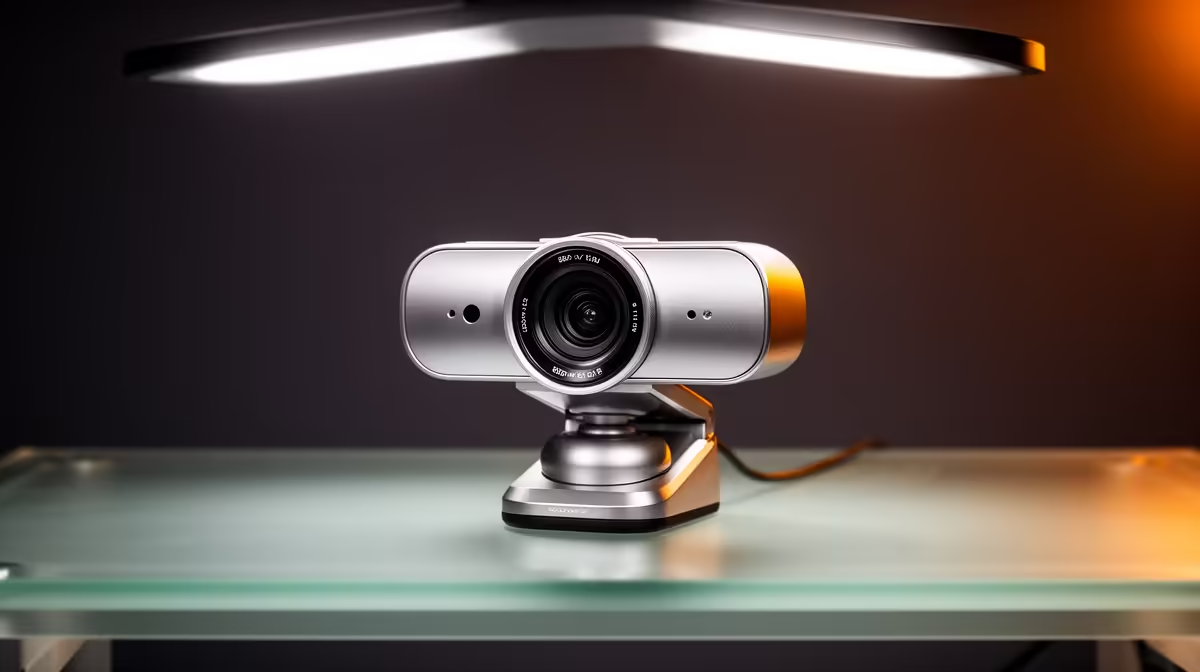
Buying a 4K streaming webcam without a sense of the Rand price landscape means either overpaying for features you will not use or under-spending into a sensor that cannot perform in your actual room. Rand budget tiers for professional 4K streaming webcams divide clearly into three bands, each with a specific feature profile, and understanding what each band actually delivers makes the spending decision straightforward rather than a gamble on specification sheets.
Quick Answer
Entry 4K webcams run R2,000 to R3,000 and cover basic 4K30 capture with standard sensors. Mid-tier models at R3,500 to R5,000 add better low-light performance, AI auto-framing, and more solid construction. Pro tier above R6,000 brings STARVIS-grade sensors, HDMI output, and multi-output connectivity for production environments. Spending more buys better sensors and connectivity, not just resolution.
💰 Entry Tier: R2,000 to R3,000
The entry band delivers genuine 4K30 resolution and basic autofocus, which is a meaningful upgrade over older 1080p cameras for daytime streaming in a decently lit room. At this price range you are buying the resolution number with a standard front-illuminated CMOS sensor behind it.
That sensor performs acceptably at 300 lux of even light or better. Keep your room well lit and the entry-tier output looks clean and sharp. The challenge appears at night or in dimly lit rooms: the sensor has to amplify its output to reach a viewable exposure level, and that amplification brings grain into shadow areas, which 4K resolution makes more visible rather than less because fine grain resolves clearly at high pixel density.
Entry models typically include a fixed mount clip without tripod-thread options, USB-only connectivity, and basic software support. The value case is strongest when streaming conditions are reliably bright, the audience watches on mobile at 1080p or lower, and the additional features of higher tiers are not part of the production workflow.
🔆 Mid Tier: R3,500 to R5,000
Spending into the mid band buys three tangible improvements over entry: a better sensor, AI auto-framing, and generally more solid build quality with more flexible mounting options.
The sensor improvement is the most consequential. Mid-tier cameras often use a more sensitive CMOS chip or an improved back-illuminated design that holds clean output at lower light levels, typically around 100 to 150 lux, compared to the 250 to 300 lux threshold of the entry band. For streamers in Joburg flats or Cape Town apartments where natural light is inconsistent across the day and reliable overhead lighting is the typical setup, the additional light sensitivity makes evening streams viable without having to invest in a full lighting kit.
AI auto-framing tracks the presenter within a wider field of view, cropping and panning to keep the subject centred. This compensates for imperfect camera placement and is useful for streamers who gesture at secondary screens or step back from the desk. Build quality at this tier typically includes a tripod thread, a more adjustable tilt mechanism, and better cable strain relief.
This tier represents the best value for a serious amateur creator or a professional remote worker who records regularly and wants reliable quality without the expense of a production setup.
🚀 Pro Tier: Above R6,000
Above R6,000 the camera becomes infrastructure rather than just a webcam. The defining features of the pro tier are sensor quality, connectivity options, and the precision of hardware controls.
Sony STARVIS or equivalent back-illuminated sensors appear consistently in this band. These chips gather substantially more light per pixel, producing genuinely clean 4K output in low-light conditions that would reduce a mid-tier camera to grainy output. For streamers running cinematic dim-room aesthetics, or for anyone whose streaming setup cannot include strong supplementary lighting, the sensor quality at this tier changes what is possible visually.
HDMI output, often alongside USB, enables a full capture-card workflow. The camera sends an uncompressed 1080p60 signal to a capture device, giving the encoder a higher-quality source than USB compression provides. For a creator who has already invested in a production chain including a capture card, HDMI maximises the value of that existing hardware.
RJ45 connectivity appears in the highest-spec pro models, designed for multi-camera fixed installs rather than solo desk streaming. Unless you are building a permanent studio or need to run a camera over existing building cabling, RJ45 is a feature you are unlikely to use and should not be the primary purchase driver.
Software support at the pro tier is typically more comprehensive, with detailed manual controls for exposure, white balance, sharpness, and anti-flicker, which matters in South African offices with 50Hz fluorescent or LED tube lighting that causes visible banding at the wrong shutter speeds.
Pro Tip ⚡
Before committing to the pro tier for the HDMI output, confirm that your capture card supports the resolution and frame rate the webcam outputs over HDMI at your planned streaming quality. Some entry capture cards accept 1080p30 over HDMI but not 1080p60, which negates the quality advantage of the better camera. Verify the full chain, not just the camera specification.
🎯 Matching the Tier to Your Actual Setup
The honest decision comes down to three variables: your room's lighting level, whether your audience will perceive the quality difference, and whether your production workflow uses pro connectivity features.
For a South African creator streaming in a well-lit room to a mobile-heavy audience watching at 1080p or below, the mid tier delivers excellent results at a sensible investment. The sensor handles typical indoor lighting, auto-framing reduces positioning stress, and the R3,500 to R5,000 spend leaves budget for a quality microphone and basic desk lighting.
The pro tier earns its price when lighting control is limited, when the channel aesthetic leans toward a cinematic low-key look, or when the setup already includes a capture card that benefits from HDMI output. Entry tier is appropriate as a first step into 4K when the setup is well-lit and the budget is firm.
Frequently Asked Questions
What does the entry Rand tier for 4K webcams actually include?
The R2,000 to R3,000 band provides 4K30 resolution with basic autofocus and a standard front-illuminated CMOS sensor. The optics and autofocus are functional, and in well-lit conditions the output is genuinely clean. The sensor does not perform as well as higher-tier chips in dim environments, and features like AI auto-framing and flexible connectivity are typically absent at this price.
What specific improvements does the mid tier add over entry?
At R3,500 to R5,000 you gain a more capable sensor with better low-light performance, AI auto-framing for dynamic tracking, and usually better physical construction with a tripod thread and more robust mounting. The sensor improvement is the most important functional change, allowing clean output at lower ambient light levels and reducing the dependency on supplementary lighting gear.
When is the pro tier worth the extra spend?
Above R6,000 the investment is justified when the setup needs clean output in dim or controlled cinematic lighting, when the production chain includes a capture card that benefits from HDMI source quality, or when the channel's visual standard requires the colour depth and low-noise performance of a STARVIS-class sensor. For a creator who streams in a bright room to a mobile audience, the pro tier's advantages are present but not decisive enough to justify the price gap.
Does spending more always mean higher resolution?
No. Most 4K webcams across all tiers cap at 4K30. The extra Rand at mid and pro tier buys sensor quality, low-light capability, connectivity options, and feature depth rather than more pixels. Resolution is the same across the spectrum; the meaningful differences are in how cleanly that resolution is captured and how flexibly the camera integrates into a broader production setup.
Which tier suits a serious South African creator on a budget?
The mid R3,500 to R5,000 tier provides the most practical value for a creator who streams regularly in real-world South African home or home-office conditions. It handles inconsistent lighting without demanding supplementary gear, includes auto-framing for natural movement, and costs significantly less than the pro tier while delivering substantially better results than entry cameras in anything less than perfect light.
Ready to choose the right 4K webcam tier for your streaming setup?
Browse the full 4K streaming webcam range across all Rand tiers and find the sensor and features that match your room, your audience, and your production ambitions.