Quick Answer
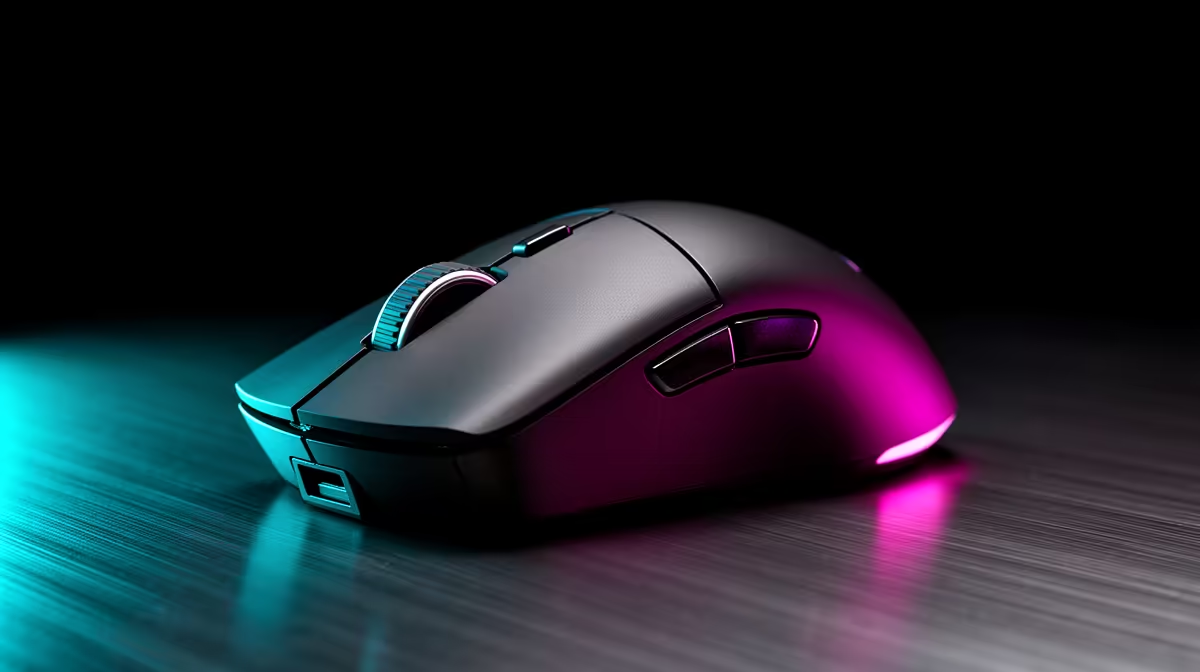
The features most worth paying for are a quality optical sensor, silent-click switches, USB-C recharging, and multi-device pairing. Features you can safely skip at most productivity price points are ultra-high DPI above 4,000, RGB lighting, and gaming-grade polling rates.
Features That Deliver Real Return 💰
A quality optical sensor, typically a PixArt PAW-series unit, is non-negotiable from a value standpoint. Budget sensors exhibit jitter, angle snapping, and tracking inconsistencies that slow you down. The sensor quality step-up from a sub-R200 mouse to a R400 to R600 mouse is stark and permanent across the life of the product. Silent-click switches, available on mid-range mice from R500 upward, reduce ambient office noise and eliminate the audible click that bleeds into open microphones during calls. Over two to three years of daily use, they also feel more satisfying than the worn-out rattle of cheap switches. USB-C recharging is worth paying an extra R100 to R200 over a micro-USB or AA-powered equivalent because it standardises your cable drawer and removes the risk of a dead mouse mid-day.
Features That Are Nice-To-Have at the Right Price 🖱️
Multi-device pairing, typically adding R150 to R300 to the price, pays off only if you genuinely switch between two or more computers during the week. For a student using a single laptop at res or home, it is surplus. Horizontal scroll wheels and free-spinning main wheels are genuinely useful for spreadsheet-heavy work and long-document review, but rare below R800. Programmable buttons deliver measurable time savings for power users but require 15 minutes of setup and ongoing profile management to realise that value.
Features Not Worth Paying For on a Productivity Mouse 🚫
RGB lighting draws power from the battery and serves no functional purpose for office use. Mice marketed with ultra-high DPI figures of 8,000 to 25,600 are targeting gamers; those numbers are irrelevant on a 1080p productivity display. Extremely low-latency 1,000Hz or 4,000Hz polling rates cost extra and the gain over a standard 125Hz office mouse is only detectable in competitive gaming, not in spreadsheet navigation. A South African buyer on a R500 to R900 budget is better served spending that budget on sensor quality, build quality, and ergonomic shaping than on specifications that do not translate to everyday productivity gains.
Compare Total Cost of Ownership ⚡
When comparing a R350 AA-powered mouse to a R650 rechargeable model, factor in two years of battery purchases at roughly R120 to R200 per year. The rechargeable model often comes out cheaper over that horizon and removes the unpredictability of batteries running flat at inconvenient moments.
FAQ
Is a wired mouse better value than wireless at the same price point?
For pure performance-per-rand, a wired mouse at the same price has a quality advantage because there is no radio hardware cost to absorb. The wireless premium is real but justified by the clean desk, freedom of movement, and ergonomic flexibility that cable-free use provides.
Are branded wireless mice significantly better than no-name options in SA?
For reputable brands like Logitech, HP, Microsoft, and Razer, the answer is yes. Brand investment goes into switch quality, sensor calibration, and firmware stability that no-name alternatives skip. Unbranded mice also rarely carry meaningful local warranty coverage.
What is the cheapest price point where wireless quality becomes dependable in SA?
Around R350 to R400 for a branded 2.4GHz optical mouse from a reputable manufacturer. Below that, connection reliability and build quality drop to a point where the mouse is likely to need replacement within 12 months of daily use.
Want to make every rand count on your next wireless mouse?
Evetech's range covers every price point from accessible entry-level 2.4GHz mice to premium multi-device models, all with transparent specifications.