Quick Answer
An ergonomic gaming desk setup positions your monitor at eye level with an arm's length distance, keeps your wrists neutral during keyboard and mouse use, and supports your back with proper chair and desk height alignment. Getting this right prevents the neck pain, wrist strain, and lower back fatigue that derail long gaming sessions.
Getting Your Desk Height and Chair Position Right First
Ergonomics starts from the floor up. Sit in your chair with your feet flat on the floor (or on a footrest if needed) and your knees at approximately 90 degrees. Adjust your chair height until your elbows, when resting naturally at your sides, align with the desk surface. This is your neutral arm position. If the desk is too high, your shoulders rise and create trapezius tension within an hour. If the desk is too low, you hunch forward and strain your neck and upper back. Most fixed-height desks in SA are built for a 175cm to 180cm person sitting without adjustment. If you are shorter or taller, a height-adjustable (sit-stand) desk removes this constraint entirely and adds the health benefit of occasional standing sessions. For a seated gaming position, your elbows should hover just above the desk surface when your arms are relaxed. Your wrists should be straight when positioned on the keyboard and mouse - not bent upward (extension) or downward (flexion). A wrist rest can help maintain neutral wrist position during typing pauses, but should not be used while actively mousing, as it restricts the small wrist movements that precise gaming requires. ## Monitor Placement for Zero Neck Strain
Monitor ergonomics are poorly understood by most gamers. The common advice is to position the top of the monitor at eye level, but this is only correct for productivity monitors where you are reading text across the full screen height. For gaming, the centre of the screen should be at or slightly below eye level, keeping your neck in a neutral position for the majority of your focal attention. Viewing distance: Seat yourself an arm's length from a 24-inch to 27-inch monitor. For 32-inch panels, increase this to approximately 70cm to 80cm. Sitting too close to a large display forces your eyes to track constantly across the screen rather than taking in the scene, and increases eye strain. Dual monitor setups: If running two screens, position your primary monitor directly in front of you and the secondary monitor to the side at an angle. Do not place both monitors at equal angles to either side - you will spend the session with your head turned and develop neck pain within days. The primary monitor stays front-centre. A monitor arm (single or dual) enables precise positioning and frees up desk surface below the screen. For SA gamers with limited desk space, this is a meaningful quality-of-life improvement. ## Keyboard and Mouse Positioning
Your keyboard should sit directly in front of you, with the mouse immediately to the right (or left for left-handed setups) on the same plane. A desk mat that extends the full width of your keyboard and mouse zone standardises the surface texture and reduces the micro-tension of moving your mouse across inconsistent surfaces. For gaming specifically, tenkeyless (TKL) or 65% keyboards move the mouse closer to the centre of your body, reducing shoulder strain from reaching right across a full-size keyboard. This is why TKL keyboards are overwhelmingly preferred by competitive FPS players. The keyboard should be flat or with a slight negative tilt (front edge raised slightly higher than back edge) to encourage neutral wrist positioning. The positive tilt provided by most keyboard kickstands actually promotes wrist extension over long sessions and should be avoided. ## Lighting, Cable Management, and Audio Positioning
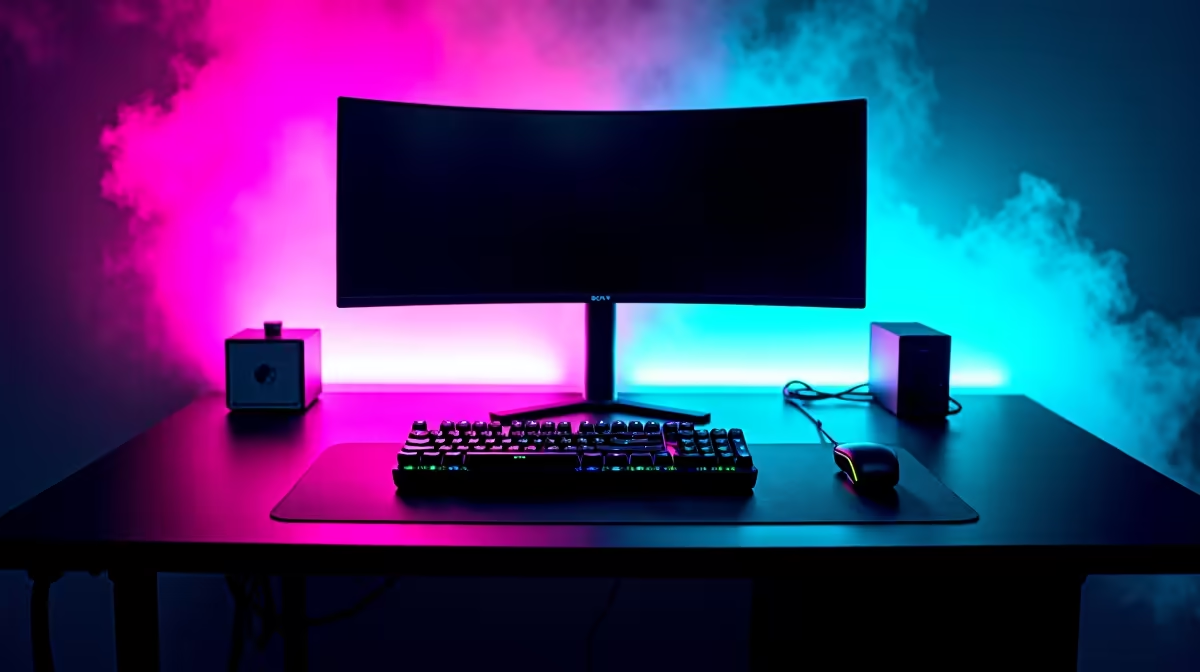
Desk lighting affects both eye strain and your camera's performance during streaming or video calls. Bias lighting behind the monitor (an LED strip matching your monitor's brightness temperature) reduces the contrast between the bright screen and dark surroundings, meaningfully reducing eye fatigue over long sessions. Cable clutter on a gaming desk is more than aesthetic. Tangled cables restrict mouse movement, create trip hazards, and make it harder to access the desk when adjusting components. Route power cables and USB connections behind or underneath the desk. Use cable clips or a cable management tray below the desk surface. Headsets and speakers should be positioned symmetrically for balanced stereo imaging in games. A headset stand or hook mounted to the desk keeps the headset off the surface when not in use and extends cable life by preventing the cable from pulling against the connector. ### FAQ
How high should my gaming monitor be? The centre of your monitor should sit at or slightly below eye level when you are seated in your normal gaming position. If your monitor is too low (common with monitors without stands that elevate them sufficiently), use a monitor stand or arm to raise it. Looking down at a screen placed too low creates the same neck strain as looking up at one placed too high. ### Should I use a wrist rest for gaming? A wrist rest is useful during non-gaming desk use (browsing, typing) to support the wrist at rest. During active gaming - particularly FPS gaming - your wrist and forearm should be free to make small movements without a rest creating a pivot point. Use a wrist rest for comfort during breaks, not during play. ### What desk size is best for a gaming setup with two monitors and a PC tower? A minimum 1.5m wide desk accommodates two monitors comfortably. A 1.8m or 2m desk is preferable when adding a PC tower on the desk surface. If floor space allows, the tower lives on the floor to free the full desk surface for peripherals. Corner desks provide excellent surface area for multi-monitor setups but require a room layout that can accommodate the L-shape. ### How often should I take breaks during long gaming sessions? The 20-20-20 rule applies to gaming: every 20 minutes, look at something 20 feet away for 20 seconds. Beyond eye breaks, stand and stretch every hour. Set a timer if needed. Even a well-ergonomically-configured desk does not eliminate the need for movement breaks - the human body is not designed for sustained static postures regardless of how well-optimised they are.
Ready to Find Your Perfect Match? Complete your ergonomic gaming setup with quality headsets and audio gear from Evetech. Browse Headsets at Evetech