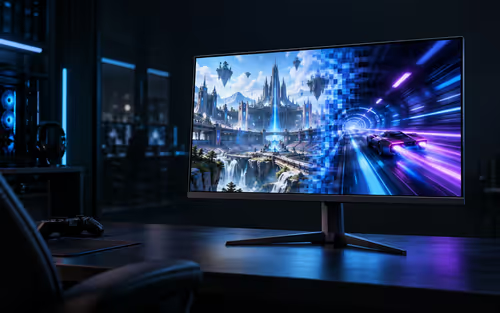
Ever been taken out in a tense Warzone firefight because you couldn't spot the enemy hiding in the grass? You’re not alone. For the significant chunk of South African gamers with colour vision deficiency (CVD), telling friend from foe or spotting that crucial objective can be a massive pain. Many modern displays now include a monitor color blind mode, promising a solution. But do they really work, or are they just a marketing gimmick? We put them to the test. 🎨
How Monitor Colour Blind Modes Actually Work
Before we dive into the results, let's quickly break down what's happening behind the screen. A monitor color blind mode isn't a magical cure; it's a clever digital filter. It works by shifting specific colours that people with common types of CVD, like Deuteranopia (red-green deficiency), find difficult to distinguish.
Essentially, the monitor's software analyses the image and adjusts the colour palette. It might boost the contrast between red and green tones or shift them towards colours that are easier to tell apart, like blue and yellow. The goal isn't perfect colour accuracy… it's to provide functional clarity so you can finally see that health bar or map marker. This technology is becoming a standard feature across many modern PC monitors.
Putting Accessibility to the Test: Our Gaming Deep Dive
We fired up a few popular titles on a high-refresh-rate display to see how these settings hold up under pressure. The experience was... interesting.
First-Person Shooters: Spotting the Enemy
In games like Apex Legends and Valorant, where enemy outlines and ability effects are colour-coded, the results were immediately noticeable. With the mode for red-green deficiency enabled, the vibrant red of an enemy highlight became much more distinct against a green or brown background. It didn't make the game look "normal," but it absolutely made targets easier to acquire. For competitive play, this functional advantage is huge, especially on immersive curved monitors where peripheral vision is key.
RPGs & MMOs: Is That Loot Purple or Blue?
Next up, we ventured into the world of loot drops. Anyone who's played an MMORPG knows the subtle but critical difference between a blue (rare) and a purple (epic) item. Here, the monitor color blind mode was a bit of a mixed bag. While it made the colours more distinct, it often did so by washing out the overall vibrancy of the game's world. It's a trade-off: clearer loot icons for a less visually stunning adventure. We found this was especially true on ultra-high-res displays, where the subtle details on 5K and 4K monitors can be affected by the aggressive filtering.
Pro Tip: Use Software Filters Too! 💡
Don't rely solely on your monitor's built-in settings. Both NVIDIA's Freestyle and AMD's Radeon Software offer customisable colour filters that you can apply on a per-game basis. These often provide more granular control, allowing you to fine-tune the settings for your specific type of colour vision deficiency without affecting your desktop's colours.
The Verdict: A Helpful Tool, Not a Magic Fix
So, do monitor colour blind modes really work? Yes, but with a few caveats. They are an excellent accessibility tool that can provide a tangible competitive edge and reduce frustration. However, their effectiveness varies greatly between monitor brands and the specific game you're playing.
They are not a substitute for true colour accuracy. They are a utility designed for clarity over fidelity. Think of it less as fixing your vision and more as giving you a pair of specialised glasses for your game. If you're a gamer on the go, even some portable monitors are starting to include these valuable features.
Finding the Right Monitor with Colour Accessibility in Mind
When you're shopping for a new screen, don't just look for a "colour blind mode" checkbox. Dig a little deeper. Check reviews to see how well the feature is implemented on that specific model. A high-contrast VA panel or a colour-accurate IPS panel from our range of all gaming monitors will often provide a better foundation for these filters to work with.
Ultimately, a good monitor is an investment in your entire PC experience. Pairing your screen with the right monitor accessories, like a quality VESA mount, can also enhance your setup for maximum comfort and performance.
Ready to See the Difference? A monitor's colour blind mode can be a powerful tool, but it starts with having the right hardware. Explore our incredible promotions and find the best PC monitor deals in South Africa to find a screen that brings your games to life.