AMD has published a new set of graphics firmware identified as RDNA 4m, giving Linux distributions another part of the software stack they can prepare before hardware appears. The milestone is real, but it does not announce a laptop, performance target or sale date. South African buyers should keep those two facts separate when deciding whether to wait for an unnamed future system.
Quick Answer
The new firmware covers GFX11.7.0 and GFX11.7.1 graphics targets plus supporting security, data-movement and video-processing blocks. Its arrival in the Linux firmware collection improves early operating-system readiness. It does not confirm compute units, clocks, memory, power use, a notebook model or a South African launch. Meanwhile, the exact local Ryzen AI laptop sample on 23 August started at R13,999.
🐧 Firmware is an enablement step, not a product launch
A modern GPU needs small binary files during start-up so its hardware blocks can initialise correctly. Making those files available upstream lets Linux distributions include support before buyers receive the related machines. Reviewers and developers are less likely to face a system that boots without the firmware needed to activate its graphics engine.
The published set names GFX11.7.0 and GFX11.7.1 targets. It also includes PSP 15.0.0 and 15.0.9 security firmware, SDMA 6.1.4 for data movement and VPE 2.0.0 for video processing. Those identifiers prove that software work is moving, but they are not retail specifications. They reveal no useful frame-rate target and do not establish how the hardware will be packaged.
This distinction matters because RDNA 4m should not be treated as a smaller copy of every desktop Radeon product. The new identifiers sit in the GFX11 family, while current desktop RDNA 4 cards use GFX12 naming. Until AMD provides a product brief, comparisons based only on the marketing label would be guesswork.
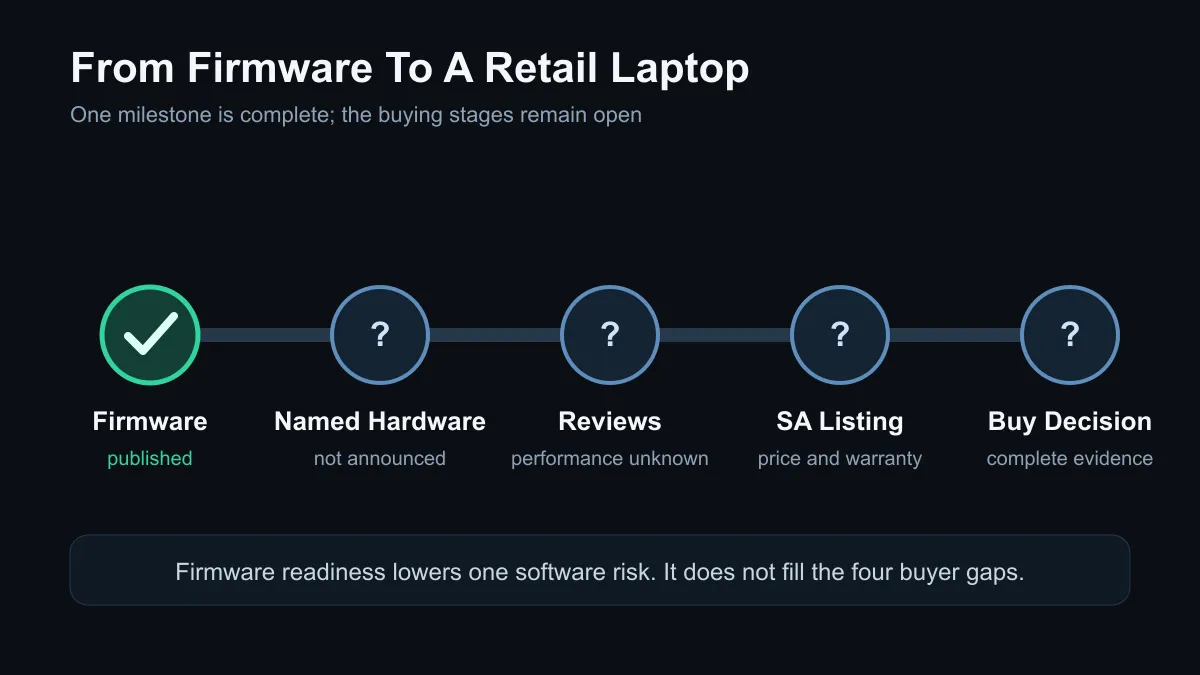
🧩 Several pieces must still meet before a laptop is ready
Firmware is one layer. A complete notebook also needs kernel and graphics-driver support, platform power management, display paths, media acceleration, vendor BIOS work and model-specific validation. A distribution may package the new files quickly, yet a finished laptop can still be months away or never reach a particular region.
No confirmed compute-unit count, clock speed, memory arrangement or power target accompanied the firmware. There is also no named notebook customer, shipping window or rand price. That means buyers cannot yet judge battery life, gaming performance or whether the graphics block sits in an entry, mainstream or premium system.
Linux users should wait for model-level evidence. A useful review needs working suspend and resume, external displays, video decode, variable refresh, stable gaming drivers and sensible power use. Early firmware availability lowers one risk but does not certify any of those behaviours.
💻 Current laptops put a price on waiting
The timestamped catalogue sample provides a practical baseline. Ryzen AI 5 systems with 16GB memory and 512GB storage appeared from R13,999. A 1TB Ryzen AI 5 model was R16,999, a Ryzen AI 7 notebook was R17,999 and another convertible Ryzen AI 5 option reached R19,499. These are current listing snapshots, not direct RDNA 4m equivalents.
Use the Ryzen AI 5 laptop range when the priority is a current mobile platform at a controlled budget. The Ryzen AI 7 laptop range suits buyers comparing more performance headroom. For a gaming-first decision, the AMD Ryzen gaming laptop range keeps the focus on a complete, available configuration rather than an unannounced graphics block.
The lowest price is not automatically the best fit. Compare memory, storage, display quality, cooling, upgrade access and local warranty. A laptop bought for study or work must solve that job every day; waiting for a future graphics target has a cost when the present machine is unreliable or too slow.
⏳ Wait only when the current machine still works
There is a sensible case for waiting if a buyer wants Linux-first graphics support and can keep using an existing laptop until named models are reviewed. The upstream firmware milestone suggests that early support is being prepared, which is better than discovering missing files after launch. It still offers no basis for reserving a budget or assuming a South African arrival.
Buy an available system when the workload, price and support terms are known. Wait when there is no urgent need and the missing details are central to the decision. The next meaningful signals are a formal platform announcement, model names, complete specifications, independent measurements and a local listing. Anything less remains preparation rather than a purchase opportunity.
Frequently Asked Questions
Does RDNA 4m firmware confirm a new laptop?
No. It confirms a software-enablement target, not a notebook model, launch date or regional release.
Is RDNA 4m the same target as desktop RDNA 4?
The identifiers differ. The new files use GFX11-family naming, so buyers should not copy desktop GFX12 specifications onto them.
Will Linux support be ready on day one?
Upstream firmware helps, but complete support also depends on drivers, the kernel, platform firmware and each notebook vendor's validation.
Should an SA buyer wait?
Only if the current laptop remains suitable and unconfirmed performance, timing and local pricing do not create a problem.
Need a laptop before the next platform arrives? Compare complete in-stock systems on workload, warranty and measured value instead of an unannounced graphics label.