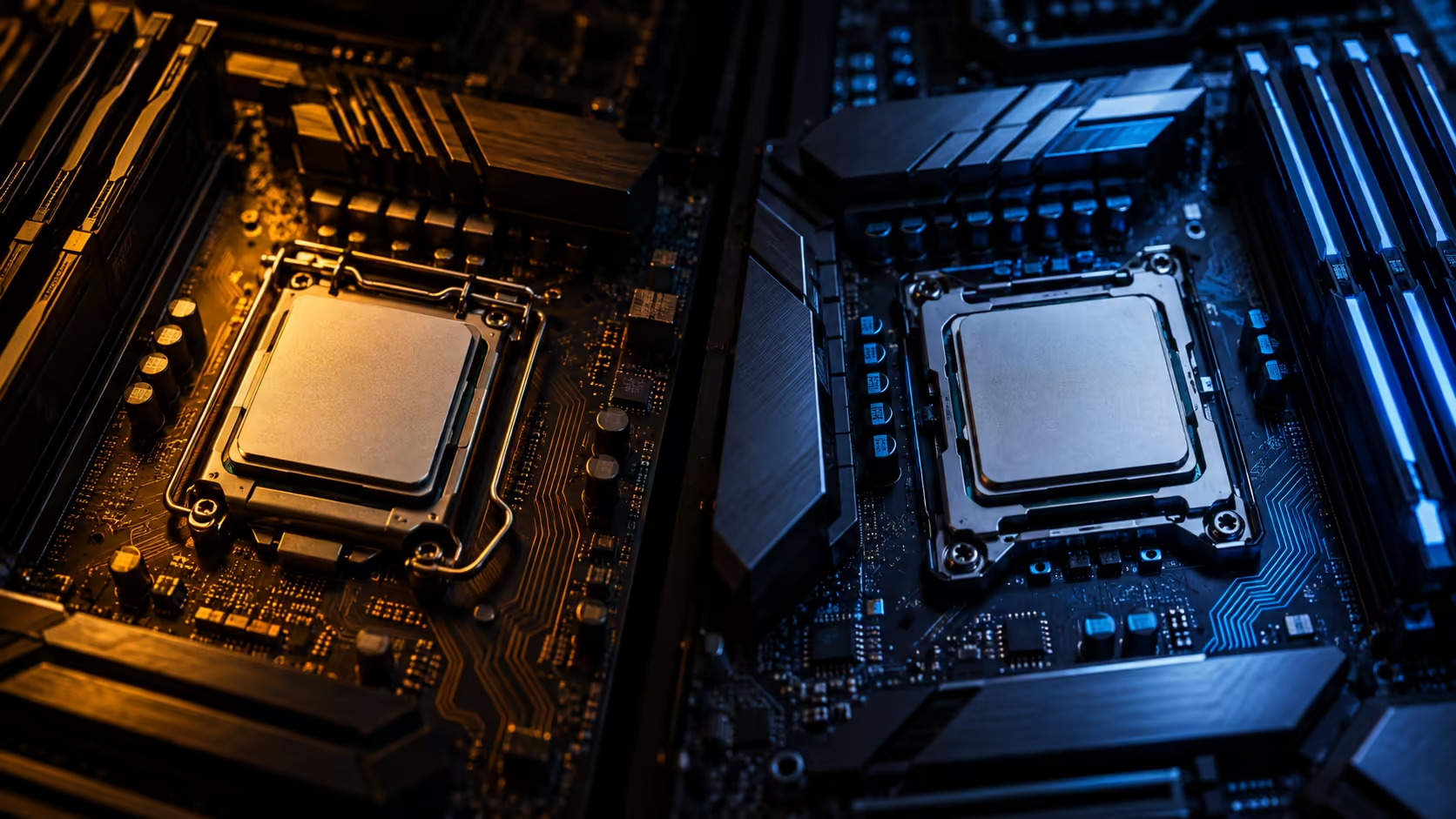
AMD has added two six-core processors at very different platform prices. The Ryzen 5 7500 brings Zen 4, AM5 and basic integrated graphics to a lower tier, while the Ryzen 5 5500F extends the older AM4 platform with Zen 3 Vermeer silicon and PCIe 4.0. The processor prices are only the first line of the budget.
Quick Answer
Both chips have six cores, 12 threads and a 65W rating. The Ryzen 5 7500 is listed at $189 in the United States and uses AM5 with DDR5 memory. The Ryzen 5 5500F is listed at $99 and uses AM4 with DDR4. Those foreign figures are not South African quotes. Compare the total cost of processor, motherboard, memory, cooling and graphics before choosing a platform.
Ryzen 5 7500: the lower AM5 entry
The Ryzen 5 7500 uses Zen 4 cores with a 3.7GHz base clock and boost up to 5.0GHz. It has 32MB of L3 cache and basic integrated Radeon graphics. That display engine is useful for setup, diagnosis and ordinary desktop output even when a gaming build will ultimately use a discrete graphics card.
AM5 requires an AM5 motherboard and DDR5 memory. The higher platform cost can buy a more modern upgrade path, but it only pays off if future processor support, newer I/O or the integrated display output is useful to the buyer. A low processor price does not automatically make the complete build cheap.
The 7500 is close to the established 7500F in CPU specification, with the important addition of integrated graphics. It should not be confused with the Ryzen 5 7500X3D, which is a separate gaming-focused processor with a much larger cache and a different local price.
Ryzen 5 5500F: a different kind of AM4 chip
The 5500F uses six Zen 3 cores, a 3.0GHz base clock, boost up to 4.4GHz and 16MB of L3 cache. Unlike the older Ryzen 5 5500, it uses Vermeer silicon and supports PCIe 4.0. The F suffix also means there is no integrated graphics, so the system needs a discrete graphics card for display output.
That distinction matters when comparing a cheap upgrade with a complete new PC. An existing AM4 owner may already have compatible DDR4 memory and a motherboard that can support the chip after the correct BIOS update. A new buyer starting with no reusable parts should price an AM5 alternative at the same time.
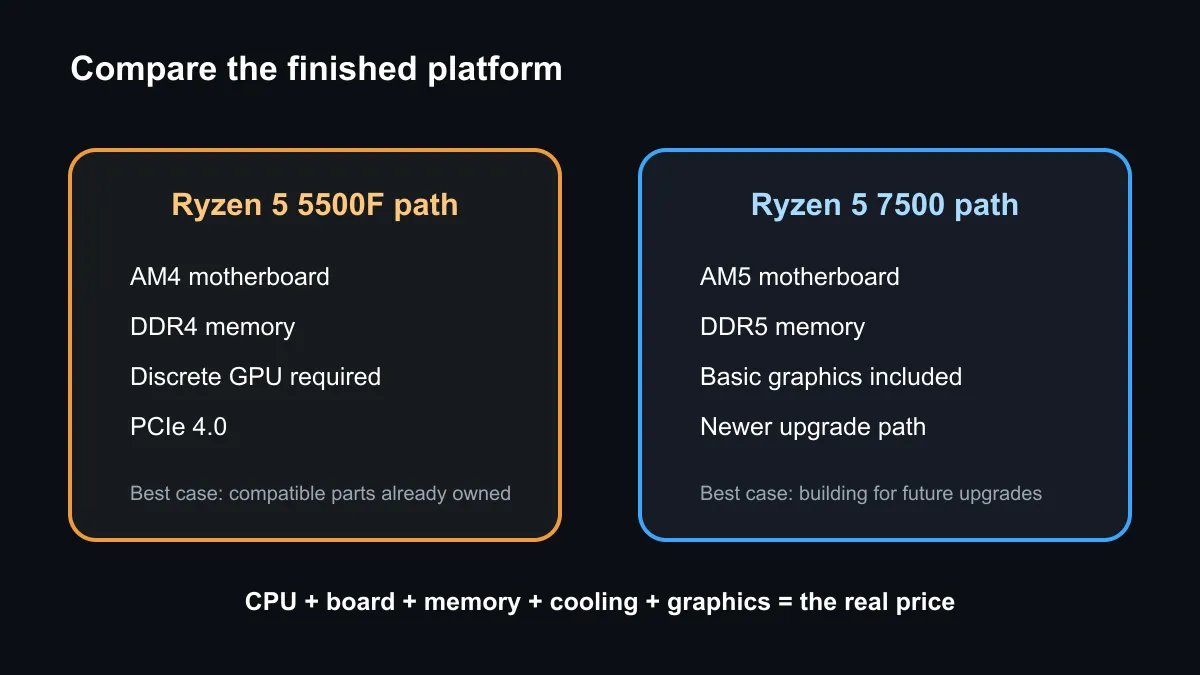
Price the entire platform
Start with the parts you already own. Confirm the exact motherboard model, current BIOS support, memory capacity, cooler mounting and power-supply headroom. Then price the missing parts as one system. A processor that saves money but forces a graphics-card purchase or gives up a useful upgrade path may not be the cheaper result.
The captured local query did not return the new non-X3D Ryzen 5 7500 or the 5500F as standalone products. It did return active Ryzen 5 5500 upgrade kits from R5,999, a Ryzen 5 7500X3D processor at R5,199 and Ryzen 5 5600 kits from R8,999. Those are current context points, not substitutes with identical specifications.
Browse AMD processors, compare the Ryzen 5 range, and check Ryzen 5 upgrade kits. Recheck every price and BIOS requirement before purchase.
Frequently Asked Questions
Does the Ryzen 5 7500 need a graphics card?
Not for basic display output. It includes integrated Radeon graphics, although gaming performance usually calls for a discrete GPU.
Does the Ryzen 5 5500F fit every AM4 board?
No. The socket may match, but the exact motherboard needs firmware support and suitable power delivery.
Which platform is cheaper?
AM4 can be cheaper when compatible parts are already owned. For a full new build, compare the finished AM4 and AM5 baskets.
Use the current Ryzen 5 range as the live price reference rather than converting the US launch figures.
Price the motherboard and memory with the CPU. Platform cost decides whether AM4 value or AM5 headroom wins.