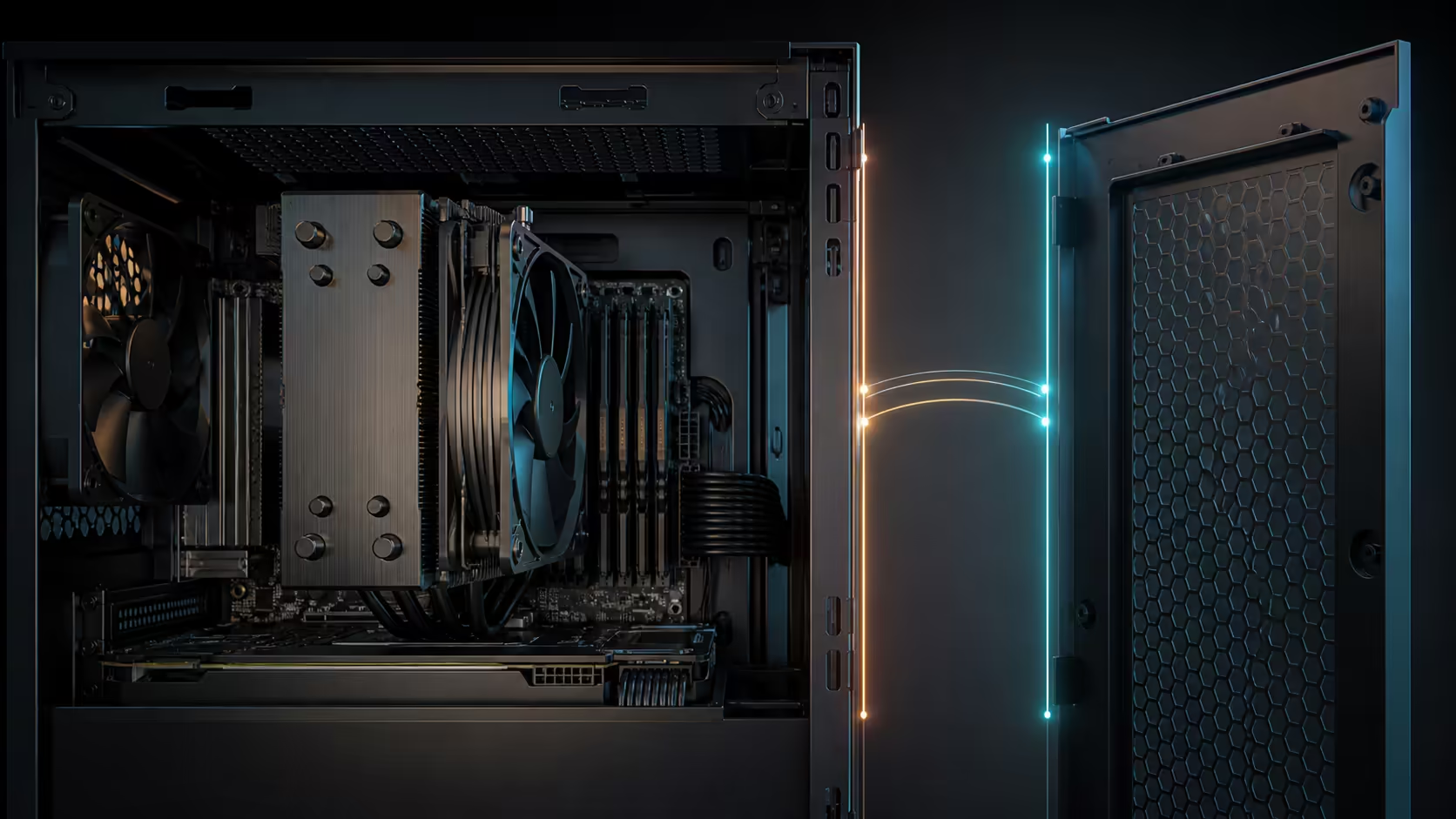
A CPU cooler clearance figure looks simple: the cooler is shorter than the case limit, so it should fit. Noctua's measurements across more than 100 cases show why that subtraction can fail. Side panels, mounting position, production tolerances, RAM and motherboard layout can remove the small margin that looked safe on a specification sheet.
Quick Answer
Check the exact case and cooler pair instead of trusting two matching height numbers. Noctua found cases with more measured room than listed and others with less. In-stock CPU air coolers started from R399 on 8 August, with checked tower heights of 153mm, 158mm and 160mm at R599, R799 and R899 respectively.
📏 Why the published number can miss the fit
Case clearance is usually presented as the maximum CPU cooler height. Cooler height is presented as one fixed dimension. In a real build, neither number exists alone. The cooler sits on a processor and socket, the motherboard fixes that socket's position, the fan may rise over tall memory and the side panel can include a bracket, lining or inward curve.
A fit can therefore fail by one or two millimetres even when the headline numbers match. Pressing a side panel against the fan or heat-pipe cap is not a valid solution. It can create vibration, prevent the panel from closing correctly or transfer force into the cooler mount.
The opposite can happen too. A case may provide more physical room than the conservative listed figure. Noctua's reported examples included cases with almost 10mm more measured clearance, while another example had about 2mm less than stated. The lesson is not that every case specification is wrong. It is that the last few millimetres need pair-specific evidence.
🧰 What the measured database adds
Noctua's compatibility list lets a builder search by case and see which of the brand's coolers have sufficient clearance. That is more useful than comparing a generic maximum with a generic height because the result is based on an actual component pairing.
The list does not guarantee every non-Noctua cooler. It can still reveal the measured space available, but another model may have a different top plate, fan position or width. Use it as evidence, then confirm the exact drawing and installation notes for the cooler you plan to buy.
Motherboard and memory compatibility remain separate checks. A cooler can clear the panel but block a tall RAM module, crowd the first graphics slot or clash with a large voltage-regulator heatsink. Small-form-factor builds have the least room for an assumption.
💸 How current local coolers frame the decision
The 8 August catalogue snapshot found in-stock CPU air coolers from R399. A compact dual-tower design listed a 153mm height at R599. A 158mm tower was R799, while a 160mm model was R899. These figures are timestamped reference points, not permanent prices.
Browse the CPU cooler range after checking the processor socket and cooling requirement. Then compare the chosen tower against the computer case range, using the exact case model rather than assuming every mid-tower has the same internal space.
Price does not replace fit. A R599 cooler that closes cleanly, clears the memory and handles the processor is a better purchase than a taller premium model that needs the fan pushed upward. Moving a fan can increase total height beyond the figure that appeared safe.
The case best sellers are useful starting points, but popularity cannot prove compatibility with your motherboard, RAM and chosen cooler. Build the parts list as one system.
✅ The four-check checkout routine
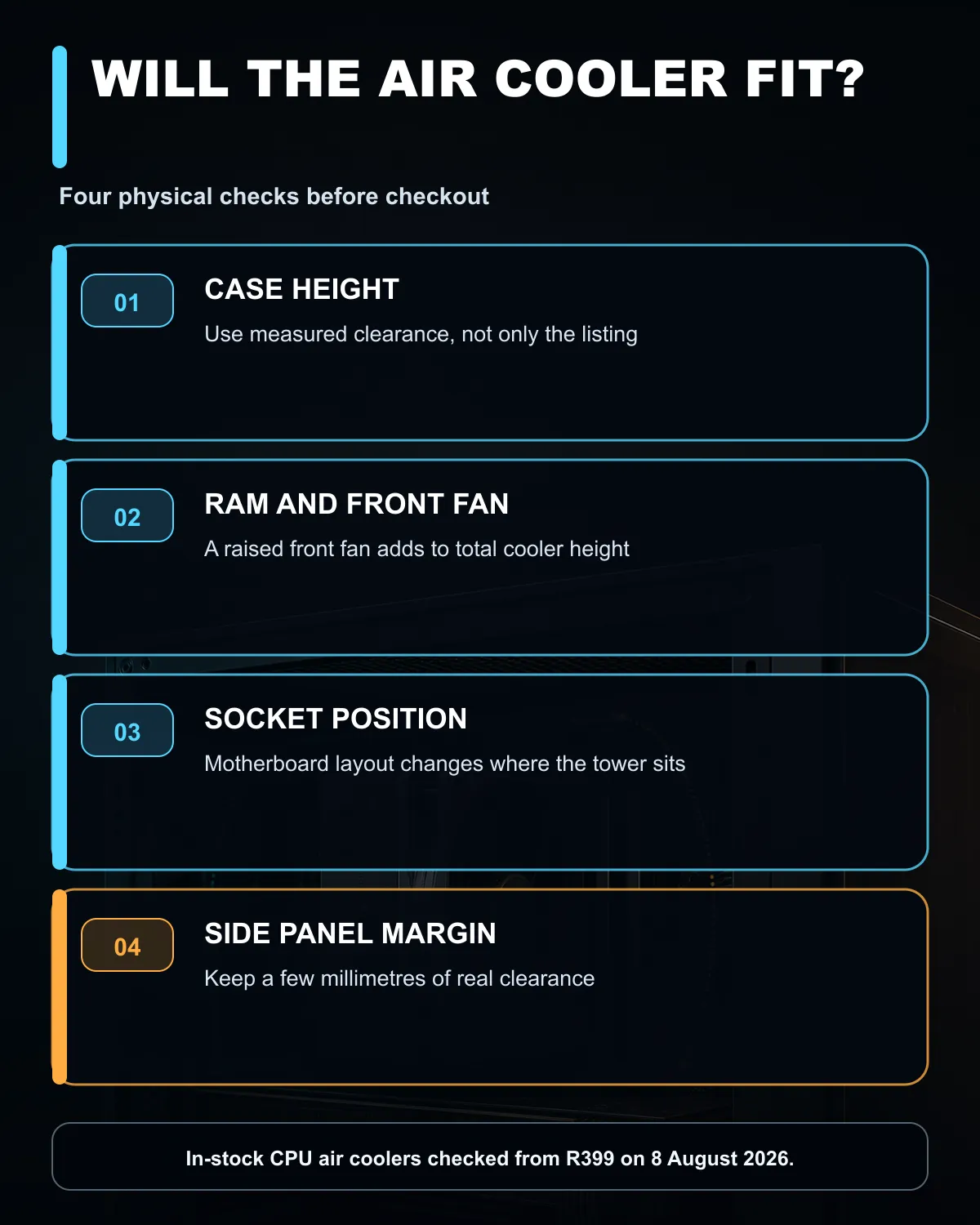
First, record the cooler's total installed height with its fan in the required position. Second, confirm the case's measured CPU area and any side-panel or bracket intrusion. Third, check RAM height and whether the front fan overhangs the memory slots. Fourth, inspect motherboard socket position, nearby heatsinks and graphics-card clearance.
Keep a few millimetres of margin where possible. If a 160mm cooler and a 160mm case limit are the only evidence, treat the fit as unconfirmed. Search for a manufacturer compatibility entry, a technical drawing or a verified build using the exact pair.
Do this before checkout, not during assembly. A cooler-fit mistake can force a return, delay the build or push the buyer toward a smaller model chosen in a rush. Ten minutes of checking protects the whole component budget.
Frequently Asked Questions
Is case cooler clearance always accurate?
It is a useful starting figure, but measured room can differ. Pair-specific compatibility data is stronger when the margin is small.
Can RAM make a cooler too tall?
Yes. If the front fan must move upward to clear tall memory, the cooler's total installed height increases.
Is a 160mm cooler safe in a case rated for 160mm?
Do not assume it is. With no spare margin, panel shape, tolerances or fan position can decide the result.
What air cooler price was checked locally?
The lowest in-stock CPU air cooler in the 8 August snapshot was R399.
Does Noctua's case list cover other cooler brands?
It is built for Noctua coolers. Its measurements can inform another comparison, but the exact non-Noctua model still needs its own fit check.
Planning a case and cooler combination?
Compare current Evetech cases and CPU coolers only after checking installed height, RAM position, motherboard layout and side-panel margin.