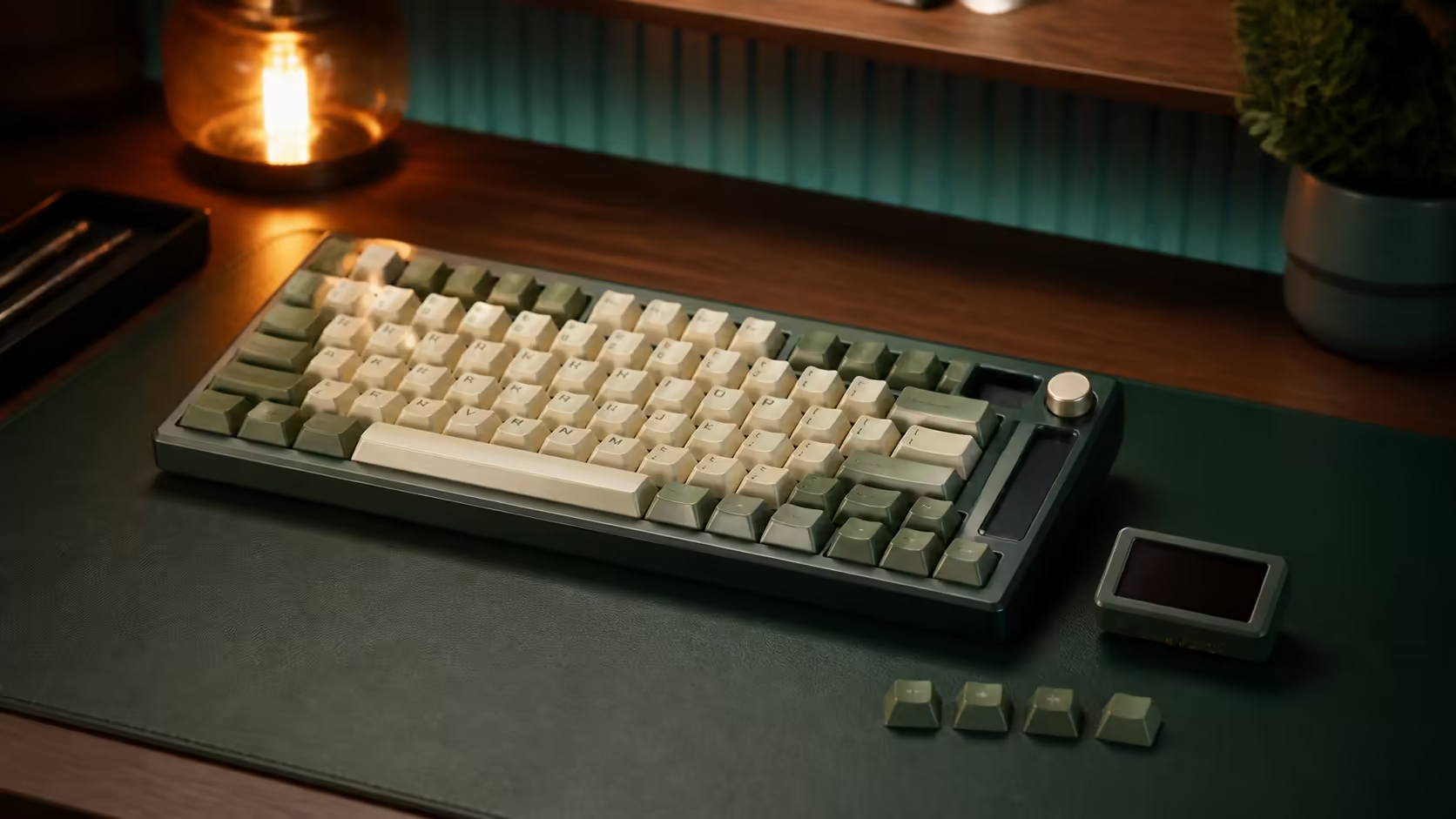
Retro styling is only the first layer of the Epomaker RT75. Its removable 1.54-inch screen can be swapped for four keys, while tri-mode connectivity, hot-swap sockets and a 5000mAh battery aim at a desk that changes between work and play. The unusual module is useful only if the keyboard basics suit the buyer first.
Quick Answer
The Epomaker RT75 is a wireless 75 percent mechanical keyboard with a removable display, gasket structure and three connection modes. No exact RT75 appeared in our 15 August Evetech read; in-stock 75 percent and TKL keyboards ranged from R699 upward, with local screen-equipped wireless examples from R1,199. Judge the RT75 on typing feel and support before its display.
🖥️ One slot, two different layouts
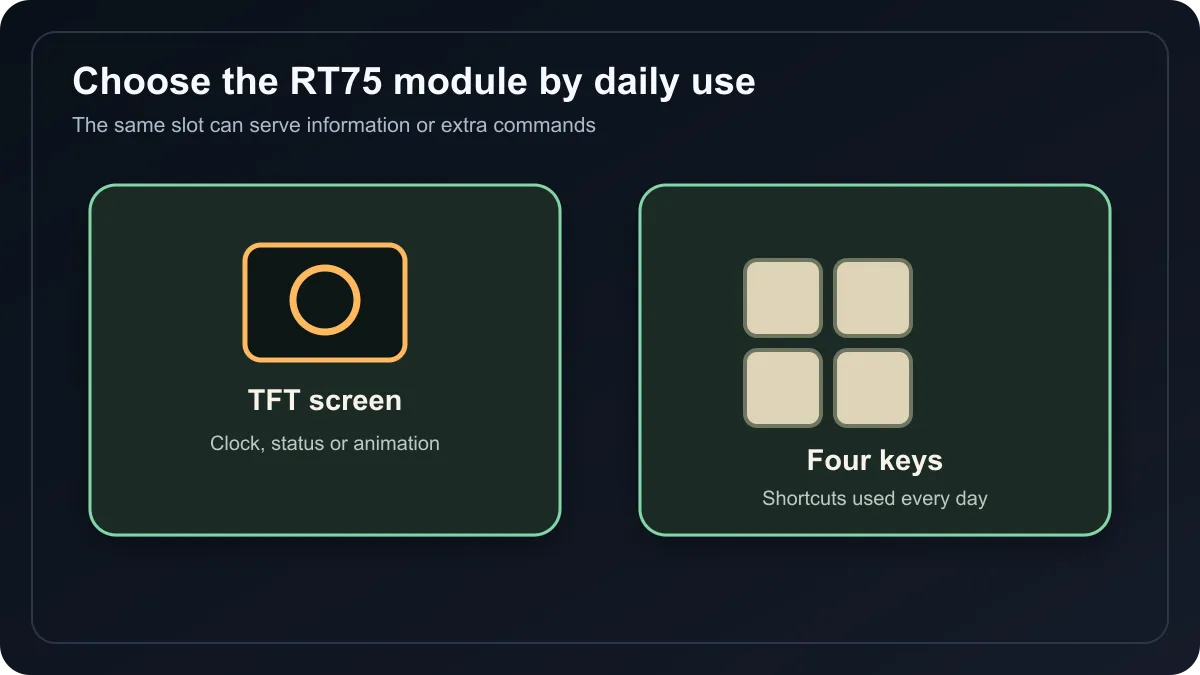
The RT75's defining feature is the detachable 1.54-inch TFT screen. It can show a clock, custom animation or system information. Removing that module makes room for a four-key replacement, shifting the practical layout closer to a compact TKL arrangement. That is more flexible than a permanently fitted display, but it also asks the buyer to decide which module will be useful most days.
A screen can be convenient for battery state or a quick visual cue. It should not become the reason to overlook key placement. Look at the position of Delete, Page Up, Page Down and the arrow cluster, then compare those positions with the shortcuts already used at work or in games. A novel module loses value if it adds friction to repeated tasks.
The board supports south-facing RGB and software control through Epomaker Driver 3.0 on Windows and macOS. Browser-based control is also advertised. Buyers using a managed work device should confirm whether software installation or browser access is permitted before relying on remapping, animations or macro features.
🔌 Three connections change the daily routine
USB-C handles wired use, while Bluetooth and 2.4GHz wireless cover mobile and low-latency setups. The 5000mAh battery is a useful capacity claim, yet real runtime depends on brightness, screen use, connection mode and sleep settings. A bright animated display can consume energy that a screen-free keyboard would save.
For a desktop gaming PC, the 2.4GHz receiver is normally the relevant wireless path. Bluetooth is better suited to quick switching with a laptop or tablet where maximum responsiveness is less important. Keep the receiver close to the keyboard and away from congested rear ports if the connection becomes inconsistent.
The official dimensions are 352 by 142 by 45 mm and the listed weight is about 1,165 g. That weight can help the board stay planted, but it is less appealing for a bag. Measure the available desk depth as well as width because the screen housing makes the board deeper than some minimal 75 percent designs.
🔧 Hot-swap does not remove every compatibility check
Epomaker lists support for three-pin and five-pin mechanical switches. The announced options include Creamy Jade linear switches and Crystal Tactile Silent switches. Linear switches favour a smooth press, while tactile switches add a physical bump. Neither choice is universally better; the right one depends on noise tolerance and how much feedback the user wants.
Hot-swap sockets make later switch changes easier, but keycap profile, switch orientation and stabiliser quality still affect the final feel. The gasket structure and five damping layers are intended to soften sound and vibration. Those construction choices should be assessed through independent sound tests rather than assuming every desk will produce the same tone.
💰 Use local products as reference points
The exact RT75 was absent from the captured catalogue rows. The lowest in-stock 75 percent model in the query was a Marvo Titan 75 at R699. A Marvo wireless 75 percent board was R999, an MSI wireless TKL with a 1.06-inch display was R1,199, and Lorgar wireless 75 percent models with displays were R1,249.
These rows show what local buyers can compare without claiming feature parity. Browse the full gaming keyboard category, inspect keyboard specials, and use the keyboard switch range when planning a future hot-swap change.
The RT75 makes the most sense for someone who will genuinely switch between the screen and four-key module, or who wants a heavy retro board across several devices. If the display will remain decorative, compare it with a simpler tri-mode keyboard and put the difference toward switches or keycaps that alter the typing experience every day.
Frequently Asked Questions
Can the RT75 screen be removed?
Yes. The 1.54-inch TFT module can be replaced with a separate four-key module.
Which wireless modes are included?
Epomaker lists Bluetooth and 2.4GHz wireless alongside wired USB-C operation.
Is the RT75 hot-swappable?
Yes. The official page says its sockets accept three-pin and five-pin mechanical switches.
How large is the battery?
The listed capacity is 5000mAh, though actual runtime varies with lighting, display and connection use.
Is the exact model locally listed?
No exact RT75 appeared in the timestamped Evetech catalogue snapshot.
What local price gives useful context?
Comparable in-stock compact keyboards began at R699, with screen-equipped wireless examples from R1,199.
Want a compact keyboard that fits more than one device? Compare local tri-mode layouts and screen-equipped options, then decide whether the RT75's removable module earns its desk space.