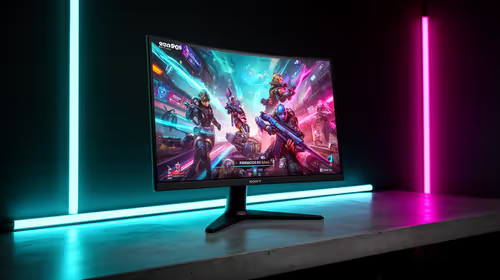
OLED is no longer a rare monitor experiment. Global OLED monitor shipments rose sharply in the second quarter of 2026, and the strongest pull came from the practical 27-inch QHD format rather than only giant premium screens. South African shelves now show a wide enough range to make panel choice a real comparison.
Quick Answer
Global OLED monitor shipments increased 26.1% quarter on quarter and 98% year on year in 2Q26. A 14 August Evetech snapshot found seven in-stock OLED monitors from R9,999 to R22,999, with several 27-inch QHD options in the middle. Faster adoption improves choice, but buyers should still compare resolution, refresh rate, panel type, warranty and desk use.
📈 Why 27-inch QHD is pulling the market
A 27-inch QHD screen balances three pressures. The resolution is sharper than 1080p without demanding the graphics load of 4K, the physical size fits many desks, and high refresh rates are useful for competitive games. That combination helps OLED's fast pixel response and strong contrast reach buyers who do not want an enormous display.
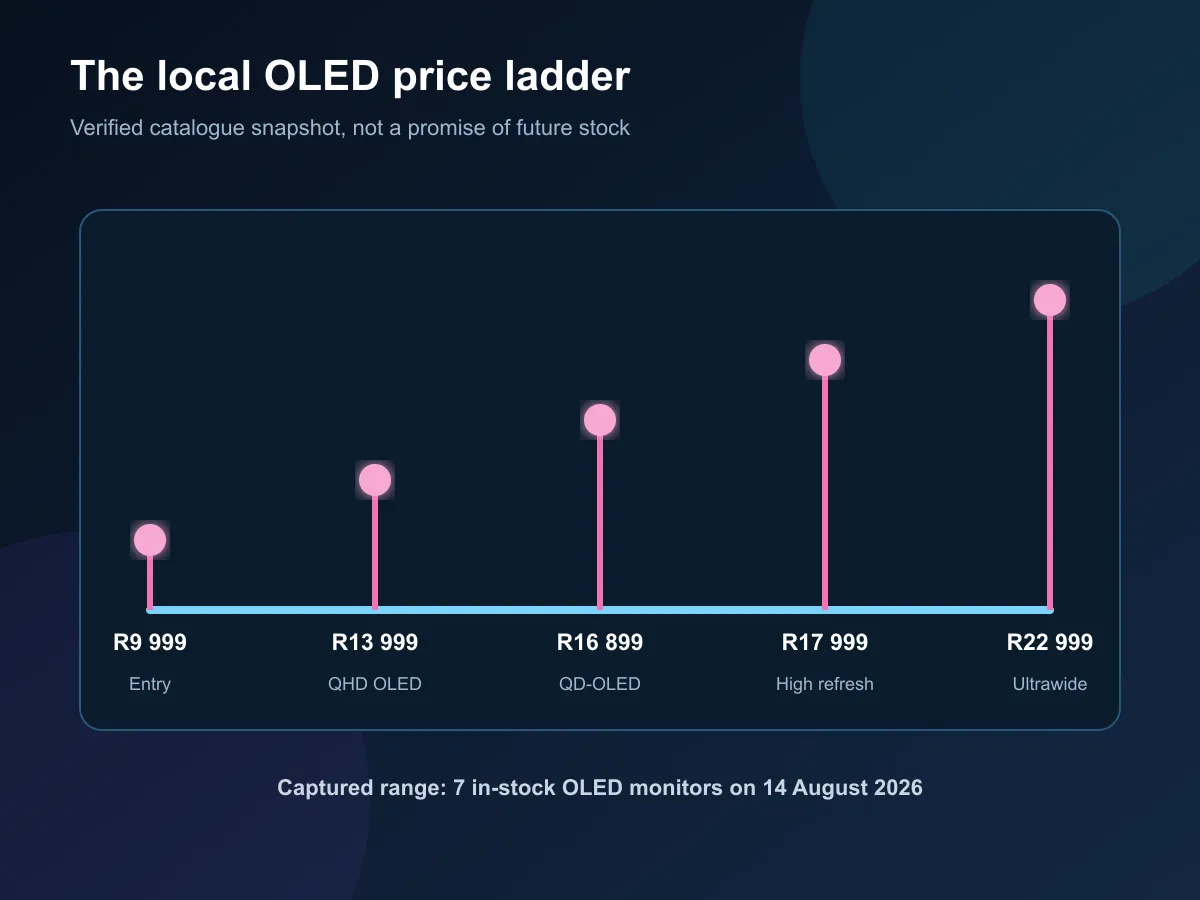
The global growth figure does not mean every OLED monitor is suddenly affordable. It means more models and panel choices are competing for attention. The local snapshot illustrates that spread: an entry 27-inch QHD WOLED appeared at R9,999, while other QHD OLED options climbed through R13,999, R16,899 and R17,999 before larger or 4K models reached higher prices.
More choice can also make names confusing. OLED is the broad display technology. WOLED and QD-OLED are different panel approaches with their own colour, brightness and text-rendering characteristics. A buyer should read the exact panel line instead of assuming that every product carrying the OLED label behaves identically.
🖥️ Match the panel to the PC
Refresh rate only helps when the system can supply enough frames. A 240Hz or 280Hz QHD panel pairs naturally with a strong gaming PC, but less demanding hardware may gain more from image quality than from the top refresh number. A 480Hz model targets a narrower competitive use case and requires the right games and settings to show its advantage.
Resolution creates a similar trade. QHD is a sensible middle ground for 27 inches. A 4K OLED can provide finer detail for creation and slower games, but it asks more from the graphics card. Ultrawide models add immersion and workspace, while also increasing the pixel load and requiring more desk width.
Do not ignore ordinary ownership questions. Confirm the warranty terms that apply to the exact unit, the port mix for the PC and console devices, stand adjustment, VESA support and any panel-care features. Check whether the screen will be used for static office windows all day or mostly changing game and video content. The right answer depends on the usage pattern, not the shipment trend.
💵 Read the local price ladder carefully
The lowest captured row was the AOC Q27G41ZDP, a 27-inch QHD WOLED at R9,999. The AOC Agon Pro AG276QZD2 appeared at R13,999, the ASUS ROG Strix XG27ACDMS at R16,899 and the LG UltraGear 27GX790A at R17,999. The top of the seven-row snapshot reached R22,999 for a 34-inch Samsung Odyssey G8 OLED.
Those are timestamped prices, not a promise that every model will remain in stock or at the same amount. They do show that an OLED decision can no longer be reduced to one premium number. A buyer can choose between a lower entry point, a faster refresh rate, 4K detail, portability or an ultrawide shape.
Start with the full monitor range to see how OLED compares with other panel types. Use the dedicated OLED monitor selection for current models, and check monitor specials before fixing the budget.
🧭 Buy for the use, not the growth chart
Shipment growth is evidence that OLED is reaching more buyers, not proof that it is right for every desk. Choose it for contrast, fast pixel response and the exact gaming or media experience you value. Stay with another panel type when price, very bright-room use or heavy static desktop work matters more.
Measure the desk, list the devices, set a real rand ceiling and decide the target resolution before comparing model names. That order prevents a headline refresh rate from pulling the purchase away from the needs that will be felt every day.
Frequently Asked Questions
How fast did OLED monitor shipments grow?
The reported 2Q26 increase was 26.1% quarter on quarter and 98% year on year.
Which OLED monitor size is driving demand?
The market report identifies 27-inch QHD models as the dominant segment supporting adoption.
How much does an OLED monitor cost locally?
Our 14 August snapshot found seven in-stock models from R9,999 to R22,999.
Is QD-OLED the only OLED monitor type?
No. The local rows included both QD-OLED and WOLED models, so panel type still needs checking.
Does a higher refresh rate always matter?
It matters most when the PC and games can deliver matching frame rates; resolution, warranty and use case also count.
Should buyers wait for prices to fall?
Wait if the current range misses your budget or warranty needs; buy when a verified model fits both use and price.
Ready to move to OLED? Compare the current panel types, resolutions and refresh rates, then choose the screen that fits your PC, room and rand limit.