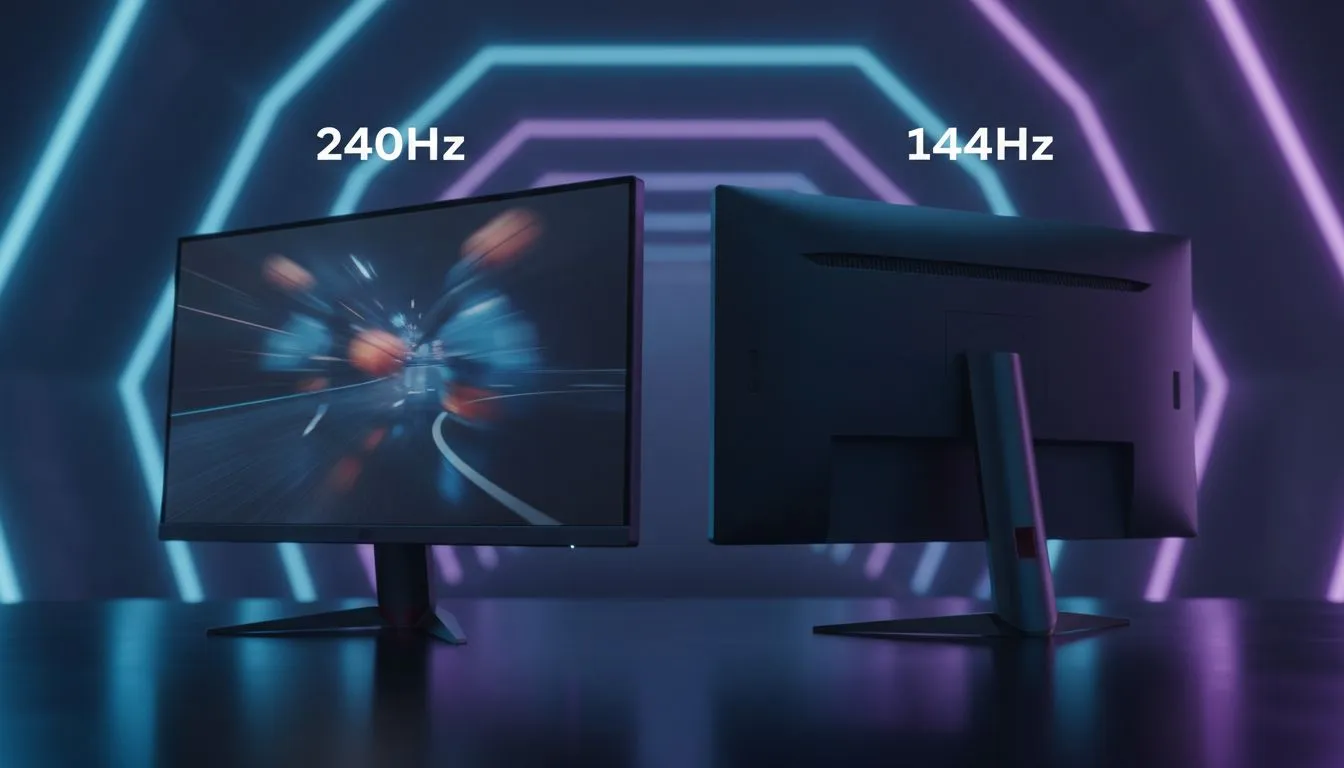
Understanding the 240Hz vs 144Hz Debate
You are holding a tight angle in a frantic match. Suddenly, an opponent swings wide. You click, but you miss... was it your aim or your screen? In South Africa, competitive gaming is growing fast. Choosing between 240Hz vs 144Hz can feel like a massive decision. Is that extra smoothness worth the ZAR investment? Let's break down if you can actually feel the dribbling difference during high-stakes play. ⚡
The primary difference lies in the refresh rate. A 144Hz screen refreshes 144 times every second. Moving to 240Hz increases this to 240 times. While the jump from 60Hz to 144Hz is massive, the move to 240Hz is more subtle. You can find some of the best PC monitor deals in South Africa that cater to both brackets.
Does the Extra Speed Matter for You?
For most casual players, 144Hz is the sweet spot. It offers fluid motion and a clear view of the action. However, professional esports athletes swear by 240Hz. It reduces "motion dribble" or ghosting. This is where the image appears to trail behind moving objects. When browsing through various PC monitors, you will notice that 240Hz panels often carry a premium price tag.
The visual difference is about frame time. At 144Hz, a new frame appears every 6.9 milliseconds. At 240Hz, that drops to 4.1 milliseconds. This tiny gap can be the difference between seeing a head peek or hitting a wall. Many gaming monitors now feature technologies like ELMB to further sharpen these transitions.
Performance Pro Tip ⚡
To truly feel the benefit of 240Hz, your PC must consistently output 240 frames per second. If your GPU only hits 150 FPS, a 240Hz monitor won't look much different from a 144Hz one. Always check your benchmarks before upgrading your display.
Form Factor and Resolution Choices
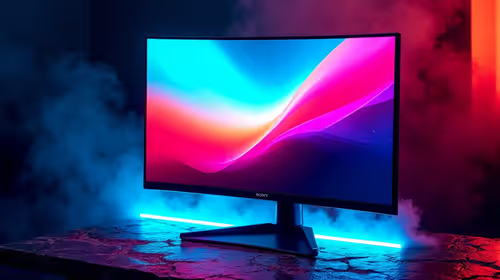
Screen shape also plays a role in how you perceive speed. Some players prefer the wrap-around feel of curved monitors to keep the edges of the screen in their peripheral vision. This can help you spot movement faster during intense firefights. 🚀
If you travel to local LAN events, you might even consider portable monitors. These are getting faster every year, bringing high refresh rates to a compact form factor. However, if you value visual fidelity over raw speed, you might look toward 5K and 4K monitors. Just remember that pushing 240Hz at 4K requires a monster of a graphics card.
Final Touches for Your Setup
Don't forget the ergonomics of your desk. High-speed gaming requires stability. Investing in quality monitor accessories like gas-spring arms can help you position your screen perfectly. This reduces neck strain during long sessions. ✨
Ultimately, the 240Hz vs 144Hz choice depends on your budget and your goals. If you are climbing the ranks in Valorant, the extra frames are a logical step. If you prefer cinematic adventures, 144Hz is more than enough.
Ready to Find Your Perfect Match? The 240Hz vs 144Hz debate is personal, but for the best speed, choice, and value in South Africa, Evetech has you covered. Explore our massive range of gaming monitors and find the perfect display to dominate your next match.