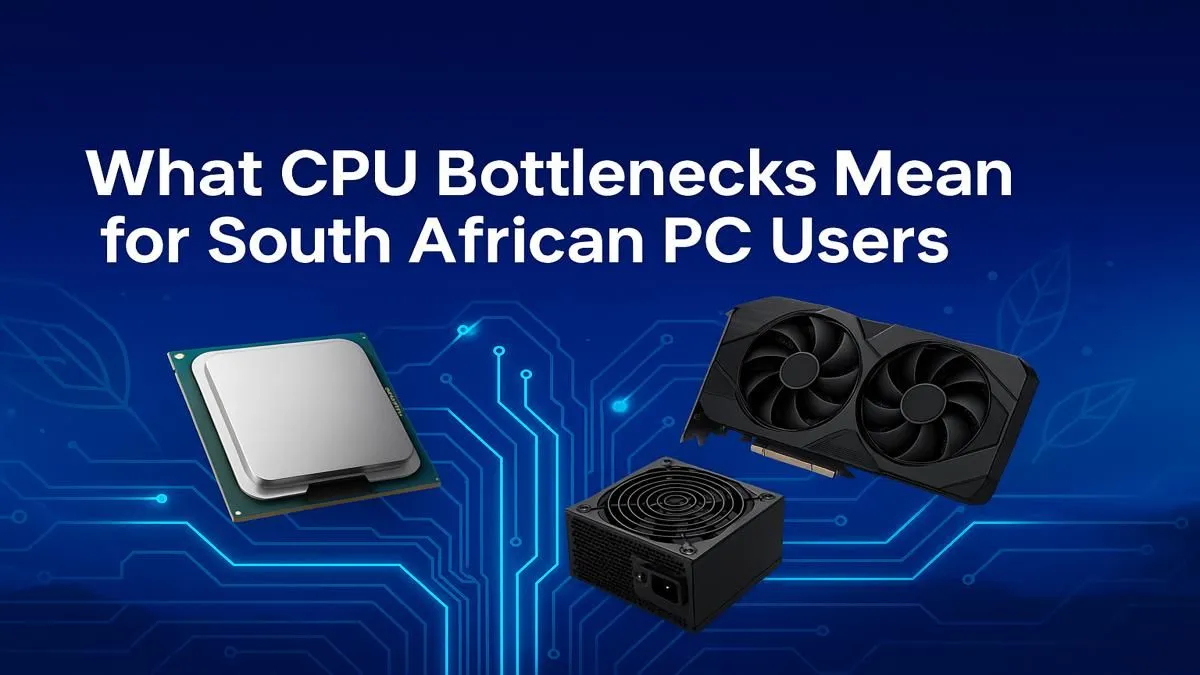
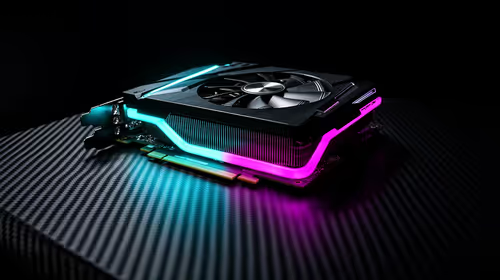
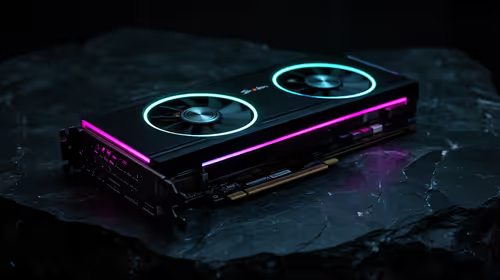
Ever feel like your beastly new graphics card isn't delivering the frame rates you were promised in South Africa? You're dropping frames in Apex Legends or stuttering in Helldivers 2, but your GPU is barely breaking a sweat. The culprit is often a silent performance killer… a CPU bottleneck. This frustrating issue happens when your processor can't keep up with your graphics card, leaving your expensive hardware's potential untapped. Let's fix that.
Understanding the CPU Bottleneck Phenomenon
So, what exactly is a CPU bottleneck? 🤔 Think of your PC as a team. Your CPU is the team captain, figuring out the game plan (physics, AI, game logic), while your GPU is the star player executing the visual plays (rendering graphics). If the captain can't issue instructions fast enough, the star player is left waiting around, unable to perform at their peak. Your game's performance is "bottlenecked" by the slowest component in the chain… in this case, the CPU.
This doesn't mean your CPU is "bad." It simply means there's an imbalance. A powerful, brand-new GPU paired with a CPU that's a few generations old is a classic recipe for a CPU bottleneck, especially at lower resolutions like 1080p where the processor has to work harder.
Is Your PC Suffering from a CPU Bottleneck?
Before you rush out to buy a new processor, you need to confirm that a CPU bottleneck is actually your problem. Luckily, there are a few simple tests you can run. The goal is to see which component hits its performance ceiling first.
The In-Game Monitoring Test 🔧
This is the most reliable method.
- Download and run a monitoring tool like MSI Afterburner with the RivaTuner Statistics Server (it's free!).
- Fire up a demanding game where you're experiencing poor performance.
- Play for a few minutes and watch your stats.
If you see your CPU usage consistently hitting 90-100% while your GPU usage is sitting much lower (e.g., 60-70%), you've found your bottleneck. Your GPU has power to spare, but it's waiting on the CPU to feed it data.
Quick Check with Task Manager ⚡
For a less detailed but super fast check, simply open the Windows Task Manager (Ctrl+Shift+Esc) to the Performance tab while your game is running in windowed mode. If one or more of your CPU cores are maxed out while your GPU is chilling, it's a strong indicator of a CPU bottleneck.
The Resolution Drop Test
Another great test involves changing your game's graphics settings. Turn your resolution down from 1440p to 1080p, or from 1080p to 720p. If your frames-per-second (FPS) barely increase, it's a massive sign that your CPU is the limiting factor. A powerful GPU should see a huge FPS jump at lower resolutions, but if the CPU can't process the frames faster, you won't see that improvement.
Upgrading Your Way Out of a CPU Bottleneck
If you've confirmed a CPU bottleneck is holding your rig back, the most effective solution is an upgrade. Solving this performance issue means finding a processor that can keep pace with your graphics card and gaming ambitions. Browsing the latest CPU processors available online is a great first step to see what's new on the market and get a feel for current tech.
When choosing, consider your primary use case. For gamers prioritising blistering frame rates in esports titles, the powerful single-core performance found in many modern Intel CPUs is often the ideal choice to feed a high-end graphics card without breaking a sweat. 🚀
On the other hand, if you're a streamer, content creator, or someone who loves complex strategy games that utilise many cores, the exceptional multi-threaded performance of current-gen AMD CPUs could be the perfect upgrade to crush that bottleneck and unlock smooth, responsive performance across all your tasks.
Ultimately, balancing your components is key to getting the performance you paid for. A well-matched CPU and GPU is the foundation of a great gaming experience in South Africa.
Ready to Unleash Your PC's True Potential?
A CPU bottleneck can be frustrating, but the fix is within reach. A balanced system is a powerful system. Explore our massive range of CPUs and find the perfect processor to eliminate lag and conquer your game.