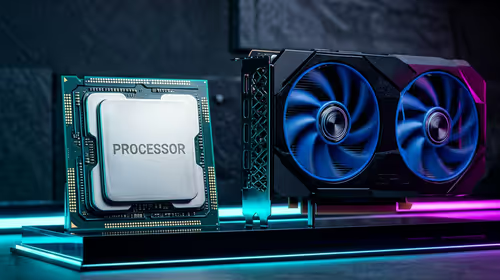
Is your high-end graphics card feeling... underwhelming? You’ve dropped some serious ZAR on a new GPU, but your frame rates in Apex Legends or Warzone are still stuttering and inconsistent. Before you blame the GPU, there’s a good chance the real culprit is your processor. This guide will walk you through a simple CPU bottleneck test, helping you diagnose performance issues and get your rig running smoothly. Let's get your PC optimised. 🚀
Understanding the CPU Bottleneck
So, what exactly is a CPU bottleneck? Think of your PC as a production line. Your CPU (Central Processing Unit) prepares data frames for your GPU (Graphics Processing Unit) to render and display on your screen. If your GPU is a high-speed machine ready to process 200 items per minute, but your CPU can only prepare 100, your powerful GPU will spend half its time waiting. That frustrating performance gap is a CPU bottleneck.
Your processor simply can't keep up, leaving your expensive graphics card's potential untapped. This is especially common in CPU-intensive games like strategy titles or open-world sandboxes with complex physics and AI.
How to Run a CPU Bottleneck Test 🔧
The easiest way to check for a CPU bottleneck is by monitoring your component usage while in-game. It’s free, quick, and gives you clear data.
Step 1: Download Your Tools
You'll need a monitoring tool that can display an on-screen overlay in your games. We recommend MSI Afterburner, which comes bundled with the RivaTuner Statistics Server (RTSS). It’s the go-to for gamers and works with any brand of hardware, not just MSI.
Step 2: Configure the On-Screen Display (OSD)
Once installed, open MSI Afterburner's settings.
- Go to the "Monitoring" tab.
- Find and select "GPU usage" in the list, then tick the "Show in On-Screen Display" box below.
- Do the same for "CPU usage" (the overall percentage).
- For a more detailed view, also enable OSD for each individual CPU core (e.g., "CPU1 usage", "CPU2 usage", etc.).
- Click "Apply" and "OK".
Check Per-Core Usage! ⚡
Many games, especially older ones, don't use all your CPU cores effectively. Your overall CPU usage might look fine at 50%, but if one or two cores are hitting 100%, that's your bottleneck right there. Always monitor individual core performance for the full picture.
Step 3: Start Testing in-game
Now for the fun part. Fire up a game where you're experiencing poor performance.
- Lower your graphics settings: Drop the resolution to 1080p and set the main graphics presets to "Low" or "Medium". This reduces the load on the GPU, demanding more from the CPU. It's the perfect way to expose a processor limitation.
- Find a demanding scene: Load into a busy area of the game—a crowded city, a massive team fight, or a physics-heavy explosion.
- Watch the numbers: Look at the OSD in the corner of your screen.
Analysing Your Test Results
The data from your OSD will tell you everything you need to know.
- Clear CPU Bottleneck: If your CPU usage is consistently high (95-100%) while your GPU usage is sitting much lower (e.g., 60-80%), you've found your problem. Your CPU is maxed out and can't feed the GPU data fast enough. This is your sign that it might be time to look at upgrading your CPU processor.
- GPU Bottleneck (The Ideal Scenario): If your GPU usage is at or near 99-100% while your CPU usage has plenty of headroom, congratulations! Your system is well-balanced, and you're getting the most out of your graphics card.
- It's Complicated: Sometimes, both might be below 90%. This could point to a game engine limitation, a RAM bottleneck, or poorly optimised game code.
If your CPU bottleneck test confirms your processor is holding you back, the best solution is an upgrade. For gamers, a modern processor from either the latest Intel CPU lineup or the powerful AMD CPU range can make a world of difference, unlocking smoother frame rates and a much better gaming experience. ✨
Ready to Unleash Your GPU's Full Power?
A CPU bottleneck can cripple your gaming rig. Don't let an old processor hold your new graphics card back. Explore our massive range of CPUs and find the perfect match to get your frame rates soaring.