Navigating the Memory Maze
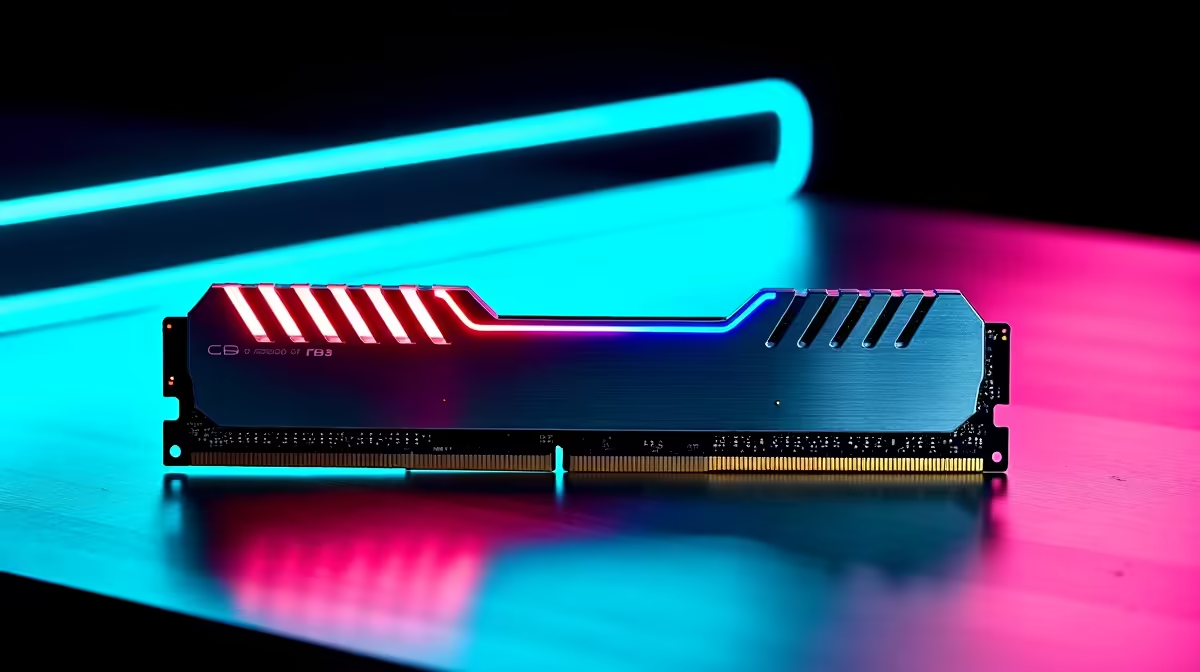
Building a new rig in South Africa means making tough choices. You have your processor and graphics card sorted... but what about memory? Choosing between DDR5 4800 vs 5600 vs 6000 vs 8000 can feel overwhelming. Does faster memory actually give you more frames per second, or is it just a marketing trick? Let us break down exactly how fast your RAM should be to maximise your ZAR and boost performance.
The Baseline Experience (4800MHz to 5600MHz)
When DDR5 first launched, 4800MHz was the standard. It is perfectly fine for basic office tasks and entry-level gaming. However, modern processors crave much more bandwidth to perform at their peak. Stepping up to 5600MHz offers a noticeable bump in overall system responsiveness.
If you are browsing laptops for sale in South Africa, you will notice many premium models now feature 5600MHz memory. It hits a brilliant sweet spot for mobile performance... giving you snappy speed without draining your battery life too quickly.
The Sweet Spot for Gamers 🚀 (6000MHz)
For desktop users, 6000MHz is currently the absolute gold standard. AMD Ryzen 7000 series and Intel Core 14th Gen chips absolutely love this specific speed. It provides the perfect balance of low latency and high bandwidth without breaking the bank.
If you want to buy memory for a custom build, 6000MHz CL30 kits offer incredible value for your hard-earned Rands. You will often find this exact speed featured in our top-tier gaming PC deals. Why? Because it delivers stable, high frame rates in demanding titles like Cyberpunk 2077 or Apex Legends. The performance leap from 4800MHz to 6000MHz is significant... often netting you up to a 10% increase in 1% low frame rates for smoother gameplay.
Motherboard Compatibility Tip 🔧
Always check your motherboard's QVL (Qualified Vendor List) before buying high-speed RAM. Just because a kit is rated for 8000MHz does not mean your specific board and CPU can run it stably at those speeds without manual BIOS tweaking.
The Enthusiast Tier ✨ (8000MHz and Beyond)
So, who actually needs 8000MHz? This ultra-fast tier is strictly reserved for extreme overclockers and hardware enthusiasts. Pushing memory to 8000MHz requires a premium motherboard and a CPU with an exceptional memory controller.
While the benchmark numbers look amazing on paper, the real-world gaming gains over 6000MHz are surprisingly minimal. Unless you are chasing world benchmarking records, your ZAR is much better spent on a faster graphics card or a larger NVMe SSD.
Making the Right Choice for Your Build
Ultimately, your choice in the DDR5 4800 vs 5600 vs 6000 vs 8000 debate depends entirely on your budget. 6000MHz remains the most sensible target to optimise new desktop builds for gaming.
If you prefer a plug-and-play experience without worrying about EXPO or XMP profiles, exploring pre-built PC deals is a great way to ensure your system arrives perfectly tuned. And if you are hunting for a massive bargain, keeping a close eye on our specials can help you snag high-speed memory kits at a fraction of the normal cost.
Ready to Supercharge Your System? ⚡ Upgrading your memory is one of the easiest ways to boost your PC's performance. Whether you need reliable 5600MHz for work or blazing-fast 6000MHz for competitive gaming, Evetech has you covered. Explore our massive range of memory specials and find the perfect DDR5 kit to conquer your world.