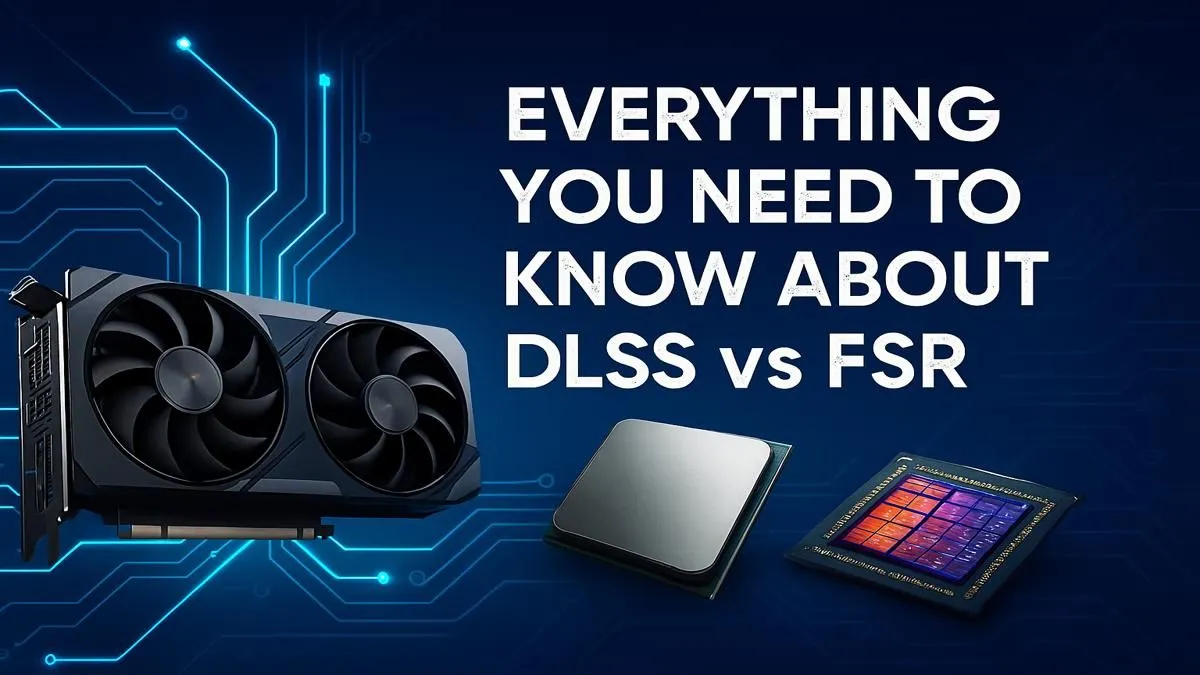
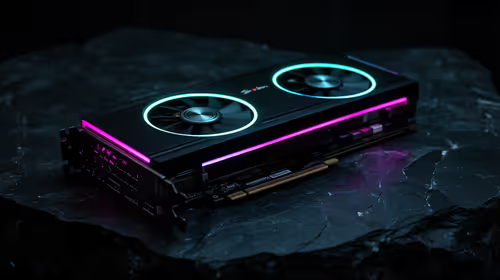
Chasing buttery-smooth frame rates in Mzansi but your GPU is sweating under 4K pressure? You're not alone. The solution might be upscaling, but that brings a big question for your next build: DLSS vs FSR? These clever technologies from NVIDIA and AMD promise more performance for free… but which one delivers the best experience for your gaming PC? Let's break it down so you can make the smart choice. 🚀
Understanding the DLSS vs FSR Showdown
Before we pick a side, what are we even talking about? Both DLSS and FSR are "upscaling" technologies. In simple terms, they let your graphics card render a game at a lower resolution (like 1080p) and then use smart algorithms or AI to stretch that image up to your monitor's native resolution (like 4K).
The result? A massive boost in frames per second (FPS). The challenge? Doing it without making the game look like a blurry mess. This is where the core differences in the DLSS vs FSR battle lie.
A Closer Look at NVIDIA's DLSS
NVIDIA's Deep Learning Super Sampling (DLSS) is the AI-powered option. It uses dedicated hardware called Tensor Cores, found exclusively on NVIDIA GeForce RTX graphics cards, to reconstruct the image. By training an AI on super-high-quality offline renders of a game, DLSS can often produce an image that is as sharp, or sometimes even sharper, than the native resolution. ✨
- Key Advantage: Generally considered the gold standard for image quality, especially with its latest versions like DLSS 3.5 which includes Ray Reconstruction.
- Key Disadvantage: It's a closed ecosystem. You need a specific NVIDIA RTX GPU to use it.
Breaking Down AMD's FSR
On the other side, we have AMD's FidelityFX Super Resolution (FSR). FSR's biggest selling point is that it's open-source. It doesn't require specialised AI hardware. Instead, it uses advanced spatial upscaling algorithms that can run on a huge variety of hardware, including the latest AMD Radeon GPUs, older NVIDIA cards, and even Intel's Arc GPUs.
- Key Advantage: Incredible hardware compatibility. If you have a gaming PC, FSR will probably work.
- Key Disadvantage: While FSR 2 and 3 have made huge leaps, some gamers feel its image quality can be slightly softer than DLSS in direct comparisons.
Pro Gamer's Tip 💡
Can't decide? YouTube is your best friend. Search for "[Your Game] DLSS vs FSR [Your GPU]" to find direct side-by-side video comparisons. Seeing the tech in motion on hardware similar to yours is the ultimate way to judge visual quality and performance gains before you commit.
DLSS vs FSR: Which is Right for You?
So, how do you choose? The decision in the DLSS vs FSR debate often comes down to one simple factor: the graphics card in your rig.
If you own (or want) an NVIDIA RTX Card...
You have the luxury of choice. You can use DLSS in supported titles for potentially the best image quality. You can also use FSR in games that don't support DLSS. For NVIDIA users, DLSS is almost always the go-to option when available.
If you own an AMD card or an older NVIDIA card...
FSR is your champion. It brings modern performance-boosting tech to a massive range of hardware, giving your trusted GPU a new lease on life. It's an incredible piece of software that ensures no gamer is left behind.
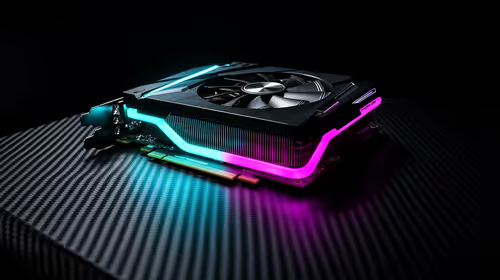
Ultimately, both technologies are fantastic for South African gamers. They allow us to push higher resolutions and settings without needing to spend a fortune on the absolute top-tier card. When you're ready to upgrade, knowing which "team" you're on can help you narrow down your choices when you check out the latest graphics card deals.
Ready to Boost Your FPS?
The DLSS vs FSR debate is all about getting the most from your hardware. Whether you're leaning towards NVIDIA's AI magic or AMD's open-source power, the right GPU is your first step to higher frame rates. Explore our incredible graphics card deals and find the perfect engine for your gaming rig.