You’re in the final circle in Apex, the tension is thick… and then it happens. A jagged, horizontal line rips across your screen, shattering your immersion. Screen tearing is the worst. You paid for a high-refresh-rate monitor with FreeSync or G-Sync specifically to avoid this, right? Don't stress, boet. This guide covers the essential FreeSync G-Sync troubleshooting steps to get your games running buttery-smooth again on your South African gaming rig. Let's get it sorted. 🔧
Understanding Why Screen Tearing Happens
Before we dive into the fixes, let's quickly understand the problem. Screen tearing occurs when your graphics card (GPU) sends out frames at a different rate than your monitor can display them. The monitor tries to show two or more different frames at once, resulting in that ugly horizontal split.
Adaptive Sync technologies like AMD's FreeSync and NVIDIA's G-Sync were designed to solve this. They allow the monitor to dynamically adjust its refresh rate to match the GPU's output, creating a seamless visual experience. Most modern PC monitors support one or both. So, when it's not working, it's usually down to a settings mismatch.
Common Causes for FreeSync & G-Sync Issues
If you're still seeing tearing, your FreeSync G-Sync troubleshooting journey starts here. The culprit is often one of these simple, overlooked settings.
### Driver and Panel Settings Mismatch
The most common issue is that the feature simply isn't enabled in all the right places. You need to activate it in three locations:
- On the Monitor Itself: Dive into your monitor's On-Screen Display (OSD) menu (using the buttons on the monitor) and ensure FreeSync or G-Sync is turned on.
- In the GPU Control Panel: For NVIDIA, open the NVIDIA Control Panel and go to "Set up G-SYNC". For AMD, open Radeon Software and check the "Gaming" > "Display" tab.
- In Windows: Make sure your display is set to its highest possible refresh rate in Windows' Advanced Display Settings.
### Conflicting In-Game Settings
Sometimes, a game's own graphics settings can clash with your driver-level settings. The old V-Sync option is a frequent offender. While it also prevents tearing, it can introduce input lag and doesn't play nicely with the more advanced adaptive sync technologies.
### Faulty or Incorrect Cables
Believe it or not, your cable matters. For G-Sync and many FreeSync implementations to work correctly, a DisplayPort cable is required. While some newer monitors support Adaptive Sync over HDMI, DisplayPort is the gold standard. A low-quality or damaged cable can also fail to transmit the necessary data, causing flickering or preventing the feature from working at all. Investing in quality monitor accessories is never a bad idea.
Your Step-by-Step Guide to Fix Screen Tearing
Ready to banish tearing for good? Follow these steps in order. This process for fixing FreeSync and G-Sync problems works for the vast majority of cases in SA. ✨
- Update Everything: Before you do anything else, update your graphics drivers to the latest version from the NVIDIA or AMD website. While you're at it, check if your monitor manufacturer has a specific driver or firmware update available.
- Item
- Item
The Golden Rule of FPS Caps ⚡
To get the absolute best performance from G-Sync or FreeSync, cap your in-game framerate (FPS) to 3-5 frames below your monitor's maximum refresh rate. For a 144Hz monitor, set your cap to 141 FPS. This ensures the adaptive sync technology is always active and prevents it from hitting its ceiling, which can introduce latency or tearing.
- Test and Verify: Many NVIDIA and AMD drivers have a built-in demo or pendulum test to show you if G-Sync or FreeSync is active. Use this to confirm your settings are working before launching a game. This is a crucial final step in any FreeSync G-Sync troubleshooting process.
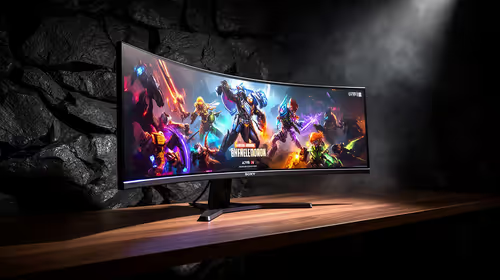
If you've followed these steps and are still facing issues, it might be a hardware compatibility problem, or perhaps it's a sign that your older gear is struggling to keep up with demanding new titles on those stunning 4K monitors or immersive curved monitors. Even a secondary display, like one of those handy portable monitors for Discord, can sometimes cause conflicts if not set up correctly.
When is it Time for an Upgrade? 🚀
Troubleshooting can solve most software issues, but it can't fix old hardware. If your monitor is a few years old or wasn't designed with high-performance gaming in mind, you might be fighting a losing battle. Newer displays offer better response times, higher refresh rates, and more reliable adaptive sync technology across all our gaming monitors.
If you've spent hours trying to fix screen tearing to no avail, upgrading your monitor might be the quickest and most effective solution. It's often the final piece of the puzzle for a perfect gaming setup. Before you pull your hair out, it's worth taking a moment to check out the latest monitor deals to see what a new screen could offer.
Ready for a Tear-Free Future? Sometimes the best fix is a fresh start. If you're tired of troubleshooting and just want that silky-smooth gameplay out of the box, we've got you covered. Explore our massive range of gaming monitors and find the perfect screen to conquer your world.