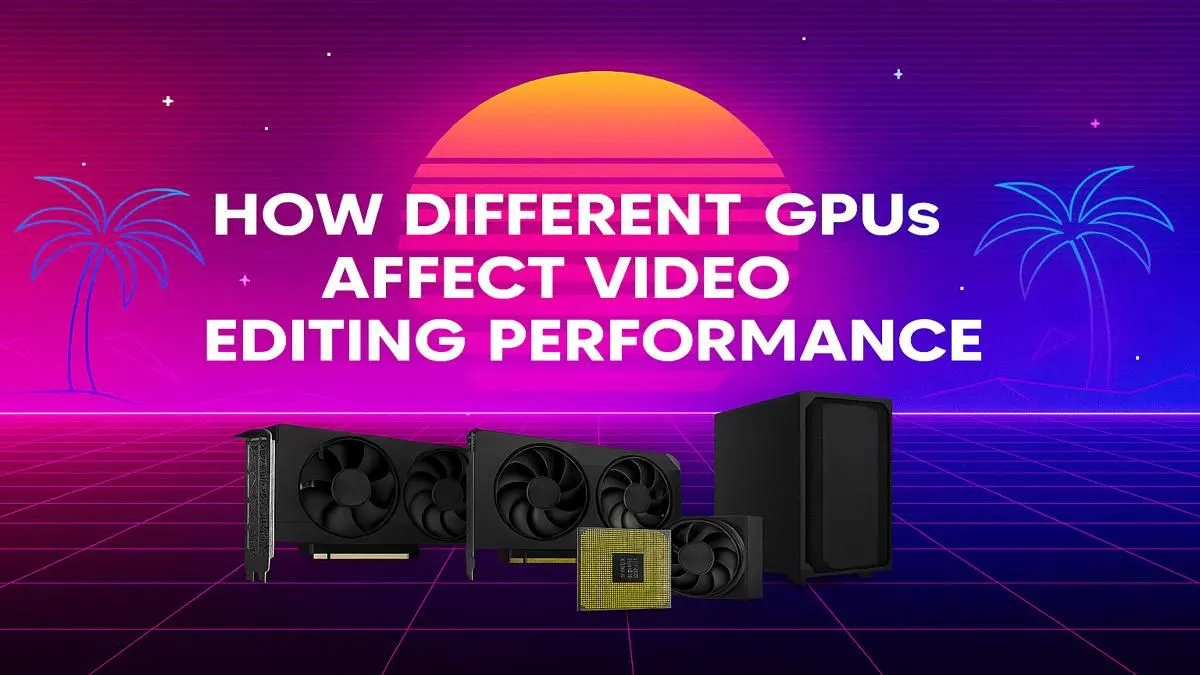
Staring at a render bar that moves slower than traffic on the N1? Or maybe your 4K timeline stutters more than a nervous first date? You’re not alone. Many South African creators battle with sluggish performance, not realising the bottleneck is their graphics card. Choosing the right GPU for video editing isn’t just about gaming… it’s about reclaiming your time and unlocking your creative flow. Let's dive into how performance dramatically changes with your card. 🚀
Why Your GPU is a Video Editing Powerhouse 🎬
Long gone are the days when your CPU did all the heavy lifting. Modern video editing software like Adobe Premiere Pro and DaVinci Resolve is built to leverage the immense parallel processing power of a graphics card. This is called GPU acceleration.
It offloads intensive tasks like rendering, applying effects, colour grading, and even playback from the CPU to the GPU. The result? A much smoother, more responsive editing experience. NVIDIA's CUDA technology, in particular, is widely supported across the industry, giving their graphics cards a strong advantage in many creative apps found in our range of NVIDIA GeForce gaming PCs.
Key GPU Specs That Actually Matter for Editing
When you're comparing cards, it's easy to get lost in technical jargon. For video editing, these are the three specs that have the biggest impact on your daily workflow.
VRAM (Video RAM)
Think of VRAM as your GPU's dedicated, ultra-fast workspace. Editing a simple 1080p video doesn't require much, but as you move to 4K or 8K resolutions, add multiple layers, and apply complex visual effects, your VRAM usage skyrockets. Running out of VRAM is what causes that frustrating, choppy playback on your timeline.
- 1080p Editing: 6-8GB of VRAM is sufficient.
- 4K Editing: 10-12GB is the sweet spot for a smooth experience.
- 8K & Heavy VFX: 16GB or more is highly recommended.
Processing Cores & Hardware Encoders
The number of processing cores (called CUDA Cores on NVIDIA cards and Stream Processors on AMD cards) directly influences how quickly your GPU can process information. More cores mean faster rendering and quicker application of GPU-accelerated effects.
Equally important are the dedicated hardware encoders, like NVIDIA's NVENC and AMD's AMF. These specialised chips handle the process of exporting your video into formats like H.264 or H.265, freeing up the rest of your system. While NVIDIA often leads in encoder quality and speed, modern AMD Radeon gaming PCs offer incredible value and raw performance, especially in GPU-heavy apps like DaVinci Resolve.
Editing Pro Tip 🔧
Struggling with 4K playback on your current setup? Use proxies! Most editing software (like Premiere Pro and DaVinci Resolve) can create low-resolution copies of your media for smooth editing. When you're ready to export, the software automatically switches back to the original high-quality files. It's a simple trick to make any machine feel faster.
Performance Scaling: From Hobbyist to Pro
The right GPU for video editing depends entirely on your needs and budget. A balanced system is always the goal.
A mid-range GPU delivers a fantastic 4K editing experience without costing a fortune, especially when paired with a powerful multi-core CPU. Building a system around a solid processor is key, and the options available in these all AMD Ryzen PC deals offer exceptional multi-threaded performance for creative work.
For professionals pushing the limits with 8K RAW footage, complex motion graphics, or 3D integration, only the best will do. A top-tier GPU needs a CPU that won't hold it back, ensuring every bit of performance is utilised. High clock speeds and strong single-core performance are crucial here, making the processors in these all Intel PC deals excellent choices for a high-end editing rig.
Do You Need a Professional Workstation GPU? ✨
You might have heard of professional cards like NVIDIA's RTX Ada Generation (formerly Quadro) or AMD's Radeon Pro series. While incredibly powerful, they are optimised for specific scientific, architectural, and data science workloads with certified drivers.
For the vast majority of video editors in South Africa, a high-end consumer gaming GPU offers far better performance-per-Rand in Premiere Pro, DaVinci Resolve, and Final Cut Pro. However, if your specific workflow demands certified drivers for niche software or absolute 10-bit colour precision across your entire pipeline, exploring dedicated workstation PCs is a wise investment.
Ultimately, the goal is a balanced system where every component works in harmony. For those who want a powerful, optimised machine without the hassle of building it themselves, browsing expertly configured pre-built PC deals is a smart and efficient way to get started.
Choosing the right graphics card is an investment in your creativity. It’s not just about a faster render; it's about a smoother workflow, fewer frustrating lags, and more time spent creating instead of waiting. Your GPU is the engine of your visual storytelling… make sure it has the horsepower you need.