Ah, Hogwarts Legacy. One minute you’re soaring over the Black Lake, marvelling at the stunning castle reflections… the next, your PC sounds like it’s trying to cast Incendio on itself. Getting the game's beautiful ray-traced lighting to work without turning your gameplay into a slideshow is a real challenge. This Hogwarts Legacy ray tracing performance guide for 2025 is here to help you find that magical balance between breathtaking visuals and buttery-smooth frame rates.
What Ray Tracing Actually Does in Hogwarts Legacy
Before we start tweaking settings, let's quickly understand what we're aiming for. Ray tracing (RT) in Hogwarts Legacy isn't just one single effect; it's a suite of three demanding technologies that simulate how light behaves in the real world:
- Ray-Traced Reflections: Makes water, polished floors, and glass surfaces reflect their surroundings with incredible accuracy. This is what makes the Great Hall's floor gleam and the dungeons feel genuinely damp.
- Ray-Traced Shadows: Creates softer, more realistic shadows that diffuse naturally depending on the light source. Say goodbye to those hard, jagged shadow edges.
- Ray-Traced Ambient Occlusion: Adds depth and realism by calculating how ambient light is blocked by objects, creating subtle contact shadows where surfaces meet.
Turning these on is what gives the Wizarding World its next-gen feel, but it puts a massive strain on your graphics card. Achieving good Hogwarts Legacy ray tracing performance means knowing which settings to prioritise.
Optimising Your Settings for Peak RT Performance 🪄
Here’s the secret: you don’t need to crank everything to Ultra to get a fantastic experience. The key is smart optimisation, especially by using upscaling technology. Your goal is to offload some of the work from your GPU so it can focus on the heavy lifting of ray tracing.
Start with these baseline settings in the game's "Display Options" menu:
- Upscale Type: Set this to match your GPU. DLSS for NVIDIA, FSR for AMD, and XeSS for Intel.
- Upscale Mode: Start with "Quality" or "Balanced." The "Performance" modes can sometimes look a bit too soft, but they provide the biggest FPS boost.
- NVIDIA Reflex Low Latency: Turn this On if you have a GeForce card.
- Ray Tracing Quality: Set all three RT options (Reflections, Shadows, Ambient Occlusion) to "Medium" instead of "Ultra." The visual difference is often minimal during fast-paced gameplay, but the performance gain is significant.
The Upscaling Pro Tip ⚡
Upscaling tech like DLSS, FSR, and XeSS is non-negotiable for ray tracing. They render the game at a lower internal resolution and then use AI to cleverly upscale the image to your monitor's native resolution. This can boost your frame rate by 30-50% or even more, making smooth ray tracing possible on a wider range of hardware. Always use it!
The Right GPU for a Magical Experience in 2025
Even with optimised settings, ray tracing needs some serious hardware muscle. If your current card is struggling to keep up with the spells, it might be time for an upgrade.
NVIDIA: The Ray Tracing Champions
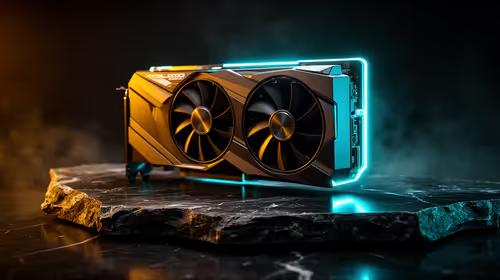
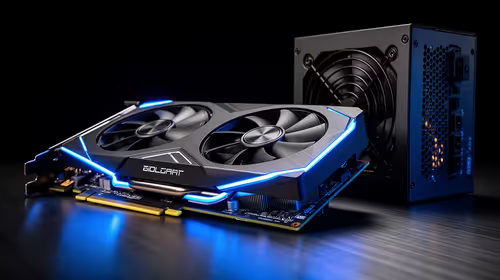
NVIDIA's RTX cards are still widely considered the top dogs for ray tracing, thanks to their dedicated RT Cores and the maturity of DLSS technology. For a solid 1080p or 1440p experience with medium RT settings, a card like the RTX 4060 is a fantastic starting point. If you're aiming for higher resolutions and frame rates, you'll want to look at the more powerful options in NVIDIA's latest GeForce cards. The raw power needed for high-fidelity RT often rivals that of professional workstation graphics cards, which shows just how demanding it is.
AMD & Intel: Strong Contenders
The competition is heating up, which is great news for South African gamers. Team Red has made huge strides, and modern AMD Radeon graphics cards paired with FSR 2 offer a compelling alternative for enjoying ray tracing in Hogwarts.
Similarly, Intel Arc graphics cards have become a brilliant budget-friendly choice, especially with their XeSS upscaling technology providing a massive performance uplift. They punch well above their weight in ZAR value. 🚀
Looking Ahead: What to Expect in 2025
As we move through 2025, we're looking forward to the next generation of GPUs. Upcoming cards, like the rumoured RTX 5060, are expected to offer even better ray tracing efficiency. This will make today's demanding visual features more accessible to everyone, ensuring that future adventures in the Wizarding World look even more spectacular.
Ready to Banish Stuttering Spells? Achieving smooth ray tracing in the Wizarding World isn't dark magic... it's about having the right hardware. Explore our massive range of gaming graphics cards and find the perfect GPU to cast Revelio on buttery-smooth frame rates.