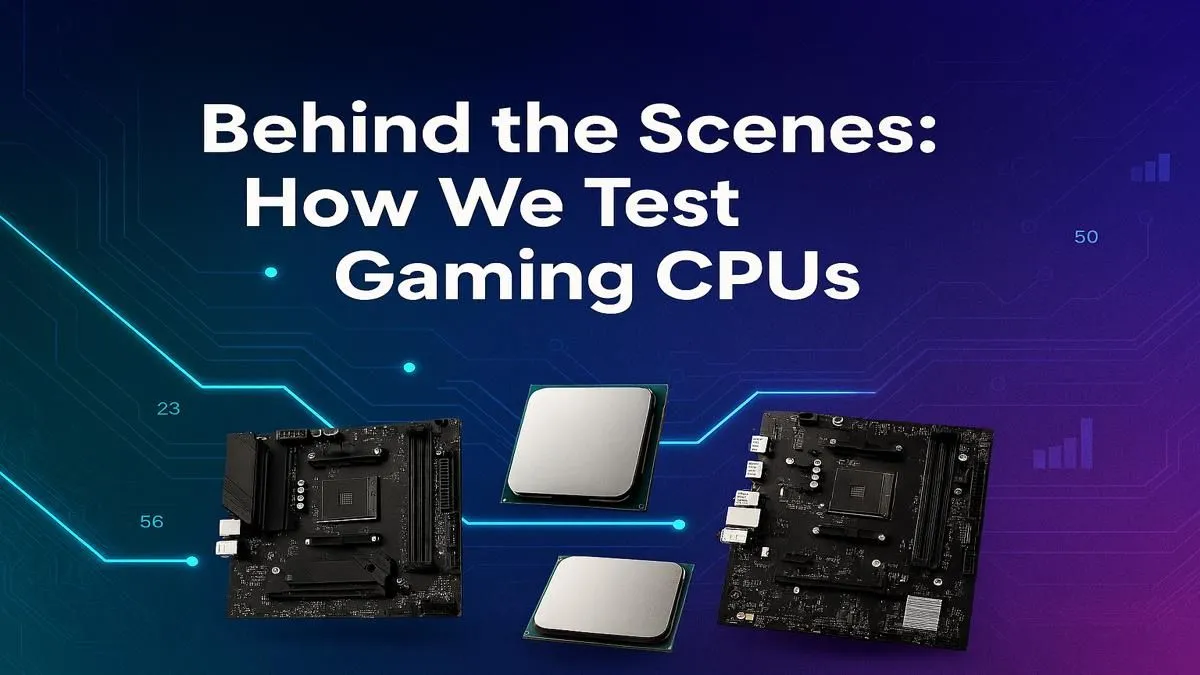
Ever stared at a dozen CPU spec sheets, wondering which one will actually stop that annoying stutter in your favourite battle royale? You're not alone. In a world of marketing hype and confusing numbers, knowing how to test gaming CPUs for real-world performance is crucial. It’s the difference between a smooth 144 FPS and a frustrating bottleneck. At Evetech, we go beyond the box specs to show you what truly matters. 🚀
Our Core Philosophy on Testing Gaming CPUs
Before a single benchmark is run, we start with a simple goal: to replicate the real-world conditions South African gamers face. Our entire process for testing gaming CPUs is built on consistency, fairness, and relevance. We're not chasing meaningless world records in sub-zero conditions. We want to know how a processor performs in a typical gaming rig, with standard cooling, running the games you actually play.
This means creating a level playing field where the only significant variable is the CPU itself. By keeping the GPU, RAM, and storage consistent across all tests, we can isolate the processor's true impact on frame rates, smoothness, and overall system responsiveness.
The Evetech Test Bench: A Controlled Environment
A reliable CPU test needs a rock-solid foundation. Our test bench is meticulously assembled with high-performance components that won't hold back even the most powerful processors. This ensures that when we test the latest Intel CPUs, we're measuring their raw potential, not the limits of a slow graphics card.
Our typical setup includes:
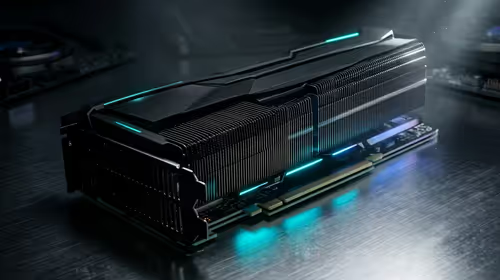
- A High-End Graphics Card: Usually a top-tier NVIDIA or AMD GPU to eliminate GPU bottlenecks, especially at 1080p where the CPU works hardest.
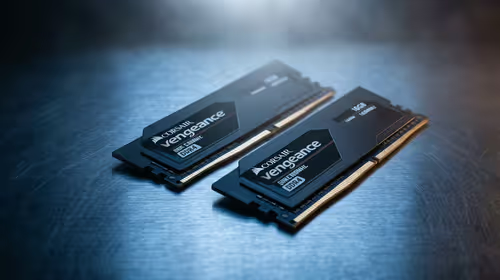
- Fast DDR5 RAM: A 32GB kit running at optimised EXPO or XMP profiles to feed the processor data without delay.
- NVMe Gen4 SSD: Games load in a flash, and test data is recorded instantly, ensuring nothing slows down the benchmark.
Whether we're putting one of the new powerful AMD CPUs through its paces or evaluating a budget-friendly option, the surrounding hardware remains the same. Consistency is key. ✨
Is Your CPU the Bottleneck? 🔧
A quick way to check is to lower your game's resolution to the minimum (e.g., 720p) while keeping texture settings high. If your frame rate (FPS) shoots up significantly, your GPU was likely the bottleneck. If the FPS barely changes, your CPU is probably the component holding you back at higher resolutions.
The Gauntlet: Gaming & Synthetic Benchmarks
This is where the magic happens. Our method for testing gaming CPUs involves a mix of synthetic benchmarks and, more importantly, a suite of popular video games.
Real-World Gaming Tests
We choose a variety of titles to get a complete picture of a CPU's performance profile. This includes:
- CPU-Intensive Titles: Games like Cyberpunk 2077 (in crowded areas) or strategy games that rely heavily on single-core speed and processing power.
- High-Refresh Rate Esports Games: Titles like CS:GO or Valorant, where achieving stable, ultra-high frame rates is the main objective.
- Graphically Demanding AAA Games: We test these to see how the CPU handles complex scenes and partners with the GPU.
For each game, we run a repeatable benchmark sequence multiple times to ensure the data is accurate, recording average FPS and, crucially, the 1% low frame rates.
Synthetic Benchmarks
While gaming is our focus, synthetic tests like Cinebench R23 are excellent for measuring a CPU's raw multi-core and single-core performance. This helps us understand its potential for productivity tasks like video editing or streaming alongside gaming.
Analysing the Results: What Really Matters
A pile of numbers is useless without context. When we analyse the data from our gaming CPU tests, we focus on what impacts your experience. Average FPS is great, but the 1% lows tell us about smoothness and stutter. A CPU with a slightly lower average FPS but much higher 1% lows will often feel significantly better to play on.
Ultimately, our in-depth process helps us guide you. It allows us to confidently recommend the best processor for your specific needs—whether you're a competitive esports player or a AAA enthusiast. Understanding this data is the first step in choosing the right CPU processor for your next build or upgrade.
Ready to Power Up Your Rig?
Understanding how to test gaming CPUs is the first step. The next is finding the perfect one for your budget and needs. Explore our massive range of CPU processors and build the rig you've always dreamed of.