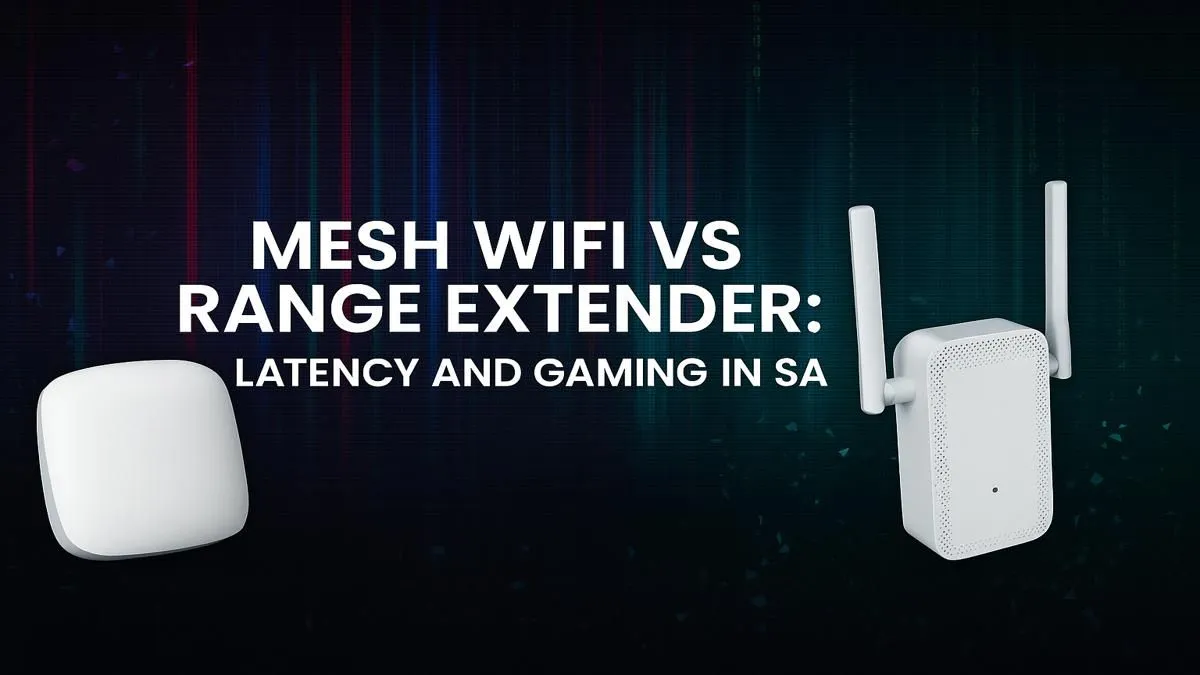
You've got fibre. You've got the beastly gaming rig from Evetech. But you're still getting bodied in Warzone because of lag spikes. What gives? Chances are, your WiFi signal is the culprit, especially in a typical South African home with brick walls. The big question is how to fix it. It's time for the ultimate showdown: Mesh WiFi vs a Range Extender for gaming. We’re diving deep into the latency test to see which one truly kills lag.
Understanding the Contenders: What’s the Difference?
Before we talk about pings and packets, let's quickly break down what these two solutions actually do. They both aim to extend your WiFi signal, but they go about it in vastly different ways, which has a massive impact on gaming performance.
The WiFi Range Extender: The Quick Fix 📶
A WiFi range extender, or repeater, is a simple, single device that captures the existing signal from your main router and rebroadcasts it. Think of it like a relay runner passing a baton. It's often the cheaper and quicker solution to a dead zone.
However, this simplicity comes with a big catch for gamers. By its very nature, a repeater creates a second network (often with "_EXT" at the end of the name) and has to "listen" then "talk," which effectively halves the potential bandwidth. This process introduces a delay... and in gaming, delay is death. While great for basic browsing in a dead spot, it's not ideal for competitive play. You can browse various wireless range extenders to see the options available.
The Mesh WiFi System: The Whole-Home Solution
A mesh WiFi system is a more modern and intelligent solution. It typically comes in a pack of two or three identical-looking nodes that you place around your home. Together, they create one single, seamless WiFi network. Your phone, console, or PC will automatically connect to the strongest node without you ever noticing.
The key difference in the mesh WiFi vs range extender for gaming debate is how mesh nodes communicate. They talk to each other using smart routing technology, often over a dedicated wireless channel (called a backhaul), to ensure data moves as fast as possible. This smart, multi-point approach is built for stability and speed. It’s why many premium wireless routers and mesh systems are becoming the standard for serious gamers.
Mesh WiFi vs Range Extender for Gaming: The SA Latency Test
Alright, let's get to the heart of the matter: latency, or "ping." This is the time it takes for data to travel from your PC to the game server and back. Lower is always better.
A range extender adds an extra "hop" for your data. Your PC sends the signal to the extender, the extender sends it to the router, and then the router sends it to the internet. This extra step, no matter how quick, adds milliseconds to your ping. In a fast-paced shooter, an extra 15-30ms of latency can be the difference between landing a headshot and staring at a respawn screen.
A well-configured mesh system is designed to minimise these hops. The nodes create the most efficient path for your data back to the main node connected to your fibre box. The handover between nodes is seamless, preventing the connection drops and stutters you often experience when moving around with an extender. For gaming, this means a more stable, consistent, and lower-latency connection, even if you’re gaming in the garage or a converted loft room.
Optimise Your Connection ⚡
with the best network, your PC's connection matters. If you're not using an Ethernet cable, ensure you have a modern WiFi 6 or 6E adapter. A high-quality [wireless adapter](https: www.evetech.co.za PC-Components buy-wireless-adapters-139) can significantly improve speed and reduce interference, giving your mesh system the best possible signal to work with.
So, Which One is Right for Your SA Home? 🤔
Deciding between a mesh system and a range extender comes down to your needs, your home's layout, and your budget.
Go for a Range Extender if...
- You're on a tight budget: They are significantly cheaper upfront.
- You have one specific dead zone: You just need to get a basic signal to a smart TV for Netflix or a laptop for emails.
- You are not a competitive gamer: If you're playing casual, turn-based games, the added latency might not be noticeable.
Invest in a Mesh WiFi System if...
- Low latency is your priority: For any serious online gamer, this is the number one reason to choose mesh.
- You live in a larger, double-storey, or thick-walled house: Mesh systems are built to blanket these challenging spaces with a strong, reliable signal.
- You have many smart devices: A mesh network handles multiple connections far more efficiently than a single router struggling with an extender.
- You value convenience: One network name, seamless roaming, and easy app-based management make life much simpler.
The Final Verdict: Investing in a Lag-Free Future 🏆
When it comes to the mesh WiFi vs range extender for gaming battle, the winner for South African gamers is clear. While a range extender can fill a gap on a budget, it’s a compromise that introduces the very thing you’re trying to eliminate: latency.
A mesh WiFi system is a true investment in your entire home network. It provides the stable, low-latency foundation that modern online gaming demands. It ensures that your fast fibre connection isn't being bottlenecked by poor signal distribution, giving you the competitive edge you paid for. To get the best results, you need a holistic approach to your home setup, considering everything from the router to the adapter, all available in a comprehensive wireless networking solution.
Ready to Banish Lag for Good?
The Mesh WiFi vs Range Extender debate has a clear winner for performance. Don't let a weak signal hold you back from victory. Explore our massive range of networking gear and build the lag-free setup you deserve.