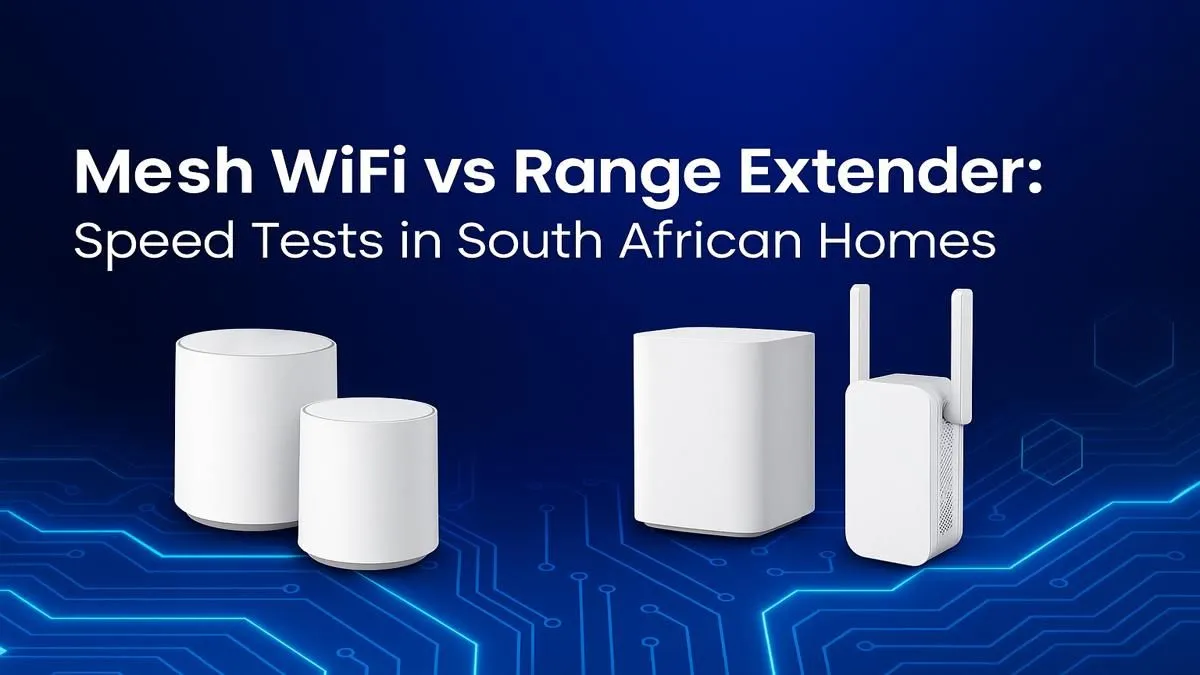
Is your fibre connection fast at the router but painfully slow in your bedroom or home office? You’re not alone. For many South Africans, conquering WiFi dead zones is a constant battle. The big question is: do you grab a cheap range extender, or invest in a modern mesh WiFi system? When it comes to the Mesh WiFi vs Range Extender South Africa debate, the answer for gamers and streamers hinges on one thing: pure, uninterrupted speed. 📶
What Exactly is a WiFi Range Extender?
Think of a WiFi range extender as a simple signal booster. It picks up the existing wireless signal from your main router and rebroadcasts it, extending its reach to cover a dead spot.
They are often the first solution people consider because they're affordable and easy to set up. You plug it in, connect it to your network, and you're done. However, this simplicity comes with a significant speed penalty. Most traditional WiFi range extenders create a new network (like "MyWiFi_EXT") and effectively cut your available bandwidth in half because the device has to both receive and transmit data on the same channel.
For basic browsing in the garden, it might be fine. For a competitive Apex Legends match? Not a chance.
How Does a Mesh WiFi System Work?
A mesh WiFi system takes a smarter, more powerful approach. Instead of one device boosting another, a mesh system consists of multiple nodes or satellites that work together as a single, intelligent team. They create one seamless, unified network throughout your entire home.
When you walk from the lounge to the kitchen, your device automatically and seamlessly connects to the strongest node without dropping the connection. This is a core feature of many high-end wireless routers and dedicated mesh kits. Because the nodes communicate with each other on a dedicated channel (a "backhaul"), they deliver much faster speeds to your devices compared to an extender.
This is the key difference when comparing a mesh system to a range extender for speed in South Africa; mesh maintains performance, while an extender sacrifices it for reach.
Placement Pro Tip ⚡
Whether you choose a mesh node or a range extender, placement is key. Don't hide it in a cupboard! Place it in an open area, halfway between your main router and the dead zone. For multi-storey homes, try placing nodes near staircases to help the signal travel vertically.
Mesh WiFi vs Range Extender: The Speed Showdown in SA
Let's get practical. Imagine you live in a double-storey house in Centurion and your gaming PC is upstairs, while the fibre router is downstairs.
- With a Range Extender: You'll see a full WiFi signal on your PC, but your download speeds might drop from 100Mbps near the router to just 30-40Mbps upstairs. Your latency (ping) will also likely be higher and less stable, leading to frustrating lag spikes.
- With a Mesh WiFi System: With one node downstairs and another upstairs, your PC will connect to the closest node at high speed. You could easily see speeds of 90Mbps or more, with the low, stable ping you need for online gaming. The system intelligently manages the traffic for optimal performance.
The winner for speed is clear. For any demanding task—4K streaming, competitive gaming, or large file downloads—a mesh system is significantly faster and more reliable. And remember, even the best network won't help if your PC has poor reception. Upgrading to powerful wireless adapters can make a massive difference to your connection stability.
The Final Verdict: Which is Right for Your Mzansi Home? 🤔
So, in the mesh WiFi vs range extender battle, who wins for your home in South Africa? It boils down to your needs and budget.
You should buy a Range Extender if:
- You have a small apartment or only one specific, nearby dead zone (e.g., a patio).
- Your internet activities are limited to browsing, email, and standard-definition streaming.
- Your budget is the primary concern.
You should buy a Mesh WiFi System if:
- You have a medium-to-large home, thick walls, or multiple floors.
- You are a gamer, a 4K streamer, or you work from home and need rock-solid stability.
- You have many smart devices (phones, TVs, consoles) competing for bandwidth.
- You value seamless connectivity and maximum speed in every corner of your house.
For most tech-savvy South Africans dealing with frustrating WiFi, investing in a mesh system is the smarter long-term choice. The performance improvement is something you'll feel every single day, making your entire wireless networking experience better.
Ready to Banish Buffering for Good?
The Mesh vs Extender debate depends on your home and your needs. For a seamless, high-speed connection across every room, a modern mesh system is the clear winner. Explore our massive range of wireless networking gear and build the ultimate home network today.