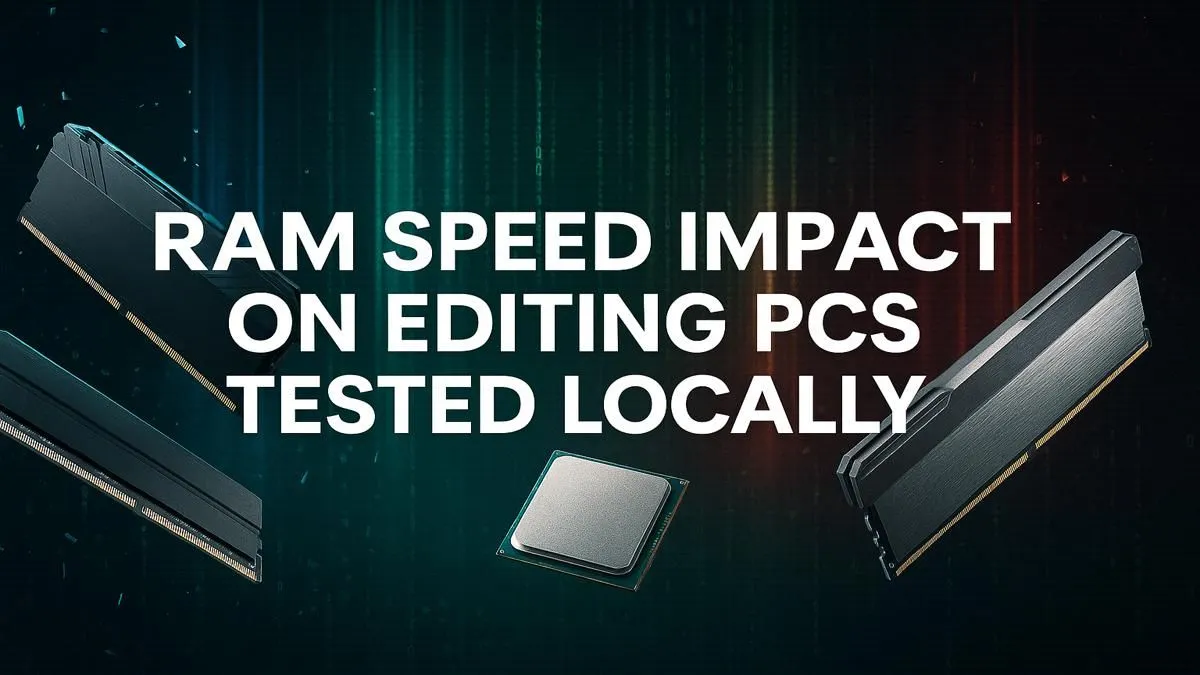
Staring at a render bar that refuses to move? Is your 4K timeline scrubbing like a slideshow? You're not alone. For South African content creators, every minute spent waiting is a minute lost. The secret to unlocking a smoother workflow isn't always a new GPU... it's often about mastering the unsung hero of your rig: your RAM. Getting the right RAM speed for video editing can dramatically cut down frustration and boost your creative output. 🚀
Why RAM Speed for Video Editing is So Crucial
Think of your computer's RAM (Random Access Memory) as its short-term memory or workspace. When you're editing video, your PC is constantly juggling massive files—your source footage, effects, audio tracks, and preview renders. The RAM speed, measured in Megahertz (MHz), determines how quickly your CPU can access and write this data.
Faster RAM means:
- Smoother timeline scrubbing: No more stuttering when you zip back and forth through your project.
- Quicker real-time playback: See your effects and colour grades applied instantly without dropping frames.
- Faster rendering and export times: The final step gets a noticeable speed boost as the system processes everything more efficiently.
While a high-end CPU and GPU are vital, slow RAM can create a bottleneck, holding back the true potential of your entire system. This is true even for more budget-focused builds; choosing the right components is key to getting the most performance for your money, especially if you're looking at powerful PCs under R20k that can handle 1080p and even light 4K editing.
The Sweet Spot: A Performance Test for SA Editors
So, what's the magic number? The best RAM speed for video editing depends on your workload and the platform you're using (DDR4 or the newer DDR5). Let's break it down.
DDR4: The Value King
For most editors, DDR4 is still a fantastic and affordable option.
- 3200MHz: This is the solid baseline. It offers a significant improvement over older, slower speeds and is perfect for 1080p projects and basic 4K editing.
- 3600MHz: This is widely considered the price-to-performance sweet spot for DDR4. It provides a tangible boost in timeline fluidity and rendering, especially on AMD systems. Many of the best AMD Ryzen PC deals are optimised around this speed.
DDR5: The Future-Proof Powerhouse ✨
If you're building a new high-end rig, DDR5 is the way to go.
- 5200MHz - 6000MHz: This is the current sweet spot for DDR5. The performance uplift over DDR4 is noticeable in demanding applications like Adobe Premiere Pro and DaVinci Resolve, particularly when working with multiple 4K streams or 6K+ footage.
Anything above 6000MHz offers diminishing returns for most video editing tasks, so your money is often better spent on more RAM capacity or a faster CPU.
Pro Tip: Unlock Your RAM's Full Speed! ⚡
"Your new RAM won't run at its advertised speed out of the box. You need to enter your PC's BIOS (usually by pressing DEL or F2 on startup) and enable the XMP (for Intel) or EXPO (for AMD) profile. It's a single click that instantly overclocks your memory to its rated performance—a free and essential performance boost!"
Beyond Speed: Capacity and Latency Matter Too
While speed is important, it's only part of the puzzle. Don't forget these two critical factors.
Capacity (How much RAM?)
This is arguably more important than raw speed. Insufficient RAM forces your system to use your much slower SSD or HDD as temporary memory (a "page file"), causing massive slowdowns.
- 16GB: The absolute minimum for 1080p editing. You might struggle with complex projects.
- 32GB: The recommended amount for serious 4K editors and content creators. This provides enough headroom for your editing software, a few browser tabs, and other background apps.
- 64GB+: For professionals working with 8K footage, heavy visual effects (VFX), or complex After Effects compositions.
Latency (How responsive is it?)
You'll see a "CL" number on RAM kits, like CL16 or CL36. This is CAS Latency—the delay before the RAM responds to a request. Lower is better. However, the real-world performance impact of latency in video editing is often less noticeable than a major jump in speed or capacity. A 3600MHz CL18 kit will generally outperform a 3200MHz CL16 kit.
Ultimately, finding the perfect balance of speed, capacity, and CPU pairing is what creates a truly responsive editing machine. Top-tier Intel PC deals often feature well-balanced configurations designed specifically for these demanding creative workloads.
"Ready for a Render-Crushing Upgrade?"
"Getting the RAM speed right is key, but it works best when paired with a powerful CPU. Whether you're Team Blue or Team Red, the right combination can slash your export times and let you focus on creating. Explore our massive range of customisable PCs and build a rig that keeps up with your vision."
"Build Your Dream Editing PC" "https://www.evetech.co.za/custom-built-computers.aspx"