240Hz Gaming Monitor Advantages Tested: The Edge You Need ⚡
Are you a competitive gamer in South Africa looking for every possible advantage? While a 144Hz monitor is great, the jump to a 240Hz gaming monitor can truly elevate your performance and immerse you deeper into the game. This isn't just about smoother visuals; it’s about gaining a split-second edge, reducing eye strain, and ultimately, winning more. Let’s dive into the tangible benefits and see if a 240Hz display is your next essential upgrade.
The Science of Speed: What 240Hz Really Means
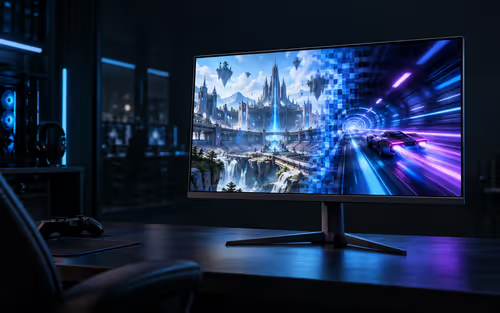
A monitor's refresh rate dictates how many times per second the image on your screen is updated. A standard 60Hz monitor refreshes 60 times, a 144Hz monitor does it 144 times, and a 240Hz gaming monitor updates a whopping 240 times per second. This dramatic increase in refresh rate directly translates to incredibly fluid motion, significantly reducing motion blur and making fast-paced action appear much clearer.
For competitive titles like CS: GO, Valorant, or Overwatch, where enemies can appear and move across your screen in a flash, this smoothness is critical. It allows you to track targets more accurately, react faster to in-game events, and reduces the visual "stutter" that can occur on lower refresh rate displays.
Tested Advantages: Why 240Hz Gives You the Edge 🎯
The benefits of a 240Hz gaming monitor are particularly pronounced in scenarios where rapid visual information is crucial:
- Superior Motion Clarity: This is the most noticeable advantage. When you're quickly panning your view or an enemy is zipping across your screen, a 240Hz display renders each frame with less blurring, making targets easier to spot and track. This can be the difference between landing a headshot and missing entirely.
- Reduced Input Lag: While often subtle, a higher refresh rate inherently means lower input lag. Your actions on your mouse or keyboard are displayed on screen faster, giving you a more immediate connection to the game. This milliseconds-long advantage can be crucial in high-stakes competitive play.
- Enhanced Reaction Time: With clearer motion and lower input lag, your brain receives visual information more quickly and efficiently. This can translate into faster reaction times, allowing you to respond to threats or opportunities before your opponents.
- Less Eye Strain: Believe it or not, the smoother motion of a 240Hz display can reduce eye fatigue during long gaming sessions. The consistent, fluid visuals are easier on your eyes than choppy, less frequent updates.
To truly experience these advantages, your PC also needs to be capable of pushing high frame rates (FPS) that match or exceed your monitor's refresh rate. Pairing a powerful graphics card with a 240Hz monitor, especially one that supports FreeSync for tear-free gaming, unlocks its full potential.
Is a 240Hz Monitor Right for You in South Africa?
While the advantages are clear, a 240Hz gaming monitor is generally recommended for serious competitive gamers who play fast-paced titles and have a PC rig capable of consistently achieving high frame rates. For casual gamers or those playing slower-paced, visually intensive single-player games, a 144Hz monitor might offer a better balance of price and performance, especially if you're keen on exploring all gaming monitors at Evetech.
However, if you're looking to gain every possible competitive edge and your system can handle it, the investment in a 240Hz display, particularly one with Adaptive Sync technology, is well worth it.
Optimise Your In-Game Settings
To get the most out of your 240Hz monitor, ensure your in-game graphics settings are tuned for maximum frame rate (FPS), not just visual fidelity. Lowering some demanding settings can help your GPU consistently push enough frames to fully utilise the high refresh rate.
The world of competitive gaming in South Africa is always evolving, and having the right gear can make all the difference. A 240Hz gaming monitor provides a distinct advantage in terms of responsiveness, clarity, and overall gaming experience, helping you perform at your absolute best.
Claim Your Competitive Advantage! Ready to experience gaming at its smoothest and most responsive? Explore Evetech's extensive range of high-performance gaming monitors, including top-tier 240Hz displays, built for victory. Shop all gaming monitors now at Evetech and elevate your gameplay!