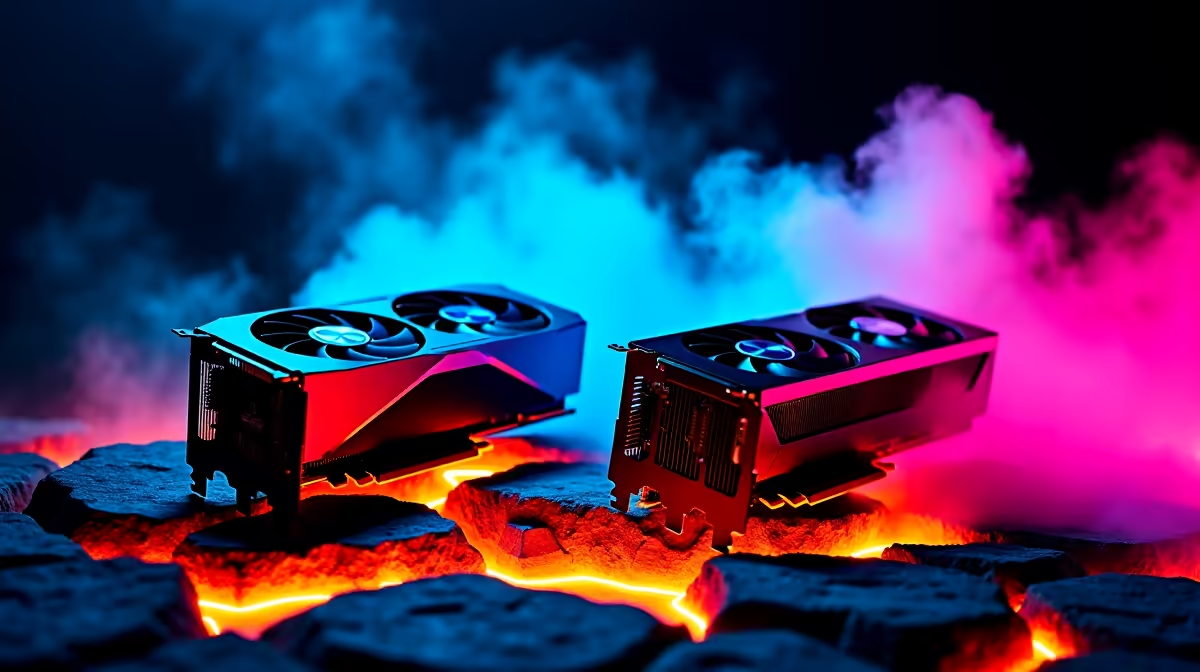
Ray tracing is where the gap between the RTX 4070 Ti Super and the RTX 4060 Ti becomes most apparent. Both are capable gaming GPUs, but their very different hardware specifications create a significant performance divide when ray tracing is enabled, especially at higher resolutions.
Quick Answer
How does the RTX 4070 Ti Super compare to the RTX 4060 Ti in ray tracing? The RTX 4070 Ti Super is significantly faster in ray tracing workloads - typically 60–80% ahead of the RTX 4060 Ti depending on the game and resolution. Its larger CUDA core count, wider memory bus, and greater RT core density give it a substantial advantage in ray-traced lighting, shadows, and reflections.
🔧 Hardware Differences That Drive Ray Tracing Performance
To understand the performance gap, look at what each card brings to ray tracing workloads:
| Specification | RTX 4070 Ti Super | RTX 4060 Ti |
|---|---|---|
| CUDA Cores | 8,448 | 4,352 |
| RT Cores (Gen 3) | 66 | 34 |
| VRAM | 16 GB GDDR6X | 8 GB GDDR6 |
| Memory Bandwidth | 672 GB/s | 288 GB/s |
| TGP | 285W | 165W |
The RTX 4070 Ti Super has nearly double the RT cores, twice the memory bandwidth, and double the VRAM of the RTX 4060 Ti. In ray-traced scenes - which need to process millions of ray intersections per frame while also managing larger scene data - all three of these advantages compound together.
📊 Ray Tracing Benchmark Comparison
Cyberpunk 2077 (Overdrive Path Tracing)
- RTX 4070 Ti Super at 1440p + DLSS Balanced: ~75–85 FPS
- RTX 4060 Ti at 1440p + DLSS Balanced: ~40–50 FPS
Alan Wake 2 (Full Ray Tracing)
- RTX 4070 Ti Super at 1440p + DLSS Quality: ~70–80 FPS
- RTX 4060 Ti at 1440p + DLSS Quality: ~38–48 FPS
Control (Full Ray Tracing)
- RTX 4070 Ti Super at 4K + DLSS Quality: ~65–75 FPS
- RTX 4060 Ti at 4K + DLSS Quality: ~28–38 FPS
The 8 GB VRAM limit of the RTX 4060 Ti is a meaningful constraint at 4K with ray tracing enabled - many scenes exceed VRAM capacity and cause additional frame time spikes. The RTX 4070 Ti Super’s 16 GB eliminates this ceiling.
💡 Which One Is Right for You?
For South African gamers the choice comes down to resolution, target frame rates, and budget:
RTX 4060 Ti is a strong choice if:
- You game primarily at 1080p or 1440p
- You use DLSS and are happy with Performance mode
- You play some ray-traced titles but not exclusively
- Budget is a primary consideration
RTX 4070 Ti Super is the better choice if:
- You game at 1440p or 4K with ray tracing enabled frequently
- You want future-proofed VRAM for upcoming titles
- You target 60+ FPS at high settings without compromising visual quality
- You want the headroom to run path tracing in supported titles
Both cards support NVIDIA DLSS 3, Frame Generation, and NVIDIA Reflex, so you have full access to NVIDIA’s AI performance toolkit regardless of which you choose. The RTX 4070 Ti Super simply starts from a much higher baseline before those features are applied.
❓ Frequently Asked Questions
Can the RTX 4060 Ti run ray tracing at 60 FPS? Yes, with DLSS Quality mode enabled at 1080p or 1440p in most games. At native 4K with full ray tracing, maintaining 60 FPS is challenging and often requires dropping to Performance or Ultra Performance DLSS modes.
Does the RTX 4070 Ti Super support path tracing? Yes. The RTX 4070 Ti Super can handle path tracing in Cyberpunk 2077 and other supported titles at 1440p with DLSS Balanced or Performance mode enabled. Full native 4K path tracing is still beyond consumer GPU capability at high frame rates.
Is the RTX 4060 Ti 16 GB version better for ray tracing? The 16 GB variant of the RTX 4060 Ti solves the VRAM limitation but does not improve ray tracing throughput because the RT core count and memory bandwidth remain the same. For ray tracing performance specifically, the RTX 4070 Ti Super is the better upgrade path.
Evetech stocks All Graphics Cards and Graphics Card Deals — browse current SA pricing and availability online.
Ready to Find Your Perfect Match? Shop at Evetech