Quick Answer
The RTX 5060 Ti delivers meaningfully better price-to-performance than the RTX 4080 Super for most SA gamers in 2026, offering strong 1440p gaming at a significantly lower price point thanks to DLSS 4 and Blackwell's efficiency improvements.
Generation Gap: Blackwell vs Ada Lovelace
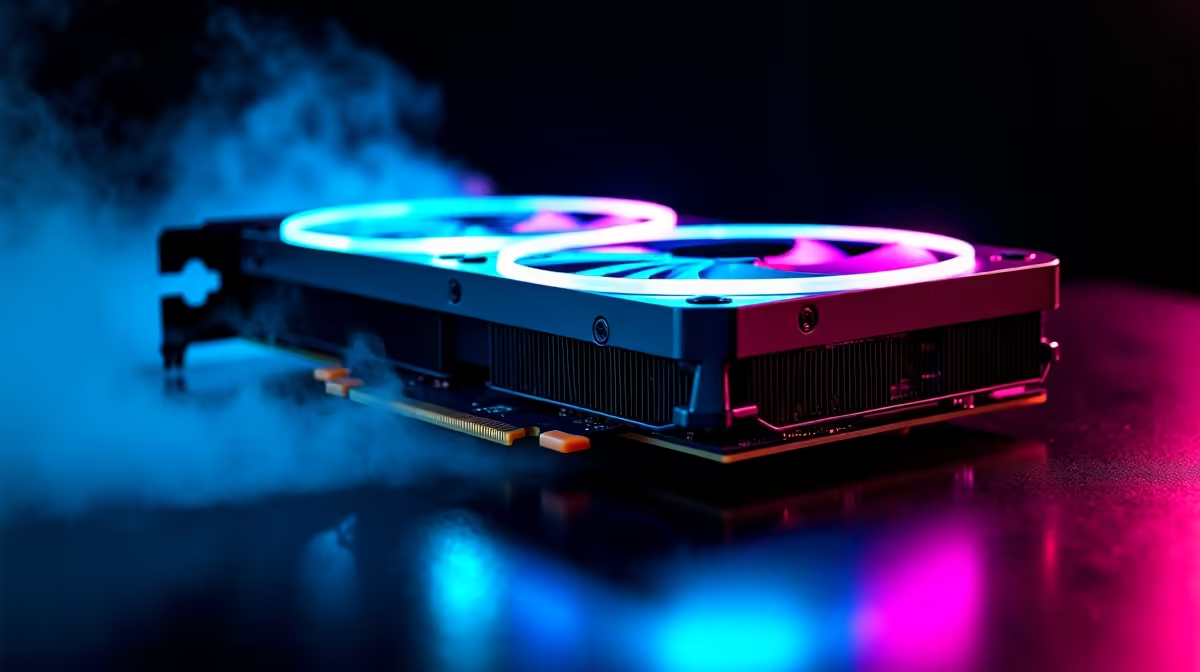
The RTX 5060 Ti is NVIDIA's Blackwell-generation mid-range card, while the RTX 4080 Super represents the top of NVIDIA's Ada Lovelace mainstream lineup from the previous generation. A generation of architectural improvements separates them, and while the RTX 4080 Super sits higher in NVIDIA's product stack by designation, the RTX 5060 Ti's generational efficiency gains make the comparison more competitive than the naming suggests.
The RTX 4080 Super features 10,240 CUDA cores, 16GB GDDR6X, and a 256-bit memory bus. It is a high-bandwidth, high-TDP part designed for 4K gaming and content creation. The RTX 5060 Ti, depending on specific variant, offers fewer raw CUDA cores but benefits from Blackwell's improved IPC and fifth-generation Tensor cores for DLSS 4. The fundamental difference is architectural efficiency - Blackwell delivers more performance per watt and per CUDA core than Ada Lovelace.
In raw native rasterisation without upscaling, the RTX 4080 Super is definitively faster. It leads by 30-50% in raw benchmark conditions at matched settings. This raw lead is significant and should not be dismissed. However, in real-world gaming with DLSS 4 enabled - which is increasingly the standard way to play on NVIDIA hardware - the gap narrows substantially, and in some titles the RTX 5060 Ti with DLSS 4 Quality or Balanced mode delivers frame rates comparable to the RTX 4080 Super's native performance.
Price-to-Performance: The Core Question for SA Gamers
The RTX 5060 Ti's value proposition in South Africa hinges on the price gap between these two cards. The RTX 4080 Super commands a significant price premium in the local market - typically R4,000 to R8,000 more than the RTX 5060 Ti depending on AIB model and timing. That is a substantial amount in the SA market, where the rand's purchasing power makes every tier of the GPU stack feel further apart than it does in USD terms.
For SA gamers gaming at 1080p, the RTX 5060 Ti is the clear value winner. At this resolution, neither card is fully utilised, and the RTX 4080 Super's additional performance goes largely unused unless you are pushing maximum frame rates on a 360Hz monitor. The extra cost delivers minimal practical benefit for 1080p gaming.
At 1440p, the comparison becomes more interesting. The RTX 4080 Super handles 1440p ultra settings natively with comfortable frame rates in virtually all titles. The RTX 5060 Ti at 1440p native high-ultra settings produces lower averages, but with DLSS 4 Quality enabled it can match or approach the RTX 4080 Super's native performance in many titles. For SA gamers willing to use DLSS (and there is little visual reason not to with DLSS 4's quality), the RTX 5060 Ti at 1440p is a compelling value proposition.
At 4K, the RTX 4080 Super's 16GB VRAM and higher raw bandwidth are genuinely better suited to the workload. If you game at 4K or plan to purchase a 4K monitor, the RTX 4080 Super justifies its premium over the RTX 5060 Ti for that specific use case.
DLSS 4 and Feature Comparison
DLSS 4 on Blackwell introduces Multi Frame Generation - the ability to generate multiple AI frames per rendered frame rather than just one. This dramatically increases effective frame rates in supported titles. The RTX 4080 Super's DLSS 3 (with single Frame Generation) is competitive but architecturally limited to one generated frame per rendered frame. The RTX 5060 Ti's DLSS 4 MFG can deliver 2x or 3x effective frame count multipliers in supported games, a significant generational capability advantage.
For SA gamers who follow NVIDIA's DLSS feature rollout - which spans most major AAA titles and grows monthly - this architectural advantage translates to measurable real-world performance differences. The RTX 5060 Ti is better positioned for the next 3-4 years of game development, where DLSS 4 support will be standard. The RTX 4080 Super, being a previous-generation card, cannot access these features.
Power efficiency is another Blackwell advantage. The RTX 5060 Ti draws considerably less power under load than the RTX 4080 Super while delivering competitive gaming performance. For SA gamers managing loadshedding with a UPS, lower power consumption directly extends the duration the system can run on battery. The RTX 4080 Super's higher TDP makes it more challenging to support with a home UPS during outages.
Practical Recommendations for SA Buyers
The RTX 4080 Super makes sense for SA buyers who already own one and are considering keeping it rather than upgrading - it remains an excellent card and does not need replacement for capable gaming through at least 2027. As a new purchase in 2026, the RTX 4080 Super is difficult to justify over the RTX 5060 Ti unless you specifically need 4K gaming performance or maximum native rasterisation without reliance on DLSS.
For first-time buyers or those upgrading from older cards (RTX 3070 and below, RX 6700 and below), the RTX 5060 Ti is the logical choice. It is newer, more efficient, supports the latest DLSS features, and costs meaningfully less in the SA market. The performance ceiling at 1440p with DLSS 4 is high enough that most SA gamers will not feel compromised compared to the RTX 4080 Super's native performance.
Frequently Asked Questions
Q: Can the RTX 5060 Ti actually match the RTX 4080 Super with DLSS 4?
A: In DLSS 4-supported titles using Multi Frame Generation, effective frame rates on the RTX 5060 Ti can reach and sometimes exceed the RTX 4080 Super's native output. Native rasterisation still favours the RTX 4080 Super significantly. The comparison depends heavily on DLSS usage.
Q: Is the RTX 4080 Super still worth buying in South Africa in 2026?
A: As a new purchase, it is difficult to recommend over the RTX 5060 Ti for most buyers given the price gap and the RTX 4080 Super's older architecture. It remains an excellent performer, but value-per-rand strongly favours the RTX 5060 Ti.
Q: How do these cards compare for content creation alongside gaming?
A: The RTX 4080 Super's 16GB VRAM is a meaningful advantage for 3D rendering, video production at high resolutions, and local AI model inference with large models. For gaming-first users with occasional creative work, the RTX 5060 Ti is adequate. For serious creative professionals, the RTX 4080 Super or a dedicated workstation GPU is a better long-term investment.
Q: Which card runs cooler and quieter in a South African summer?
A: The RTX 5060 Ti, due to its lower TDP and Blackwell's improved efficiency. Cooler operation means quieter fans and better sustained performance in the warm ambient temperatures common to SA summers, particularly in Gauteng.
Also at Evetech: RTX 5060 Ti Gaming PCs | RTX 5060 Gaming PCs
Ready to Find Your Perfect Match? Shop at Evetech