Quick Answer
Enabling AMD Fluid Motion Frames (AFMF) or game-specific frame generation on the RX 7900 XTX delivers a significant fps boost - typically 60-90% more output frames - but introduces added input latency of 20-40ms depending on base frame rate. Frame generation is best used at high base frame rates (60 fps and above) where the latency penalty is proportionally smaller and the experience remains responsive.
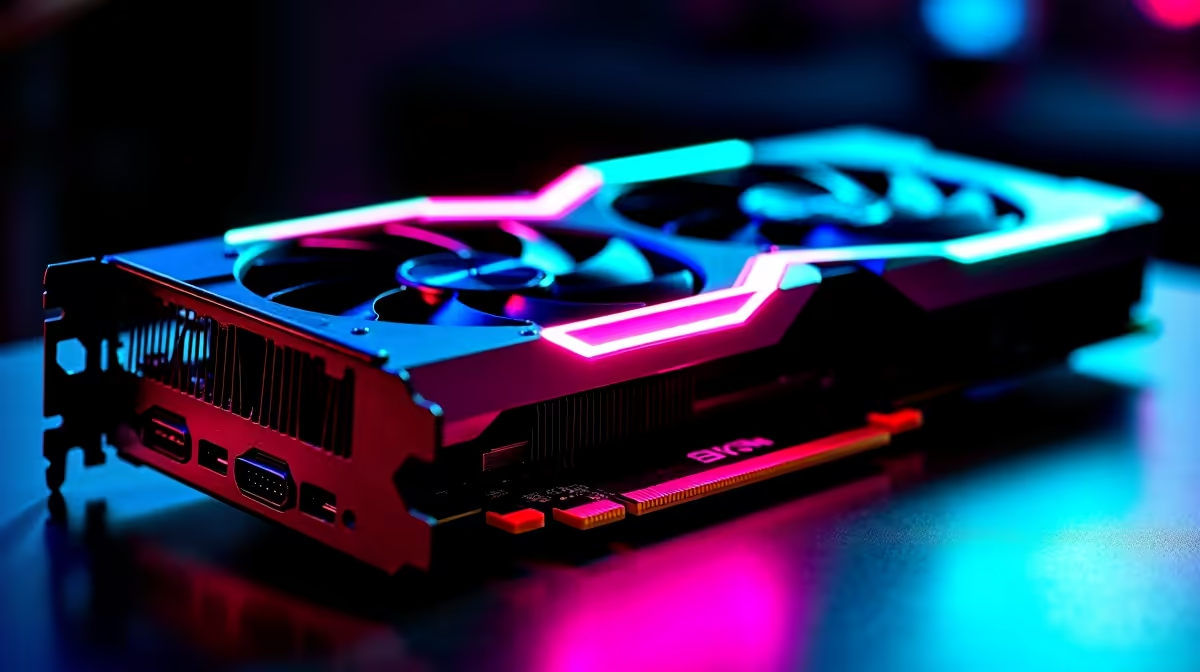
The RX 7900 XTX supports two forms of frame generation in 2026: AMD Fluid Motion Frames (AFMF2), which works as a driver-level solution across most games, and game-native implementations like FSR 3 Frame Generation built into specific titles. Both multiply output frame rates substantially but carry trade-offs that matter for different use cases. In South Africa, where the RX 7900 XTX sits in the R18,000-R22,000 segment, understanding how to get the most from frame generation shapes your display upgrade decisions too.
Performance Impact at Different Base Frame Rates
Frame generation doubles output frame rates by interpolating frames between rendered ones. The real-world uplift is highest when your base rendering rate is already high. At a 60 fps base, frame generation delivers roughly 110-120 fps output (not a clean 2x due to overhead). At 80 fps base, you get 150-160 fps output. At 100 fps base, output reaches 190-210 fps.
In practical terms on the RX 7900 XTX: at 1440p in Cyberpunk 2077 with Ultra settings, a 65 fps base becomes 125 fps with AFMF2. In Starfield at 1440p High, a 75 fps base becomes 140 fps. In Forza Horizon 5 at 4K Ultra, a 90 fps base becomes 170 fps.
Input Latency Considerations
The trade-off with frame generation is input latency. Interpolated frames are not rendered from new input data - they are generated from existing frames - which means the visual output runs slightly behind your actual inputs. At a 60 fps base, AFMF2 adds approximately 30-40ms of additional perceived latency. At 100 fps base, this drops to 15-20ms.
For single-player story games, open-world exploration, and racing games, this latency penalty is imperceptible to most players and the smoothness benefit is clear. For competitive multiplayer - Counter-Strike 2, Valorant, Apex Legends - frame generation at low base rates creates a mushy feel that experienced players notice immediately. The recommendation is to only enable frame generation in competitive games when your base frame rate exceeds 100 fps, where the latency addition is small enough to be irrelevant.
Frequently Asked Questions
Q: Does AFMF2 work across all games on the RX 7900 XTX? A: AFMF2 works at the driver level and applies to most DirectX 11 and DirectX 12 games. Some games with anti-cheat or specific engine configurations may not be compatible.
Q: Is FSR 3 Frame Generation better than AFMF2 on the RX 7900 XTX? A: In-engine FSR 3 implementations are generally more stable and produce fewer artifacts than AFMF2 because the game engine has context about scene changes. For supported titles, in-game FSR 3 Frame Generation is the preferred option.
Q: Should I enable frame generation for competitive games on the RX 7900 XTX? A: Only if your base frame rate already exceeds 100 fps. Below that, the added latency hurts responsiveness more than the visual smoothness helps.
Ready to Find Your Perfect Match? Explore AMD RX 7900 XTX gaming PC builds with the processing power to maximise frame generation benefits.