Quick Answer
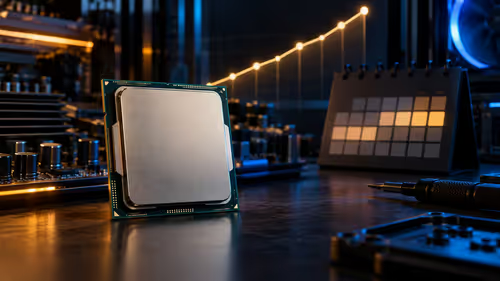
The Ryzen 7 9800X3D is the stronger chip overall, offering meaningful gaming improvements over the 7800X3D alongside better productivity performance thanks to its Zen 5 architecture. The 7800X3D remains a formidable gaming CPU and represents excellent value if found at a lower price point. Your choice depends on budget, platform, and how much you value future-proofing.
AMD''s 3D V-Cache technology has redefined what a gaming CPU looks like, and the 9800X3D is the latest evolution of that formula. But the 7800X3D set such a high bar when it launched that many South African PC builders are asking whether the upgrade is genuinely worth it - or whether the older chip still makes more sense. Here is a thorough comparison across both gaming and productivity workloads.
Architecture: Zen 5 vs Zen 4
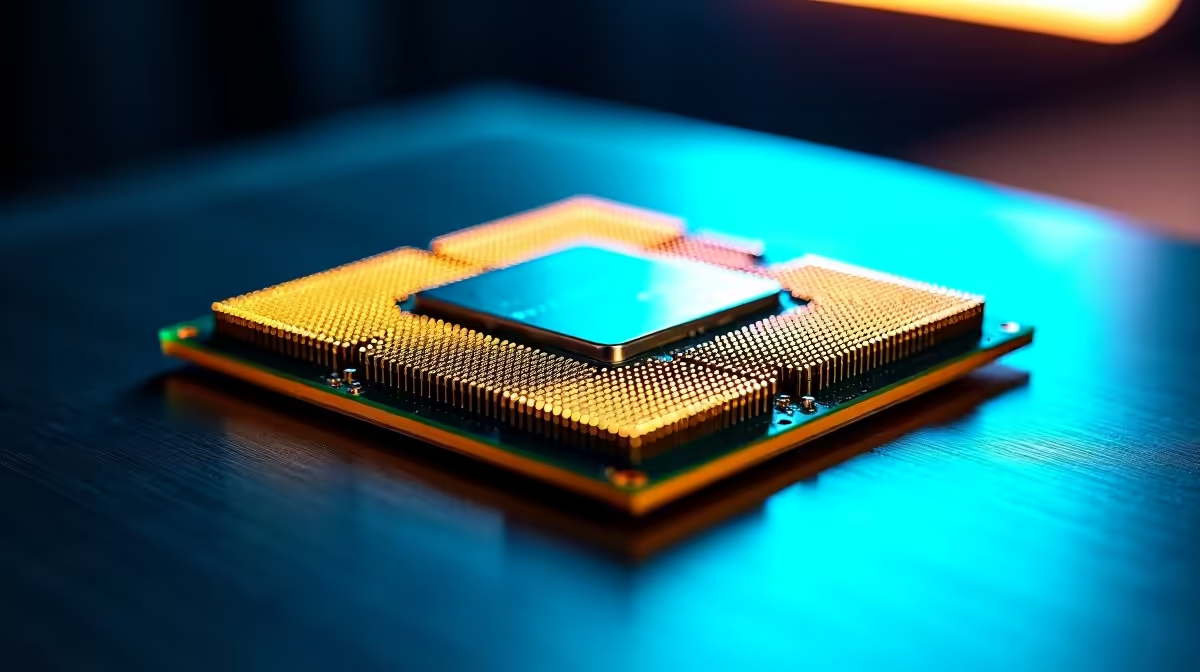
The fundamental difference between these two CPUs is the underlying architecture. The 7800X3D runs on Zen 4, which was AMD''s high-efficiency, high-IPC design that launched on the AM5 platform. The 9800X3D moves to Zen 5, which brings a wider front end, improved branch prediction, and better overall instruction throughput. In raw CPU-intensive tasks - video editing, 3D rendering, software compilation, scientific workloads - the 9800X3D''s architectural improvements translate into a real performance gap. For productivity-heavy users, the newer chip is the clear winner. The platform is the same (AM5 with DDR5), so if you are already on AM5, upgrading from a 7800X3D to a 9800X3D is a straightforward BIOS update and CPU swap on most boards.
Gaming Performance: How Much Does the Gap Matter?
Both CPUs use 96MB of 3D V-Cache, which is the key ingredient for gaming performance. The cache allows these chips to keep far more game data close to the processor cores, dramatically reducing latency in CPU-limited scenarios. In practice, both CPUs deliver exceptional gaming frame rates - they are rarely the bottleneck even at 1080p with a high-end GPU. The 9800X3D edges ahead in most titles, particularly in games that are sensitive to IPC improvements and in CPU-limited competitive titles like strategy games and simulation titles. The gap is more noticeable at lower resolutions (1080p) and closes as GPU load increases at 1440p and 4K. For competitive esports titles where every frame counts, the 9800X3D''s advantage is meaningful. For most AAA gaming at 1440p or 4K, both chips will feel very similar.
Thermals, Power, and Overclocking
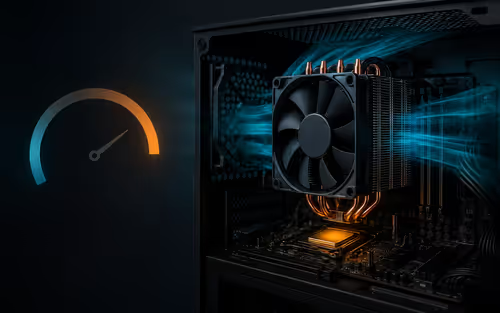
Neither of these CPUs is designed primarily for overclocking - the 3D V-Cache stack is thermally sensitive, and AMD locks out traditional overclocking on both chips (though Curve Optimizer is available on the 9800X3D, giving more tuning headroom). The 9800X3D runs cooler under gaming loads than its predecessor thanks to AMD moving the V-Cache to the top of the die, which improves heat dissipation. A 240mm AIO or a high-quality tower cooler is sufficient for both. Power consumption is broadly similar, with the 9800X3D being slightly more efficient in many workloads due to the Zen 5 architecture''s improved performance-per-watt characteristics.
Which Should You Buy in South Africa?
In the South African market, price is always a major consideration. If the 7800X3D is available at a significantly lower price - which is increasingly likely as 9800X3D stock becomes more common - it remains a tremendous gaming CPU that will satisfy virtually any gamer for years. If you are building a new system from scratch and the price delta between the two is modest, the 9800X3D is the smarter long-term investment, especially if you do any creative or professional work alongside gaming. Both chips require an AM5 motherboard and DDR5 memory, so platform costs are identical.
Frequently Asked Questions
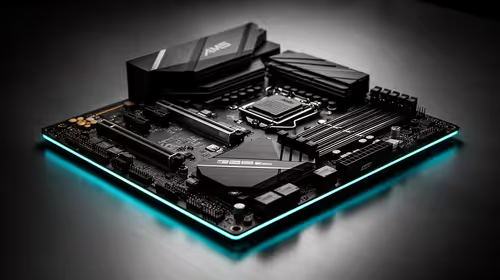
Q: Is the Ryzen 7 9800X3D compatible with AM4 motherboards? A: No. The 9800X3D requires an AM5 motherboard with DDR5 memory. The 7800X3D also uses AM5.
Q: How much faster is the 9800X3D than the 7800X3D in productivity tasks? A: Productivity gains from Zen 5 are generally in the 10–20% range depending on the application, with the largest gains in tasks that benefit from improved IPC and wider execution resources.
Q: Do I need a new cooler when upgrading from 7800X3D to 9800X3D? A: Not necessarily. Any cooler that worked well on the 7800X3D will work on the 9800X3D. The 9800X3D actually runs cooler under gaming loads due to the improved die layout.
Q: Is 3D V-Cache still relevant as game engines evolve? A: Yes. The cache advantage remains highly relevant for current and upcoming titles. Larger, more complex game worlds benefit from reduced CPU latency, and 3D V-Cache addresses exactly that bottleneck.
Ready to Find Your Perfect Match? Shop AMD Ryzen processors at Evetech.