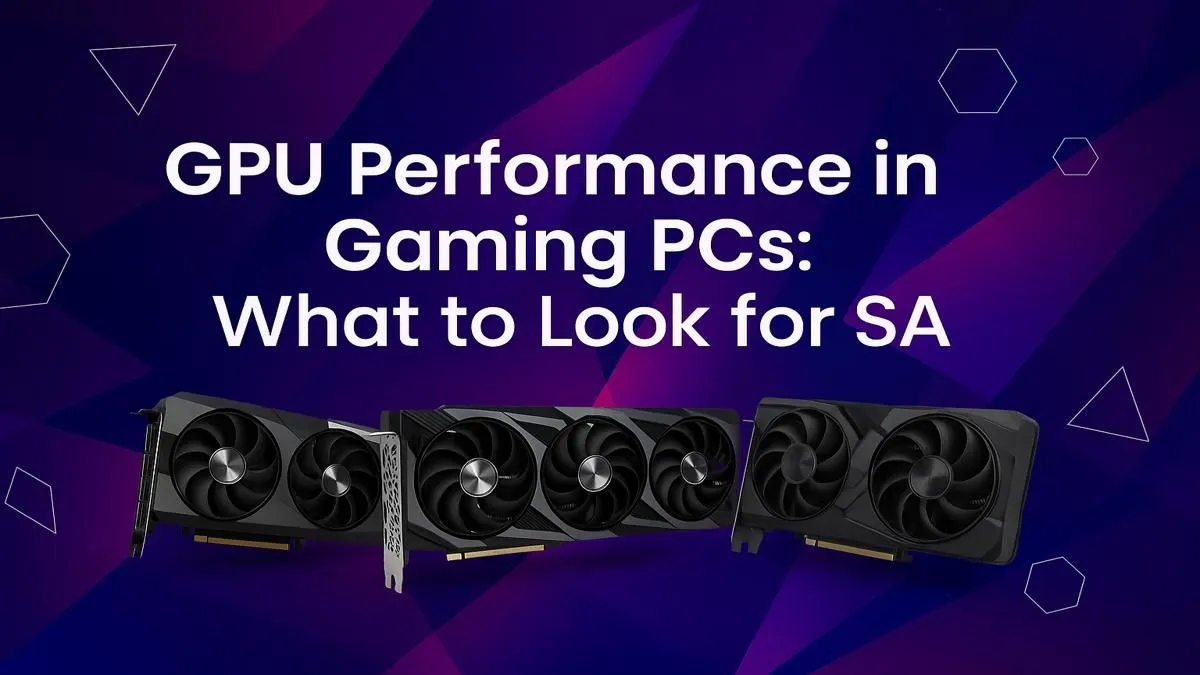
Stuttering through a final-circle firefight in Sandton? Or watching the Cape Town scenery in Flight Simulator load one blurry tile at a time? Chances are, your graphics card (GPU) is holding you back. It’s the heart of any gaming PC, turning code into glorious pixels. But with so many models and specs, knowing what to look for in a GPU can feel overwhelming. This gaming PC performance guide cuts through the noise and gets you ready for your next upgrade. 🚀
Decoding the Specs: What to Look for in a GPU
Forget the marketing jargon for a second. When you're choosing a new graphics card, a few key specifications determine 90% of its real-world performance. Let's break them down so you can make an informed choice.
VRAM: Your GPU's Short-Term Memory
Think of VRAM (Video RAM) as the desk space your GPU has to work with. It stores high-resolution textures, models, and other assets the game needs instantly. Not enough VRAM, and your PC has to constantly fetch data from slower storage, causing awful stuttering and texture pop-in.
For 1080p gaming, 8GB is a solid baseline today. But if you’re aiming for 1440p or want to crank up the settings in visually stunning titles like Cyberpunk 2077 with its demanding ray tracing, you should be looking at 12GB or even 16GB of VRAM for a smooth experience.
Clock Speeds & Cores: The Engine's Horsepower
This is the raw processing power of your card.
- Cores (CUDA/Stream Processors): These are like tiny individual processors within the GPU. More cores generally mean more power to handle complex calculations simultaneously.
- Clock Speed (MHz/GHz): This is how fast those cores can run. A higher boost clock speed means faster performance, but it's the combination of cores and speed that truly matters.
Don't get too hung up on comparing core counts between NVIDIA (CUDA Cores) and AMD (Stream Processors) directly; their architectures are different. Instead, use these numbers as a guide when comparing cards within the same brand.
Benchmark Before You Buy ⚡
Paper specs are useful, but they don't tell the whole story. The best way to understand a GPU's performance is to look up real-world gaming benchmarks on YouTube or trusted tech sites. Search for "[GPU Name] + [Game Name]" to see exactly how it performs in the titles you play most.
Resolution & Refresh Rate: Hitting Your Target
A powerful GPU is only half the equation; your monitor is the other. What's the point of a card that can push 200 frames per second (FPS) if your monitor can only display 60? When choosing a GPU, know your target:
- 1080p High Refresh Rate: For competitive games like Overwatch 2, maximising FPS for smooth, responsive gameplay is key. A mid-range card is often the sweet spot here.
- 1440p "QHD": This is the new standard for many gamers, offering a great balance of visual clarity and performance demands. You'll need a solid upper-mid-range to high-end GPU.
- 4K Ultra HD: For the ultimate visual fidelity, you'll need a top-tier GPU to run modern games at smooth frame rates.
Your Perfect GPU: A Gaming PC Performance Guide for SA's Favourite Titles
The best GPU for you depends heavily on what you play. A card that's brilliant for one game might be overkill or underpowered for another.
For fast-paced battle royales, every frame counts. You need a GPU that can consistently deliver high FPS to give you a competitive edge in games like Fortnite, Call of Duty: Warzone, and PUBG. Here, focusing on 1080p or 1440p performance is often smarter than chasing 4K.
On the other hand, sprawling open-world games and simulators prioritise immersion. You want a card that can handle complex environments and detailed textures without breaking a sweat. This is crucial for navigating the detailed streets in GTA V or soaring over a photorealistic world in a Microsoft Flight Simulator ready PC.
And don't underestimate less graphically intense-looking titles! A game like Minecraft can become incredibly demanding once you start adding realistic shaders and texture packs, requiring a surprisingly powerful GPU to run smoothly. ✨
Budgeting for Your GPU: The Price-to-Performance Play
Let's be real, GPUs can be the single most expensive component in a gaming PC. It’s essential to find the right balance for your budget. The good news is that you don't always need the most expensive card on the market.
Think about your total PC budget in Rands. A good rule of thumb is to allocate around 30-40% of your total build cost to the graphics card. This ensures you have a balanced system where the GPU isn't being held back (bottlenecked) by a weaker CPU or slow RAM.
Ultimately, this GPU performance guide is about making an informed choice. By understanding VRAM, core performance, and how they relate to the games you love, you can confidently select a card that will deliver a lekker gaming experience for years to come. 🔧
Ready to Unleash True Gaming Performance?
Choosing the right GPU is the most important step in building a powerful rig. Our experts have already done the hard work, creating perfectly balanced systems for every budget and game. Explore our massive range of custom gaming PCs and find the perfect machine to conquer your world.