


550W PSU Planning for RTX 5080 Super Builds in SA
550W for RTX 5080 Super needs a full-build check, not a simple yes. Review GPU guidance, CPU draw, transient load, connectors, PSU quality, and upgrade plans before deciding.
Read moreA 420 x 420 x 480mm build volume is worthwhile when recurring projects use that capacity or avoid unwanted joins. The R9,399 Neptune 4 Max combines this envelope with a dual-sided plate and a 300C nozzle.

A large build envelope earns its price by preventing unwanted splits, containing future projects or enabling a proven batch layout. Asking whether 420 x 420 x 480mm build volume is worth it requires a project history, not admiration for three large numbers.
The 420x420x480mm volume is worth R9,399 when it removes recurring splits in large models or supports useful batch production.
This capacity is worthwhile when regular prepared models use its width, depth or height, or when avoiding joins has measurable value. The R9,399 Neptune 4 Max provides exactly 420 x 420 x 480mm, along with a dual-sided plate and 300C nozzle. If nearly every job occupies a small central area, a standard-size alternative may use the budget and room more efficiently.
Export dimensions from several completed and planned jobs after orientation and support decisions. A long object may fit diagonally, while a tall object can exceed the 480mm axis despite using little bed area. Treat each boundary independently.
Build a simple table of fits, needs rotation, needs splitting and does not fit. The large-format 3D printer range can then be compared by how many important rows each machine resolves.
Splitting a model adds alignment, fastening or bonding, surface repair and inspection. Some projects benefit from that modularity, especially when orientation improves or damaged sections should be replaceable. Others lose time or function at every seam.
Choose one previous split project and calculate the extra hands-on steps. If the larger envelope would remove those steps repeatedly, the size has a concrete job. If splitting was easy and rare, the benefit is smaller.
The 420 x 420mm bed may hold several smaller items. Test the actual spacing and orientation, then count acceptable parts at completion. More pieces exposed to one failed job can increase risk, so quantity placed is not the same as productive output.
The Neptune 4 Max also supports operation up to 500mm/s through a Klipper high-speed motherboard. Keep that speed question separate from capacity: a wide bed does not guarantee a rapid full batch, and a high ceiling does not prove quality.
Compare other 3D printers available from Evetech with single-part and batch scenarios scored independently.
The upgraded dual-sided plate provides another face for a controlled surface routine. Verify its exact composition and release instructions before assigning convenience value. Its 300C nozzle likewise identifies temperature capability without proving a filament list.
Review 3D printing filament through Evetech after naming the material. Obtain exterior machine dimensions and movement clearance before approving the installation, because build volume cannot stand in for workshop footprint.
The final value statement should name the recurring part, the axis it needs and the step the large envelope removes. That is stronger evidence than a vague desire for future flexibility.
Review the table again after one production cycle. If proposed work changes often, reserve margin on the axis that repeatedly grows rather than buying equal unused space in every direction. A measured trend creates a more defensible future-capacity allowance than one oversized concept model.
Capacity comes with supporting hardware rather than an empty frame: 121-point levelling covers the broad bed, a direct-drive extruder controls filament and Klipper supports recommended 250mm/s operation. The dual-sided plate adds surface options. Buyers making mostly small occasional parts may gain little from the footprint, while prop, prototype or multi-part workflows can convert the volume into fewer joins and more organised batches.
Makers with repeated large parts, difficult seams or validated multi-part layouts can attach the extra capacity to a specific production gain.
It can if that project has enough value and no better production route, but recurring demand usually creates a stronger case.
The Neptune 4 Max allows 420mm in width, 420mm in depth and 480mm in height within its printable envelope.
No. Confirm chassis size, motion space, spool position and access separately before allocating workshop floor or bench area.
This model pairs its volume with Klipper high-speed hardware, a 300C nozzle and an upgraded plate with two usable faces.
The ELEGOO Neptune 4 Max costs R9,399. Judge the Rand amount by avoided joins, useful batches and projects that actually fit.
Prepare real files, document which axis blocks them and compare the labour or design compromise required by a smaller envelope.
Ready to put a Rand value on extra printable space? Compare large 3D printers and filament at Evetech using the projects, joins and batch layouts that define your capacity case.
Makers with repeated large parts, difficult seams or validated multi-part layouts can attach the extra capacity to a specific production gain.
It can if that project has enough value and no better production route, but recurring demand usually creates a stronger case.
The Neptune 4 Max allows 420mm in width, 420mm in depth and 480mm in height within its printable envelope.
No. Confirm chassis size, motion space, spool position and access separately before allocating workshop floor or bench area.
This model pairs its volume with Klipper high-speed hardware, a 300C nozzle and an upgraded plate with two usable faces.
The ELEGOO Neptune 4 Max costs R9,399. Judge the Rand amount by avoided joins, useful batches and projects that actually fit.
Prepare real files, document which axis blocks them and compare the labour or design compromise required by a smaller envelope.
550W for RTX 5080 Super needs a full-build check, not a simple yes. Review GPU guidance, CPU draw, transient load, connectors, PSU quality, and upgrade plans before deciding.
Read more
8000Hz polling is overrated for most SA gamers because gains can be tiny next to battery drain and monitor limits. Mbombela players should weigh mouse feel, game support, and system stability before chasing the number.
Read more
Magnetic switches are taking over SA gaming keyboards because actuation can be tuned. For Sandton gamers, rapid trigger, reset control, and profile depth can help, but layout, key feel, and software quality still matter.
Read more
Polokwane oled monitor value questions need cautious SA context because pricing can move with availability, exchange rates, specs, and warranty support. Treat the trend as a planning signal, not a fixed price promise.
Read more
Arc B580 budget builds for Midrand gamers can shift with exchange rates, supply, specs, and model tier. Treat the title as a buying prompt, then compare SA warranty, timing, and build priorities.
Read more
ROG Ally X may beat the LCD Steam Deck for SA gamers who value stronger handheld performance, more memory, and Windows flexibility. Compare battery life, controls, game libraries, and Polokwane support needs before deciding.
Read more
Minisforum's M2 Pro pairs Core Ultra X7, Arc B390 graphics and 32GB onboard memory in 1.8 litres. SA buyers should weigh its fixed memory and $1,439 launch offer against local mini PCs.

Lenovo says Legion Go failures linked to BIOS N3CN42WW are not user error. Affected SA owners should stop retrying the update, preserve proof and open a support case.

Smart monitors can add apps and convenience, but they also add privacy settings and unwanted-software risk. SA buyers should audit the operating system before paying for extras.

A fake 113GB GTA VI ISO reportedly used empty padding around a small malware payload. SA gamers should delete unofficial builds, keep Windows security active and wait for official channels.
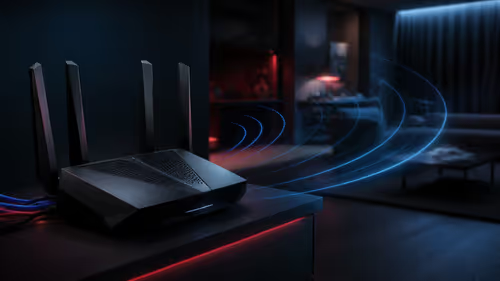
ASUS calls the ROG GT-BN98 the first Wi-Fi 8 gaming router. SA buyers should fix coverage and client limits before paying for a future wireless standard.
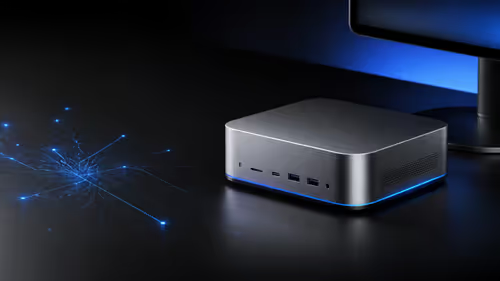
Apple's M6 Mac mini adds faster AI, graphics and networking in the same compact format. SA buyers should wait for a rand listing before comparing value.
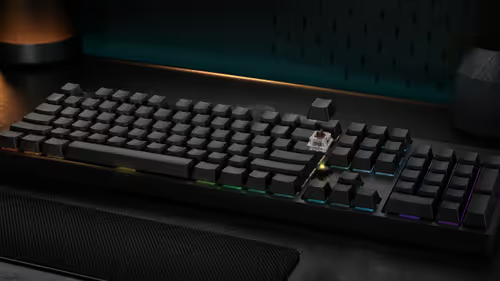
The Vulcan II XP adds hot-swappable switches, sound damping and gaming controls to a full-size wired board. SA buyers should compare feel before features.

Microsoft says Windows on Arm now has over 7,000 verified apps and games. SA buyers should still check each driver, game and work tool before switching.

Xbox Insiders can test disc-to-digital from 31 August 2026. Supported Xbox One and Series X discs gain a digital entitlement, but older discs, regions and title coverage still need exact checks.

ViewSonic's XG2738 pairs QHD QD-OLED with 240Hz and automatic panel care. SA buyers should compare warranty, brightness, ports and burn-in protection against today's R9,999-plus OLED shelf.

NVIDIA's final Windows 10 Game Ready driver is due in October 2026. SA gamers can keep using their GPU, but new game optimisations move on while critical security fixes continue quarterly.

JBL's new Quantum 520, 520X and 120 headsets cover wireless, Xbox-certified and wired use. SA buyers should compare connection, comfort and microphone needs before paying for a new badge.