Quick Answer
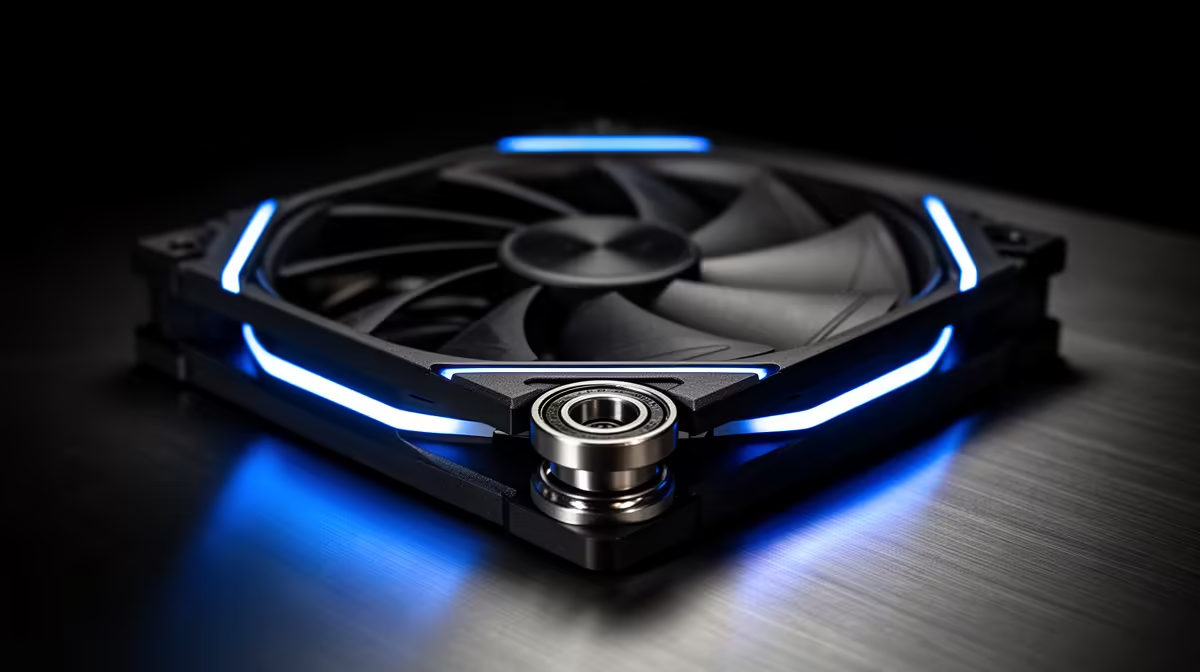
Axial-Tech fans are ASUS ROG's high-pressure fan design originally developed for GPU heatsinks and later adapted for use in ROG-branded power supplies. Dual ball bearings replace the sleeve bearings used in standard PSU fans, providing longer operational lifespan (50,000+ hours), lower noise under variable speed operation, and better performance in varied orientations.
Axial-Tech Fan Design: What Makes It Different 💨
Standard PSU fans use an axial blade design optimised for high airflow at relatively low static pressure, since PSU internals are fairly open compared to a GPU heatsink or radiator fin stack. ASUS ROG Axial-Tech fans use a blade profile with a broader chord, steeper pitch angle, and a barrier ring at the blade tips that reduces tip vortex turbulence. The barrier ring increases static pressure output by recirculating a small amount of airflow at the blade periphery, which improves air throughput through the PSU internal component stack at lower RPMs. In the ROG THOR and ROG LOKI PSU series, this fan runs semi-passively: it stops completely below 20% to 30% PSU load, delivering silent operation during desktop use and light gaming, then spins up smoothly as power draw climbs.
Dual Ball Bearings vs. Sleeve Bearings in PSU Fans 🔧
Sleeve bearings use a lubricated bushing that supports the fan shaft. They are quiet when new but develop clicking or grinding noise after three to five years as lubrication dries, particularly in horizontal orientations where gravity displaces lubricant from the contact zone. Dual ball bearings use hardened steel ball raceways at both shaft ends, maintaining consistent noise and performance through 50,000+ hours of operation. For PSUs in horizontal ATX cases, the most common SA gaming PC orientation, dual ball bearings show substantially lower degradation rates over five-year periods.
Real-World Relevance for South African PC Builders 🇿🇦
ROG THOR and ROG LOKI PSUs with Axial-Tech fans and dual ball bearings are priced from approximately R4,500 for the 850W Gold LOKI to R6,500 for the THOR 1000W Platinum. For builders investing R50,000 or more in a build, a PSU that operates quietly and reliably for five to ten years is proportionally appropriate. Semi-passive operation also suits quiet study or workstation environments where fan noise matters.
Axial-Tech Fan Models Require Clearance for Fan Startup ⚡
Semi-passive PSUs stop their fan entirely below a load threshold. At startup or when first crossing the activation threshold, some units produce a brief low-frequency hum as the fan spins up from zero. This is normal and not a defect. If you notice the startup hum and want to suppress it, enable semi-passive mode only in the companion software after the system has warmed to operating temperature rather than from cold boot.
FAQ
Are Axial-Tech fans replaceable in ROG PSUs?
ROG PSUs are not designed for user fan replacement. The fan is a sealed assembly within the PSU chassis, and opening the unit voids the warranty. If the fan fails within the warranty period, the entire unit is replaced through the local warranty process.
Do dual ball bearing PSU fans last significantly longer than sleeve bearings?
Yes. Independent longevity testing shows sleeve bearing fans degrade measurably after 20,000 to 30,000 hours, while dual ball bearing fans maintain consistent noise and performance through 50,000 hours. For a PSU used 8 hours daily, that is 17 years versus 7 to 10 years.
Is semi-passive mode worth having in a South African climate?
Yes, particularly for builders in the Highveld where daily temperature swings can be large. Semi-passive operation means the PSU fan only runs when actually needed, reducing dust ingestion during idle periods and extending fan life in dusty environments.
Want a premium PSU with genuine long-term fan engineering? Evetech stocks ROG THOR and ROG LOKI PSUs with Axial-Tech fans and dual ball bearings, with full local warranty and specifications listed on each product page.