A video wall stops feeling like a collection of monitors when imagery crosses its boundaries without losing visual continuity. Building that effect starts with a professional GPU synchronization plan, not with screen count alone. PNY RTX Pro Sync brings Mosaic, Genlock and Frame Lock to layouts that can extend across eight RTX Pro GPUs and 32 synchronised displays.
Quick Answer
RTX PRO Sync is built to keep high-resolution video walls aligned, using professional NVIDIA GPUs to deliver one seamless visual field across many screens.
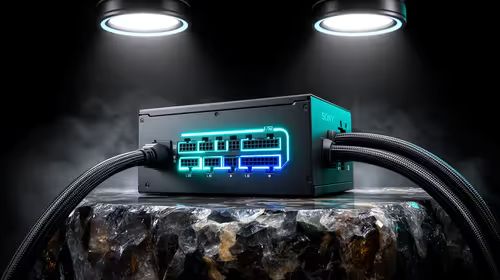
For a seamless multi-display wall, separate the canvas design from the timing design and verify both with representative moving content. The synchronisation card in this plan is R19,599; it supports NVIDIA Mosaic plus the two lock functions required for coordinated professional visuals.
🧩 Define what "seamless" means
There are two different seams to manage. A physical seam comes from panel edges, gaps and mounting. A digital seam appears when content or timing fails to line up across the display boundary. RTX Pro Sync addresses the coordinated graphics side; the room layout and physical joins remain design work.
Start with a scaled wall sketch. Mark the intended canvas, visible panel boundaries and where important content may travel. This tells the content team what to avoid near bezels and tells the hardware team how many outputs must act together. Evetech's PC monitor selection can then be reviewed against that drawing rather than treated as an isolated shopping list.
🎛️ Match functions to the wall
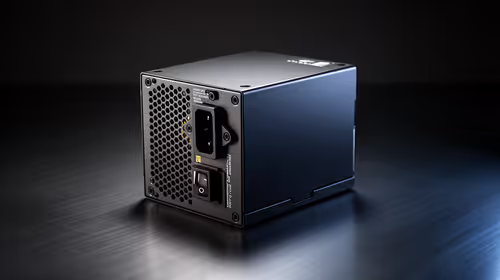
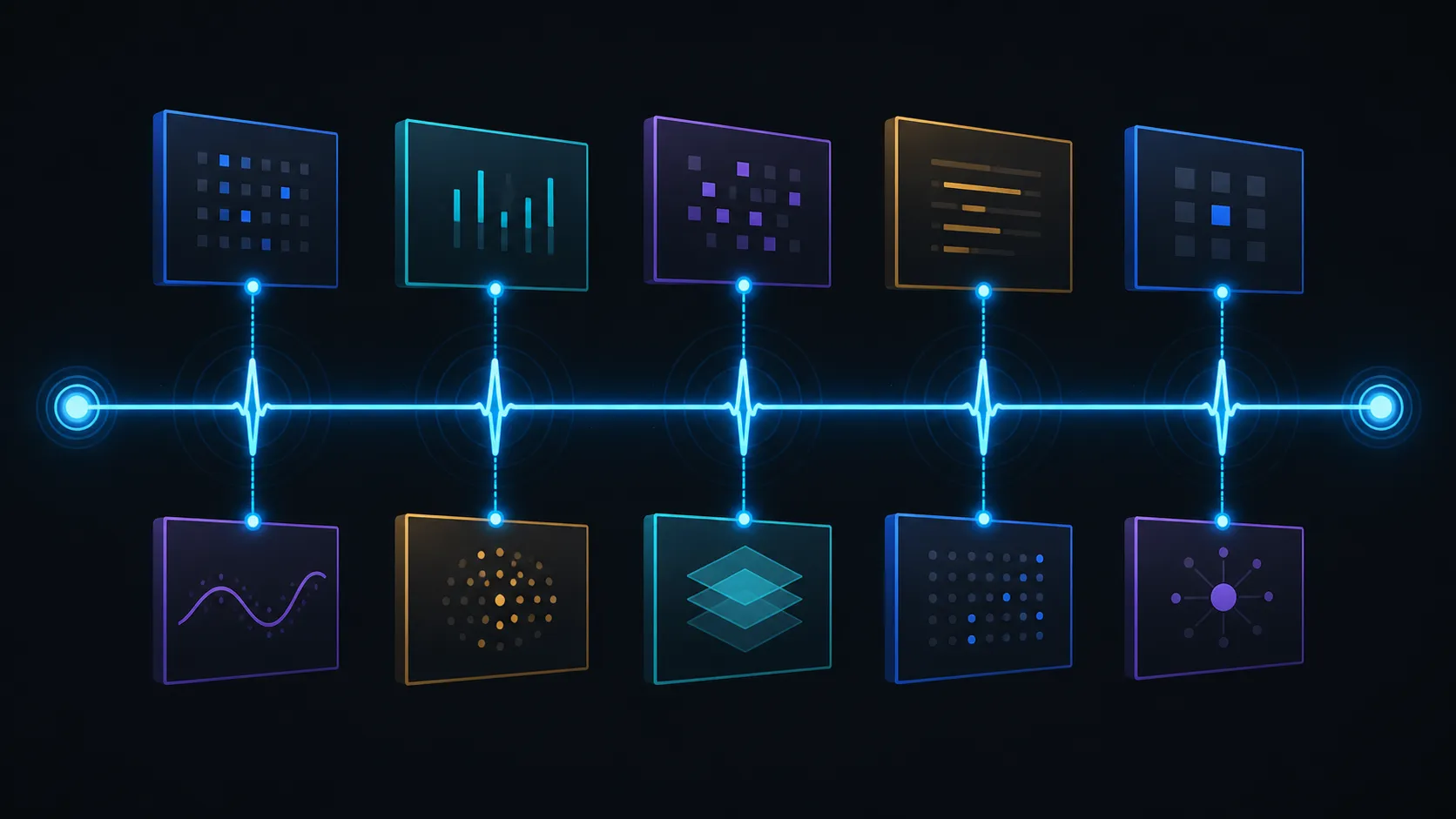
Mosaic gives the wall its unified output arrangement. For timing, Genlock relates the participating equipment to the chosen reference; Frame Lock keeps GPU-produced frames in step. A design requiring that complete trio can use the PNY NVIDIA RTX Pro Sync card at R19,599.
Capacity matters only after the function is right. The card reaches up to 32 synchronised screens across no more than eight RTX Pro GPUs. Keep both figures in the architecture diagram; counting screens without counting processors can leave an otherwise polished wall with an incomplete design.
🎞️ Validate content across boundaries
Use acceptance material that reveals discontinuity. Slow pans, straight moving lines and repeated geometric shapes are more useful than a static logo because they cross several display edges. Watch corners and outer panels as closely as the centre of the wall.
Run the test through every content layout expected in daily use. Mosaic support does not decide the content workflow, and lock hardware does not correct a poorly prepared source. The goal is to prove that the chosen arrangement, participating GPUs and signal timing work together for the actual presentation.
Professional graphics hardware can be compared in Evetech's workstation GPU category. Choose the processors only after the visual workload and output map have been defined.
🧾 Budget the system in layers
Keep the R19,599 sync card as its own project line. Add displays, graphics processors, mounting, content systems and installation work separately. This makes it possible to resize the wall without disguising where the budget changes.
Supporting parts should follow the approved architecture. Review the graphics card accessories section after the GPU and display decisions are settled, then document the accepted configuration for future maintenance.
Review the wall as a viewer would
Technical acceptance at arm's length is not enough. Stand at the closest, typical and farthest audience positions, then replay the same boundary-crossing sequence. Note whether the content still reads as one intentional composition and whether an important detail disappears into a bezel from any of those viewpoints.
The final handover should include that viewing sequence, the approved canvas drawing and the active GPU allocation. A later content refresh can then be checked against the experience the wall was originally designed to deliver.
A single system may serve as many as 32 displays or projectors through Mosaic, with room for eight GPUs and two sync cards. The included set of four 12-inch and two 24-inch cables gives the installer two internal connection lengths. That known scale suits anything from digital signage to immersive building-sized visuals, while the wall layout determines how much of the capacity is actually used.
Frequently Asked Questions
What makes the PNY card relevant to a seamless wall?
It combines NVIDIA Mosaic, Genlock and Frame Lock. Those functions cover display arrangement, reference timing and frame coordination within one supported architecture.
How large can the coordinated wall become?
At the upper end, one design can comprise 32 coordinated screens and eight NVIDIA RTX Pro graphics processors.
Will synchronization remove the physical bezels?
No. Panel edges and mounting geometry are physical design issues. Synchronisation keeps the graphics presentation coordinated across the screens.
Is R19,599 the price of the complete video wall?
It is the price of the PNY synchronization card. The wall's panels, GPUs and installation need their own budget lines.
Ready to turn the wall sketch into a hardware plan?
Explore Evetech's professional graphics and monitor categories with the final canvas, timing roles and display count beside you.