Quick Answer
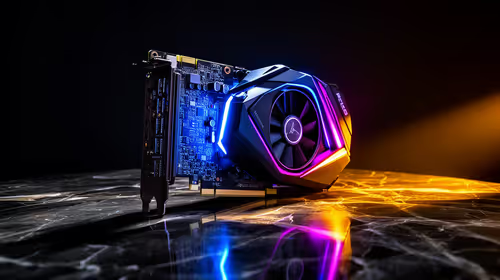
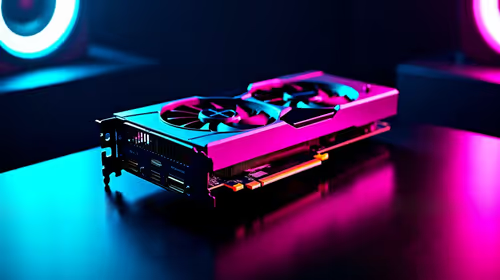
A second-hand GPU can save real money, but only buy one you can bench-test in person and that still carries transferable warranty. Used RTX 30-series cards (a 3070 around R4,500-R6,500, a 3080 around R7,000-R9,500) make sense; a used card with no warranty and a mining history rarely does.
When a used GPU is the right call
Buy used when the saving versus a new equivalent is at least 30-40% and the card has warranty left. A used RTX 3070 at R4,500-R6,500 undercuts a new RTX 5060-class card while delivering similar 1080p performance of roughly 90-120 fps in most titles. If the discount is under 25% or the warranty has lapsed, a new card with a fresh 3-year guarantee is the safer rand.
How to verify a used card before paying
Run it for 20-30 minutes under a load like Furmark or a demanding game and watch for artifacts, fan rattle or thermal throttling above 83C. Confirm the original invoice, check the warranty is transferable, and inspect the PCB for burnt 12VHPWR pins or repaste residue. Reject any card the seller will not let you test.
FAQ
What is a fair used price for an RTX 3070 in SA?
Roughly R4,500-R6,500 depending on warranty and condition. Below that with proof of warranty is a strong buy; above R7,000 you are close to a new RTX 5060-class card with a full guarantee.
How do I check a used GPU is healthy?
Bench it for 20-30 minutes under Furmark or a heavy game, watch for artifacts and temperatures over 83C, and inspect the power connector for burn marks. Insist on testing before payment.
Is mining damage a real risk on used cards?
Mining itself is gentle on the GPU die but bakes the fans and thermal pads. Budget for a repaste and new pads, and discount the card further if the cooler sounds rough on spin-up.
Pro Tip
Always test a used GPU under load for 20-30 minutes and confirm the warranty transfers. If the seller refuses either, walk away and put the budget toward a new card with a 3-year guarantee.