


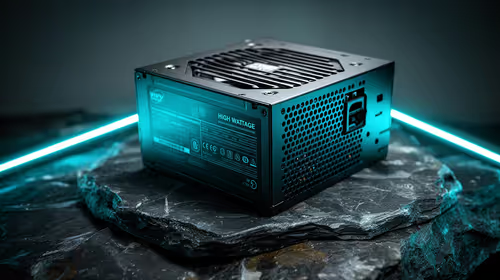
550W PSU Planning for RTX 5080 Super Builds in SA
550W for RTX 5080 Super needs a full-build check, not a simple yes. Review GPU guidance, CPU draw, transient load, connectors, PSU quality, and upgrade plans before deciding.
Read moreA 500mm/s-capable printer can make functional parts only when geometry, material and settings meet the job. The Neptune 4 Max supports speeds up to that ceiling, but no quality outcome is implied at the maximum.

A functional print succeeds because it fits, carries its intended load and remains repeatable, not because the printer reaches a dramatic speed. Testing whether a 500mm/s 3D printer can produce detailed functional parts requires a feature-by-feature acceptance plan.
Yes, but 500mm/s is the Neptune 4 Max ceiling rather than its recommended 250mm/s setting, and detailed functional parts need feature-specific speed control.
Yes, a printer capable of 500mm/s can make functional parts, but the maximum rate does not prove that a specific component will pass. The R9,399 Neptune 4 Max supports operation up to that ceiling through a Klipper high-speed motherboard. Begin with a stable profile, test the critical geometry and raise speed only while fit, strength and repeatability remain acceptable.
Write the part's purpose in measurable terms. A bracket may need hole positions, mating faces and load behaviour checked; an enclosure may prioritise dimensions, fastening points and lid fit. Decorative detail is secondary unless it affects assembly or use.
Build a pass sheet that records each critical feature and how it will be evaluated. Avoid a universal claim that a part is detailed. The high-speed printer selection at Evetech becomes useful after the functional tests have names.
Extract the difficult holes, walls, corners, snap areas or interfaces into a smaller test. Keep their orientation and local geometry consistent with the final component. A generic speed tower may not reproduce the feature that governs success.
Print the coupon at a known passing profile, measure or fit-test it, then introduce one motion change. Preserve every sample with its profile label. This creates a physical record of where function begins to degrade.
The Neptune's 500mm/s limit is a capability boundary. Short features, tight turns and other profile choices may run differently, so complete job time and feature condition deserve separate columns. A faster command that causes a failed fit is slower in practice after rework.
Repeat the promising coupon before applying the profile to the full part. Compare 3D printers across Evetech with accepted functional output as the metric rather than maximum movement alone.
Use different profiles for rough prototypes and end-use functional pieces if their acceptance standards differ. The quickest draft route should not silently replace the controlled production route.
The Neptune 4 Max has a nozzle temperature limit of 300C, but heat alone does not establish filament suitability or part properties. Match the exact material's printer, surface, handling and workspace requirements, then test the finished component under its intended conditions.
Explore filament for 3D printing through Evetech with the functional requirement already defined. Keep material identity, plate face and orientation stable during speed trials.
Move from coupon to complete part only after every critical feature passes. Record both the fastest failure and the fastest repeated success; the gap helps keep future profiles away from an uncertain edge.
Add an assembly test when the part mates with another component. Measure isolated dimensions if they matter, but also fit the pieces through their actual movement or fastening route. A surface can look detailed while a hidden interface blocks use. Photograph the accepted assembly and keep it beside the coupon so every later speed change faces the same functional proof. Date the assembled sample too.
The printer's resonance sensors and 8000mm/s² acceleration support high-speed motion, while the 5.2:1 dual-gear direct drive aims for steady extrusion. Outer walls, holes, mating faces and bridges may need slower treatment than infill or travel. Prove dimensional fit and surface acceptance on the intended material before claiming that maximum speed preserves every requirement across a complex functional part.
No. It identifies machine capability, while the part still needs exact fit, feature, strength and consistency checks under a controlled profile.
Include the interfaces that determine use: holes, mating faces, wall sections, fasteners, loaded areas and any detail required for assembly.
Start with a passing reference, change one motion control and rerun the same representative geometry before moving to the full component.
Its Klipper-equipped high-speed controller permits motion reaching 500mm/s. Useful settings depend on the job and material.
It does not. Confirm complete compatibility and test whether the selected filament delivers the properties the part requires.
They reveal the proven operating window for that geometry, material and acceptance standard instead of leaving one isolated result.
Ready to validate speed through a functional coupon? Compare high-speed 3D printers and filament at Evetech after defining the exact interfaces and properties your part must preserve.
No. It identifies machine capability, while the part still needs exact fit, feature, strength and consistency checks under a controlled profile.
Include the interfaces that determine use: holes, mating faces, wall sections, fasteners, loaded areas and any detail required for assembly.
Start with a passing reference, change one motion control and rerun the same representative geometry before moving to the full component.
Its Klipper-equipped high-speed controller permits motion reaching 500mm/s. Useful settings depend on the job and material.
It does not. Confirm complete compatibility and test whether the selected filament delivers the properties the part requires.
They reveal the proven operating window for that geometry, material and acceptance standard instead of leaving one isolated result.
550W for RTX 5080 Super needs a full-build check, not a simple yes. Review GPU guidance, CPU draw, transient load, connectors, PSU quality, and upgrade plans before deciding.
Read more
8000Hz polling is overrated for most SA gamers because gains can be tiny next to battery drain and monitor limits. Mbombela players should weigh mouse feel, game support, and system stability before chasing the number.
Read more
Magnetic switches are taking over SA gaming keyboards because actuation can be tuned. For Sandton gamers, rapid trigger, reset control, and profile depth can help, but layout, key feel, and software quality still matter.
Read more
Polokwane oled monitor value questions need cautious SA context because pricing can move with availability, exchange rates, specs, and warranty support. Treat the trend as a planning signal, not a fixed price promise.
Read more
Arc B580 budget builds for Midrand gamers can shift with exchange rates, supply, specs, and model tier. Treat the title as a buying prompt, then compare SA warranty, timing, and build priorities.
Read more
ROG Ally X may beat the LCD Steam Deck for SA gamers who value stronger handheld performance, more memory, and Windows flexibility. Compare battery life, controls, game libraries, and Polokwane support needs before deciding.
Read more
Minisforum's M2 Pro pairs Core Ultra X7, Arc B390 graphics and 32GB onboard memory in 1.8 litres. SA buyers should weigh its fixed memory and $1,439 launch offer against local mini PCs.

Lenovo says Legion Go failures linked to BIOS N3CN42WW are not user error. Affected SA owners should stop retrying the update, preserve proof and open a support case.

Smart monitors can add apps and convenience, but they also add privacy settings and unwanted-software risk. SA buyers should audit the operating system before paying for extras.

A fake 113GB GTA VI ISO reportedly used empty padding around a small malware payload. SA gamers should delete unofficial builds, keep Windows security active and wait for official channels.

ASUS calls the ROG GT-BN98 the first Wi-Fi 8 gaming router. SA buyers should fix coverage and client limits before paying for a future wireless standard.

Apple's M6 Mac mini adds faster AI, graphics and networking in the same compact format. SA buyers should wait for a rand listing before comparing value.

The Vulcan II XP adds hot-swappable switches, sound damping and gaming controls to a full-size wired board. SA buyers should compare feel before features.

Microsoft says Windows on Arm now has over 7,000 verified apps and games. SA buyers should still check each driver, game and work tool before switching.

Xbox Insiders can test disc-to-digital from 31 August 2026. Supported Xbox One and Series X discs gain a digital entitlement, but older discs, regions and title coverage still need exact checks.

ViewSonic's XG2738 pairs QHD QD-OLED with 240Hz and automatic panel care. SA buyers should compare warranty, brightness, ports and burn-in protection against today's R9,999-plus OLED shelf.

NVIDIA's final Windows 10 Game Ready driver is due in October 2026. SA gamers can keep using their GPU, but new game optimisations move on while critical security fixes continue quarterly.

JBL's new Quantum 520, 520X and 120 headsets cover wireless, Xbox-certified and wired use. SA buyers should compare connection, comfort and microphone needs before paying for a new badge.