You are out of the house, you open the app to grab a file off your NAS, and it spins, fails, and offers nothing useful. Before you start opening ports on the router, check the NAS itself. Reaching your NAS remotely usually breaks for one of three reasons: the relay service is switched off, the NAS has lost its own internet connection, or a DDNS hostname has not caught up after your IP changed.
Quick Answer
Open the NAS control panel and confirm the relay service, such as Synology QuickConnect, is enabled and that the NAS can reach the internet. If you use DDNS, check the hostname has refreshed to your current IP. These NAS-side checks fix most remote-access failures before the router is ever involved.
Check the NAS Before the Router
The instinct is to blame the router and start port-forwarding, but the relay services that power most remote access do not need any router configuration to work. They rely on the NAS being able to reach the vendor's relay servers. So the first move is always to look at the NAS, not the network around it.
Open the external-access settings on the device. Confirm the relay feature is ticked on, and that the specific services you want to reach remotely are enabled in its advanced options. A relay that has been switched off, or a service that was never enabled, accounts for a large share of "cannot connect" reports.
The Three Usual Causes
Work through these in order and you will catch nearly every case.
First, the relay service is disabled. Re-enable it in the control panel and confirm the services you need are switched on. Second, the NAS itself has no internet. The relay cannot connect if the NAS cannot reach the vendor's servers, so check the NAS has a working connection and that its DNS is set sensibly, for example to a reliable public DNS server if your router changed recently. Third, a DDNS hostname has gone stale. When your ISP hands you a new IP, the DDNS record must update to match; if it has not refreshed, the hostname points at the wrong address and remote access fails.
When It Is Genuinely the Network
If the relay is on, the NAS has internet, and DDNS is current, only then look outward. A recent router or ISP change is a common trigger, since it can reset DNS settings or change your IP. Confirm the NAS can reach the internet on the ports its relay needs, and check nothing on the network is blocking it. You can review current models and their remote-access features in the NAS storage range at Evetech if you are weighing a unit with simpler remote setup.
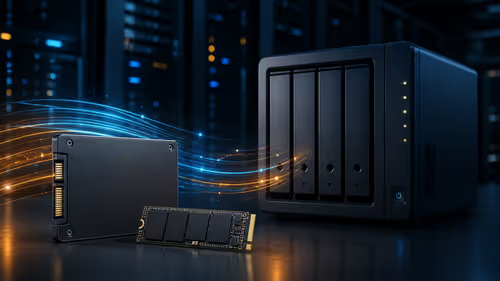
A relayed connection can also feel slow because traffic takes a longer path through the relay server. That is normal and separate from a failure; if files load but crawl, the relay is working but routing the long way. Keeping fast storage in the NAS helps the experience once you are connected, and a quick look at the top-selling SSDs shows what fits.
Frequently Asked Questions
Why can't I reach my NAS remotely all of a sudden?
The most common causes are the relay service being disabled, the NAS losing its internet connection, or a DDNS hostname that has not refreshed after an IP change. Check those on the NAS before touching the router.
Do I need to port-forward to access my NAS remotely?
Usually not. Relay services like QuickConnect work without router configuration as long as the NAS can reach the vendor's servers. Check the relay and the NAS's internet connection first.
Why did remote access stop after I changed routers?
A new router can reset DNS settings or change your IP, which breaks DDNS until it refreshes. Set the NAS to a reliable DNS server and confirm the DDNS hostname has updated to your current address.
Why is my remote NAS connection so slow?
A relayed connection routes traffic through the vendor's relay server, which adds latency. If files load but slowly, the relay is working but taking the longer path rather than a direct connection.
How do I know if the relay service is the problem?
Open the NAS external-access settings and check the relay feature is enabled and the services you want are switched on. A disabled relay or an unenabled service is one of the most frequent causes of remote-access failure.
Get reliable access to your files from anywhere. Browse the NAS storage range at Evetech and choose a unit with straightforward, dependable remote access built in.