


550W PSU Planning for RTX 5080 Super Builds in SA
550W for RTX 5080 Super needs a full-build check, not a simple yes. Review GPU guidance, CPU draw, transient load, connectors, PSU quality, and upgrade plans before deciding.
Read moreSchools and businesses should choose through project fit, supervision, workflow and workspace needs. The R9,399 Neptune 4 Max offers 420 x 420 x 480mm capacity, Klipper speed control and a 300C nozzle for comparison.

Schools, shared workshops and small businesses need a printer process that different users can repeat safely and consistently. Choosing a 3D printer for South African organisations means matching projects, supervision, materials, room access and handover routines before headline speed.
South African schools, workshops and small businesses can use the Neptune 4 Max for large models or batches, provided space, supervision, ventilation and material workflow are planned.
Define the projects, trained users, approval steps and measured workspace first. At R9,399, the Neptune 4 Max offers a 420 x 420 x 480mm build volume, Klipper high-speed control and a 300C nozzle for evaluation. The organisation should adopt it only when exact materials, plate procedures and complete jobs can be supervised and reproduced.
List the objects the printer will support: teaching samples, workshop prototypes, jigs, models or batch items. Prepare one representative file for each important class and write the acceptance result in plain language.
Assign who prepares files, approves materials, starts jobs, monitors operation, removes parts and closes the workspace. Shared ownership without named responsibility creates inconsistent profiles and plate care.
Compare large 3D printers through Evetech using the same role and project matrix. Capacity matters only when authorised work uses it.
The Neptune envelope measures 420 x 420 x 480mm. Check every prepared axis, including orientation and supports. Large pieces may avoid joins, while smaller repeated objects can use a validated bed layout.
The high-speed board uses Klipper and allows motion reaching 500mm/s. Time complete accepted work instead of scheduling from the maximum. Detail, first layers and profile choices can reduce realised speed.
The 300C nozzle sets a thermal ceiling without defining compatible filament. Select approved spools through 3D printing filament at Evetech, then document their full printer, storage, handling and room requirements.
The upgraded dual-sided plate needs face labels and separate care notes after construction is identified. Record cleaning, active material, first-layer result and release. Another user should be able to restore the baseline without guessing.
Keep approved profiles readably named by project and material. Restrict experimental changes to a supervised trial route so routine output remains recoverable.
Obtain exterior dimensions and mark motion, spool, cable, plate-removal, maintenance and operator clearance. Printable volume is not footprint. Access controls should reflect the exact equipment and material guidance.
Use the broader Evetech 3D printer collection after measuring the room and defining supervision. Ventilation or safety arrangements must follow the actual process; nozzle temperature cannot supply a universal answer.
Run a dry rehearsal covering file approval, material collection, loading, monitoring, unloading, plate return and shutdown. Record where responsibility or space fails. A successful organisational setup makes the correct route easier to follow than an improvised shortcut.
Review the process after several jobs. Track rejected prints, plate incidents, unavailable material and training questions by cause, then improve the workflow rather than assuming the machine needs replacement.
Keep a short competency sign-off for each operator role. File preparation, supervised start, monitoring and plate handling can be learned separately. Clear permissions allow students or staff to participate at an appropriate level without giving every user control of the complete process. Date each approval.
The 121-point levelling system supports repeatable first layers, while direct drive and a 300C hotend broaden filament work from PLA to nylon. Klipper speed can shorten suitable jobs, and 8GB storage holds design files locally. Schools should control hot surfaces and access; workshops should protect calibration; businesses should measure accepted throughput. The same hardware serves each setting only when its operating routine matches the users.
Define project classes, authorised users, approval steps, material routes, acceptance checks and the measured operating area.
It can contain large teaching models or workshop items and support tested batches, provided prepared files fit all three axes.
No. Schedule from repeatable complete-job times and accepted output, not from the 500mm/s motion ceiling alone.
Treat it as one thermal boundary. Every approved filament still needs a verified full-system and workspace process.
Two usable faces require identification, correct care and a handover note so different operators preserve the chosen baseline.
Follow exact equipment and material guidance, assign trained responsibilities and rehearse access, monitoring, unloading and shutdown.
The Neptune 4 Max costs R9,399. Relate that amount to the organisation's repeated projects and controlled workflow.
Ready to build a repeatable shared 3D printing process? Explore printers and filament at Evetech with project ownership, approved materials and room responsibilities already mapped.
Define project classes, authorised users, approval steps, material routes, acceptance checks and the measured operating area.
It can contain large teaching models or workshop items and support tested batches, provided prepared files fit all three axes.
No. Schedule from repeatable complete-job times and accepted output, not from the 500mm/s motion ceiling alone.
Treat it as one thermal boundary. Every approved filament still needs a verified full-system and workspace process.
Two usable faces require identification, correct care and a handover note so different operators preserve the chosen baseline.
Follow exact equipment and material guidance, assign trained responsibilities and rehearse access, monitoring, unloading and shutdown.
The Neptune 4 Max costs R9,399. Relate that amount to the organisation's repeated projects and controlled workflow.
550W for RTX 5080 Super needs a full-build check, not a simple yes. Review GPU guidance, CPU draw, transient load, connectors, PSU quality, and upgrade plans before deciding.
Read more
8000Hz polling is overrated for most SA gamers because gains can be tiny next to battery drain and monitor limits. Mbombela players should weigh mouse feel, game support, and system stability before chasing the number.
Read more
Magnetic switches are taking over SA gaming keyboards because actuation can be tuned. For Sandton gamers, rapid trigger, reset control, and profile depth can help, but layout, key feel, and software quality still matter.
Read more
Polokwane oled monitor value questions need cautious SA context because pricing can move with availability, exchange rates, specs, and warranty support. Treat the trend as a planning signal, not a fixed price promise.
Read more
Arc B580 budget builds for Midrand gamers can shift with exchange rates, supply, specs, and model tier. Treat the title as a buying prompt, then compare SA warranty, timing, and build priorities.
Read more
ROG Ally X may beat the LCD Steam Deck for SA gamers who value stronger handheld performance, more memory, and Windows flexibility. Compare battery life, controls, game libraries, and Polokwane support needs before deciding.
Read more
Minisforum's M2 Pro pairs Core Ultra X7, Arc B390 graphics and 32GB onboard memory in 1.8 litres. SA buyers should weigh its fixed memory and $1,439 launch offer against local mini PCs.

Lenovo says Legion Go failures linked to BIOS N3CN42WW are not user error. Affected SA owners should stop retrying the update, preserve proof and open a support case.

Smart monitors can add apps and convenience, but they also add privacy settings and unwanted-software risk. SA buyers should audit the operating system before paying for extras.

A fake 113GB GTA VI ISO reportedly used empty padding around a small malware payload. SA gamers should delete unofficial builds, keep Windows security active and wait for official channels.

ASUS calls the ROG GT-BN98 the first Wi-Fi 8 gaming router. SA buyers should fix coverage and client limits before paying for a future wireless standard.
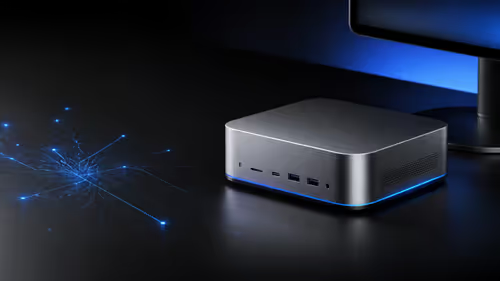
Apple's M6 Mac mini adds faster AI, graphics and networking in the same compact format. SA buyers should wait for a rand listing before comparing value.
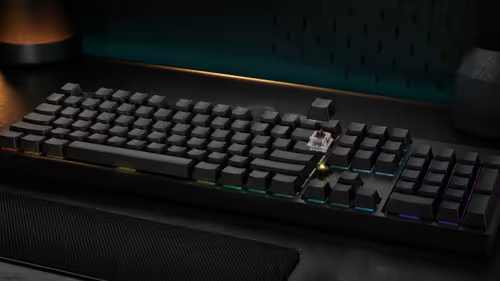
The Vulcan II XP adds hot-swappable switches, sound damping and gaming controls to a full-size wired board. SA buyers should compare feel before features.

Microsoft says Windows on Arm now has over 7,000 verified apps and games. SA buyers should still check each driver, game and work tool before switching.

Xbox Insiders can test disc-to-digital from 31 August 2026. Supported Xbox One and Series X discs gain a digital entitlement, but older discs, regions and title coverage still need exact checks.

ViewSonic's XG2738 pairs QHD QD-OLED with 240Hz and automatic panel care. SA buyers should compare warranty, brightness, ports and burn-in protection against today's R9,999-plus OLED shelf.

NVIDIA's final Windows 10 Game Ready driver is due in October 2026. SA gamers can keep using their GPU, but new game optimisations move on while critical security fixes continue quarterly.

JBL's new Quantum 520, 520X and 120 headsets cover wireless, Xbox-certified and wired use. SA buyers should compare connection, comfort and microphone needs before paying for a new badge.