


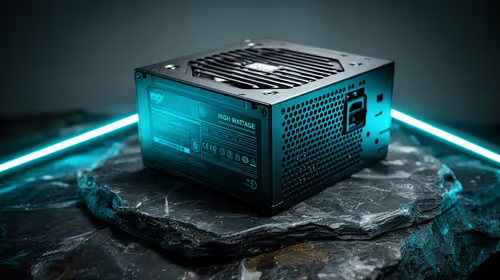
550W PSU Planning for RTX 5080 Super Builds in SA
550W for RTX 5080 Super needs a full-build check, not a simple yes. Review GPU guidance, CPU draw, transient load, connectors, PSU quality, and upgrade plans before deciding.
Read moreCloud gaming streams video continuously through your router for every minute played, while downloading pays a large upfront data cost then uses little after. Evetech's advice: for dozens of hours of play, downloading usually costs less data overall.
Cloud play spends data every minute; a local install pays most of the cost before the first session. The cloud gaming vs download data answer changes with file size, patching and how many hours you expect to play.
Cloud gaming uses data for a live video and audio stream during every minute you play. A downloaded game has a large upfront install and patch cost, then sends much smaller gameplay traffic. Downloading often uses less data over many hours, but the break-even point depends on the game's current download size, patch history and the cloud service's measured hourly use at your chosen quality. Cloud play saves local storage and can avoid one large install. Calculate both routes before using a capped LTE line.
For download play, add the full install, patches expected during the month and measured match traffic. For cloud play, multiply the service's observed hourly data by your planned hours and add any client updates.
Use the current queue size and your own provider counter. Marketing resolution does not give a precise rate because codecs, frame complexity and adaptive quality change the stream.
The break-even point is the download total divided by the cloud hourly rate. Recalculate after a large season patch or quality change.
Reset the provider or device counter, cloud-play for two normal hours and record the data. Use the service's selected resolution and frame rate. Divide the current local download plus expected patches by that measured hourly result.
The answer is the rough number of cloud hours at which the local route catches up on data. It is a planning aid, since adaptive bitrate and future patches move both sides.
For a game you may abandon after one evening, cloud play can avoid the install. For a title you expect to play every week, the repeated stream can pass the one-off download. Storage, service availability and image quality still decide whether either route suits you.
Higher resolution, frame rate and image quality tend to raise the stream bitrate. Adaptive services may reduce quality when the line becomes unstable, which changes the data rate and visual result.
Voice chat and party systems add traffic to both methods. Cloud input also needs a stable, low-latency path to the remote machine, so packet loss can hurt before the cap runs out.
Cloud gaming can suit a small SSD or a title you want to sample. A local install gives the PC or console direct rendering and removes video-stream compression from play.
Check whether the exact game and cloud service are available to your South African account. Do not build a cap plan around a catalogue entry from another region.
Browse routers and networking equipment for stable coverage and queue controls. Match a wired test with the correct lead from popular accessories.
No. A huge install played for one hour can exceed a short cloud trial. Longer play often moves the balance towards local installation.
Yes. Resolution, frame rate, codec and adaptive bitrate shape the stream. Measure the selected service and quality.
Local rendering removes the cloud video round trip. Both still depend on the game server, while cloud play adds the remote-render path.
Price the decision in gigabytes by comparing the live install queue with a measured cloud hour at the quality you will use.
No. A huge install played for one hour can exceed a short cloud trial. Longer play often moves the balance towards local installation.
Yes. Resolution, frame rate, codec and adaptive bitrate shape the stream. Measure the selected service and quality.
Local rendering removes the cloud video round trip. Both still depend on the game server, while cloud play adds the remote-render path.
550W for RTX 5080 Super needs a full-build check, not a simple yes. Review GPU guidance, CPU draw, transient load, connectors, PSU quality, and upgrade plans before deciding.
Read more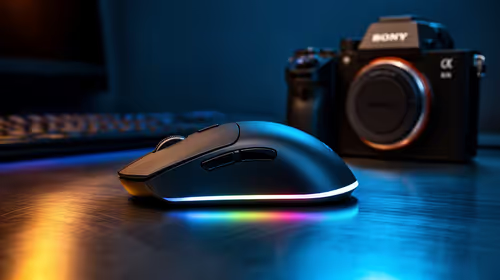
8000Hz polling is overrated for most SA gamers because gains can be tiny next to battery drain and monitor limits. Mbombela players should weigh mouse feel, game support, and system stability before chasing the number.
Read more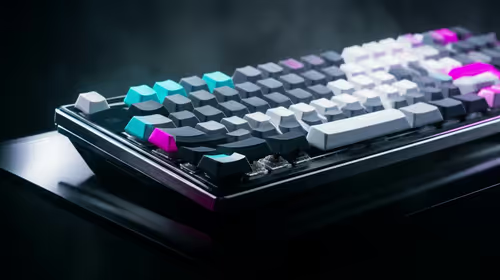
Magnetic switches are taking over SA gaming keyboards because actuation can be tuned. For Sandton gamers, rapid trigger, reset control, and profile depth can help, but layout, key feel, and software quality still matter.
Read more
Polokwane oled monitor value questions need cautious SA context because pricing can move with availability, exchange rates, specs, and warranty support. Treat the trend as a planning signal, not a fixed price promise.
Read more
Arc B580 budget builds for Midrand gamers can shift with exchange rates, supply, specs, and model tier. Treat the title as a buying prompt, then compare SA warranty, timing, and build priorities.
Read more
ROG Ally X may beat the LCD Steam Deck for SA gamers who value stronger handheld performance, more memory, and Windows flexibility. Compare battery life, controls, game libraries, and Polokwane support needs before deciding.
Read more
Minisforum's M2 Pro pairs Core Ultra X7, Arc B390 graphics and 32GB onboard memory in 1.8 litres. SA buyers should weigh its fixed memory and $1,439 launch offer against local mini PCs.
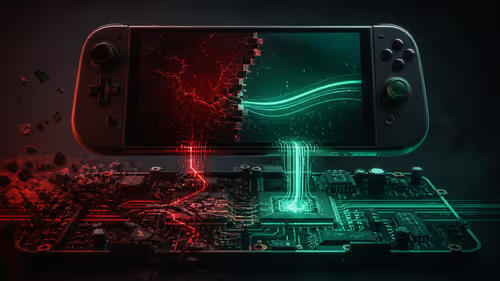
Lenovo says Legion Go failures linked to BIOS N3CN42WW are not user error. Affected SA owners should stop retrying the update, preserve proof and open a support case.

Smart monitors can add apps and convenience, but they also add privacy settings and unwanted-software risk. SA buyers should audit the operating system before paying for extras.

A fake 113GB GTA VI ISO reportedly used empty padding around a small malware payload. SA gamers should delete unofficial builds, keep Windows security active and wait for official channels.
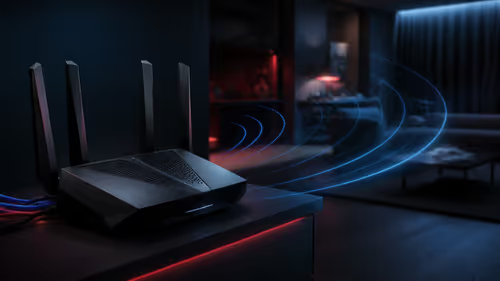
ASUS calls the ROG GT-BN98 the first Wi-Fi 8 gaming router. SA buyers should fix coverage and client limits before paying for a future wireless standard.
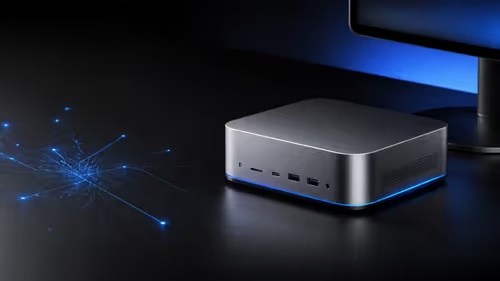
Apple's M6 Mac mini adds faster AI, graphics and networking in the same compact format. SA buyers should wait for a rand listing before comparing value.
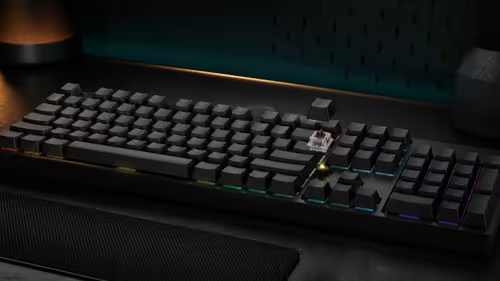
The Vulcan II XP adds hot-swappable switches, sound damping and gaming controls to a full-size wired board. SA buyers should compare feel before features.

Microsoft says Windows on Arm now has over 7,000 verified apps and games. SA buyers should still check each driver, game and work tool before switching.

Xbox Insiders can test disc-to-digital from 31 August 2026. Supported Xbox One and Series X discs gain a digital entitlement, but older discs, regions and title coverage still need exact checks.
ViewSonic's XG2738 pairs QHD QD-OLED with 240Hz and automatic panel care. SA buyers should compare warranty, brightness, ports and burn-in protection against today's R9,999-plus OLED shelf.

NVIDIA's final Windows 10 Game Ready driver is due in October 2026. SA gamers can keep using their GPU, but new game optimisations move on while critical security fixes continue quarterly.

JBL's new Quantum 520, 520X and 120 headsets cover wireless, Xbox-certified and wired use. SA buyers should compare connection, comfort and microphone needs before paying for a new badge.