


550W PSU Planning for RTX 5080 Super Builds in SA
550W for RTX 5080 Super needs a full-build check, not a simple yes. Review GPU guidance, CPU draw, transient load, connectors, PSU quality, and upgrade plans before deciding.
Read moreA 140-degree recline makes an office chair more versatile when the user wants a broader back-angle option beyond upright desk work. The E3 Air reaches that maximum; buyers can assess its controls before using the reclined position.

A recline figure is useful when it describes a position the owner can actually use. A 140-degree recline office chair adds a wider back-angle option than upright desk work, yet that maximum says nothing by itself about room clearance, control feel or the best posture for a task. The E3 Air reaches this angle at R7,399.
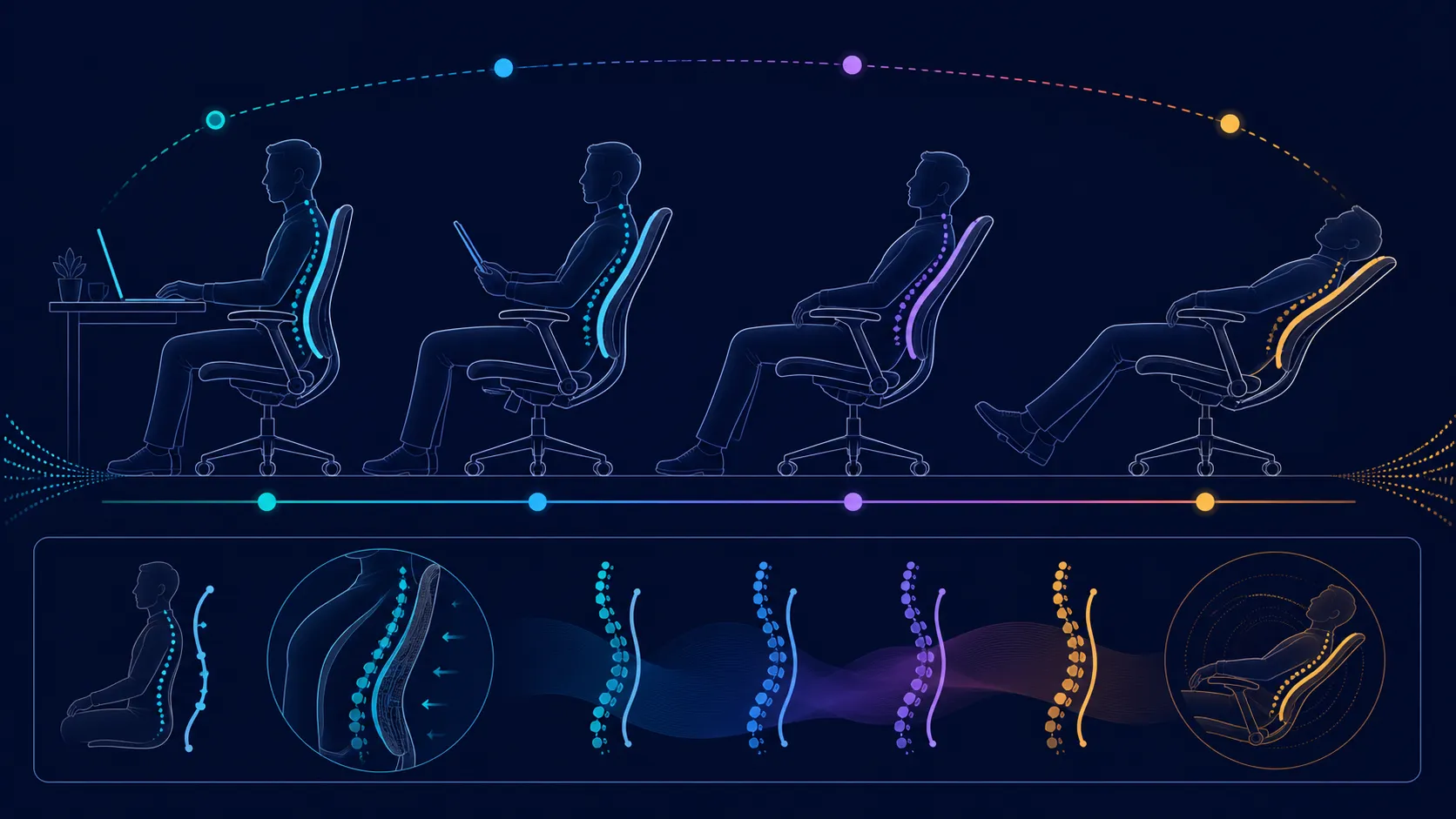
The E3 Air reclines through three useful bands: 105-115 degrees for focus, 115-125 degrees for flow and 140 degrees for a zero-gravity nap position.
Yes, a 140-degree recline can make an ergonomic chair more versatile by adding a clearly different posture for appropriate breaks or less input-heavy activities. On the R7,399 E3 Air, buyers should treat 140 degrees as the endpoint and assess the controls, support and available space separately. It is an option, not a reason to recline through every task.
The maximum angle tells you how far the backrest can travel. It does not identify the route to that position, whether intermediate angles lock, or how resistance behaves. Learn the chair's controls before leaning back, and do the first movement slowly with clear space behind and around the seat.
Check where the monitor, keyboard and mouse go as the back angle changes. A position may be suitable for listening or reading while placing the inputs too far away for sustained typing. Versatility comes from matching posture to activity, not from forcing one reclined angle to handle all office work.
Browse HBADA office chairs through Evetech with the intended activities in mind. Comparing maximum figures without a task list can make a rarely used endpoint seem more valuable than daily support.
The E3 Air pairs its recline with an 80-degree auto-wrap lumbar design spanning three zones. It also has a 4D dual-axis headrest. Changed back angles can alter how both supports meet the user, so assess them through the motion instead of assuming an upright arrangement remains ideal.
Move the 360-degree omni-motion armrests only after settling on an angle. If a break does not require the inputs, the arms may serve a different position than they do for keyboard work. Make one change, spend a few minutes in the intended activity and return to upright before judging whether the alternative is genuinely useful.
Place the chair at its real desk rather than in an open room. Confirm that the five-star steel base remains clear of obstacles and that the reclined back will not meet a wall, shelf or walkway. Apply the 150kg maximum user-weight rating as a firm check, then measure external dimensions and the floor area needed for motion.
Return to the working angle and see whether the desk setup is easy to recover. A versatile recline should not require rebuilding the workstation after every break. Note the chair position relative to the desk if several people use the same space.
The wider Evetech office-chair collection can then be compared by usable posture rather than headline angle. At R7,399, the E3 Air makes sense when the endpoint, support system and footprint work together in the room available.
That makes the chair more versatile than one upright setting. Use the first band for close tasks, the middle range for less input-heavy work and the 140-degree cradle for an appropriate break, with room clearance checked before reclining.
Return through the intermediate band before resuming close keyboard work.
Its maximum recline is 140 degrees. Use that endpoint for comparison, then inspect the actual controls, usable positions and task-appropriate angles separately.
Learn the chair controls, clear the area behind it and move slowly. Make sure the base, backrest and user's limbs will not contact nearby furniture during the change.
It can add another posture for a break, reading or listening when the inputs are not central. Match the angle to the task instead of treating maximum recline as a default.
Yes, contact can change as the backrest moves. The E3 Air uses three-zone support with an 80-degree auto-wrap design, which should be reassessed at the changed angle.
No angle guarantees comfort. Body dimensions, activity, support contact and time in the position differ, so each user needs a separate practical test.
A cloud-like, high-density mesh forms the seating surface. The individual still needs to judge the long-session experience.
Ready to compare recline as a usable posture, not a headline? Explore Evetech office chairs with the room clearance and tasks for each angle already mapped.
Its maximum recline is 140 degrees. Use that endpoint for comparison, then inspect the actual controls, usable positions and task-appropriate angles separately.
Learn the chair controls, clear the area behind it and move slowly. Make sure the base, backrest and user's limbs will not contact nearby furniture during the change.
It can add another posture for a break, reading or listening when the inputs are not central. Match the angle to the task instead of treating maximum recline as a default.
Yes, contact can change as the backrest moves. The E3 Air uses three-zone support with an 80-degree auto-wrap design, which should be reassessed at the changed angle.
No angle guarantees comfort. Body dimensions, activity, support contact and time in the position differ, so each user needs a separate practical test.
A cloud-like, high-density mesh forms the seating surface. The individual still needs to judge the long-session experience.
550W for RTX 5080 Super needs a full-build check, not a simple yes. Review GPU guidance, CPU draw, transient load, connectors, PSU quality, and upgrade plans before deciding.
Read more
8000Hz polling is overrated for most SA gamers because gains can be tiny next to battery drain and monitor limits. Mbombela players should weigh mouse feel, game support, and system stability before chasing the number.
Read more
Magnetic switches are taking over SA gaming keyboards because actuation can be tuned. For Sandton gamers, rapid trigger, reset control, and profile depth can help, but layout, key feel, and software quality still matter.
Read more
Polokwane oled monitor value questions need cautious SA context because pricing can move with availability, exchange rates, specs, and warranty support. Treat the trend as a planning signal, not a fixed price promise.
Read more
Arc B580 budget builds for Midrand gamers can shift with exchange rates, supply, specs, and model tier. Treat the title as a buying prompt, then compare SA warranty, timing, and build priorities.
Read more
ROG Ally X may beat the LCD Steam Deck for SA gamers who value stronger handheld performance, more memory, and Windows flexibility. Compare battery life, controls, game libraries, and Polokwane support needs before deciding.
Read more
Minisforum's M2 Pro pairs Core Ultra X7, Arc B390 graphics and 32GB onboard memory in 1.8 litres. SA buyers should weigh its fixed memory and $1,439 launch offer against local mini PCs.

Lenovo says Legion Go failures linked to BIOS N3CN42WW are not user error. Affected SA owners should stop retrying the update, preserve proof and open a support case.

Smart monitors can add apps and convenience, but they also add privacy settings and unwanted-software risk. SA buyers should audit the operating system before paying for extras.

A fake 113GB GTA VI ISO reportedly used empty padding around a small malware payload. SA gamers should delete unofficial builds, keep Windows security active and wait for official channels.

ASUS calls the ROG GT-BN98 the first Wi-Fi 8 gaming router. SA buyers should fix coverage and client limits before paying for a future wireless standard.

Apple's M6 Mac mini adds faster AI, graphics and networking in the same compact format. SA buyers should wait for a rand listing before comparing value.

The Vulcan II XP adds hot-swappable switches, sound damping and gaming controls to a full-size wired board. SA buyers should compare feel before features.

Microsoft says Windows on Arm now has over 7,000 verified apps and games. SA buyers should still check each driver, game and work tool before switching.

Xbox Insiders can test disc-to-digital from 31 August 2026. Supported Xbox One and Series X discs gain a digital entitlement, but older discs, regions and title coverage still need exact checks.

ViewSonic's XG2738 pairs QHD QD-OLED with 240Hz and automatic panel care. SA buyers should compare warranty, brightness, ports and burn-in protection against today's R9,999-plus OLED shelf.

NVIDIA's final Windows 10 Game Ready driver is due in October 2026. SA gamers can keep using their GPU, but new game optimisations move on while critical security fixes continue quarterly.

JBL's new Quantum 520, 520X and 120 headsets cover wireless, Xbox-certified and wired use. SA buyers should compare connection, comfort and microphone needs before paying for a new badge.