


550W PSU Planning for RTX 5080 Super Builds in SA
550W for RTX 5080 Super needs a full-build check, not a simple yes. Review GPU guidance, CPU draw, transient load, connectors, PSU quality, and upgrade plans before deciding.
Read moreDirectX 12 Ultimate matters on a creator-focused graphics card because it enables ray traced previews in supported apps. The R14,399 ASRock Pro B60 Creator includes full support, alongside 24GB of GDDR6 and Xe2-HPG architecture.
Creative software has quietly shifted toward real-time ray tracing for preview windows, and that shift changes what a graphics card needs to support before it is worth buying. Ray traced shadows and reflections used to be reserved for a final render pass; now they show up while you are still dragging a light around the viewport. That is exactly the gap a 24gb creator graphics card with modern API support is built to close.
Yes, DirectX 12 Ultimate matters on a creator graphics card, because it unlocks ray traced previews, mesh shading, and variable rate shading inside supported applications rather than leaving those features unused. Priced at R14,399, the ASRock Intel Pro B60 Creator ships with full support for the API, backed by 24GB of GDDR6 memory to hold the scenes that benefit from it.
Older workflows often meant setting up lighting blind, then waiting through a full render just to see how reflections and shadows actually behaved. With DirectX 12 Ultimate support in place, compatible 3D and video applications can show a ray traced approximation directly in the working viewport, so lighting decisions get made in seconds instead of minutes. Pulling that off smoothly needs a GPU with enough dedicated memory to keep the whole scene loaded rather than swapping pieces in and out, and that is exactly the job the 24GB GDDR6 buffer on this card is built to do.
DirectX 12 Ultimate is not only about ray tracing. It also standardises mesh shading and variable rate shading, both of which help software manage complex geometry and rendering workloads more efficiently across the GPU. For a creator relying on this Intel-based creator GPU, that broader feature set means the card stays useful as software updates lean further into these capabilities rather than becoming outdated the moment a new engine version ships.
Underneath DirectX 12 Ultimate sits Intel's Xe2-HPG architecture, running at a 2400 MHz clock and handling the rasterisation, ray tracing, and compute work the API calls for. The dedicated XMX engines add AI acceleration on top, useful for denoising ray traced previews so they look clean at interactive frame rates rather than grainy and unfinished. Together, architecture and API support form a package rather than a single standout feature, and comparing it against the workstation graphics card lineup shows how that combination stacks up against other creator-focused options.
For anyone weighing a R14,399 purchase, the deciding factor is usually whether current software actually uses these features day to day, rather than the spec sheet alone. Editors and 3D artists working in applications with active ray tracing or mesh shading support get tangible benefit; those on older pipelines may see less difference immediately. Checking the full ASRock catalogue helps put this model's price and feature set into context against the brand's other offerings.
It enables ray traced previews, mesh shading, and variable rate shading in supported applications, letting software use modern rendering techniques rather than older fallback methods.
Many video applications increasingly use ray traced effects for previews and colour work, so the support still has practical value even outside pure 3D pipelines.
Yes, complete DirectX 12 Ultimate compliance ships as standard here, alongside the 24GB GDDR6 buffer and Xe2-HPG architecture already covered above.
Yes, DirectX 12 Ultimate support is additive rather than a requirement, so existing workflows continue to function as before.
Ready to weigh up whether DirectX 12 Ultimate matters to you? See the B60 Creator, ASRock's 24GB card on Evetech's stock of creator GPUs, tagged at R14,399 and works to pair DirectX 12 Ultimate support with serious creator memory.
It enables ray traced previews, mesh shading, and variable rate shading in supported applications, letting software use modern rendering techniques rather than older fallback methods.
Many video applications increasingly use ray traced effects for previews and colour work, so the support still has practical value even outside pure 3D pipelines.
Yes, complete DirectX 12 Ultimate compliance ships as standard here, alongside the 24GB GDDR6 buffer and Xe2-HPG architecture already covered above.
Yes, DirectX 12 Ultimate support is additive rather than a requirement, so existing workflows continue to function as before.
550W for RTX 5080 Super needs a full-build check, not a simple yes. Review GPU guidance, CPU draw, transient load, connectors, PSU quality, and upgrade plans before deciding.
Read more
8000Hz polling is overrated for most SA gamers because gains can be tiny next to battery drain and monitor limits. Mbombela players should weigh mouse feel, game support, and system stability before chasing the number.
Read more
Magnetic switches are taking over SA gaming keyboards because actuation can be tuned. For Sandton gamers, rapid trigger, reset control, and profile depth can help, but layout, key feel, and software quality still matter.
Read more
Polokwane oled monitor value questions need cautious SA context because pricing can move with availability, exchange rates, specs, and warranty support. Treat the trend as a planning signal, not a fixed price promise.
Read more
Arc B580 budget builds for Midrand gamers can shift with exchange rates, supply, specs, and model tier. Treat the title as a buying prompt, then compare SA warranty, timing, and build priorities.
Read more
ROG Ally X may beat the LCD Steam Deck for SA gamers who value stronger handheld performance, more memory, and Windows flexibility. Compare battery life, controls, game libraries, and Polokwane support needs before deciding.
Read more
Minisforum's M2 Pro pairs Core Ultra X7, Arc B390 graphics and 32GB onboard memory in 1.8 litres. SA buyers should weigh its fixed memory and $1,439 launch offer against local mini PCs.

Lenovo says Legion Go failures linked to BIOS N3CN42WW are not user error. Affected SA owners should stop retrying the update, preserve proof and open a support case.

Smart monitors can add apps and convenience, but they also add privacy settings and unwanted-software risk. SA buyers should audit the operating system before paying for extras.

A fake 113GB GTA VI ISO reportedly used empty padding around a small malware payload. SA gamers should delete unofficial builds, keep Windows security active and wait for official channels.
ASUS calls the ROG GT-BN98 the first Wi-Fi 8 gaming router. SA buyers should fix coverage and client limits before paying for a future wireless standard.
Apple's M6 Mac mini adds faster AI, graphics and networking in the same compact format. SA buyers should wait for a rand listing before comparing value.
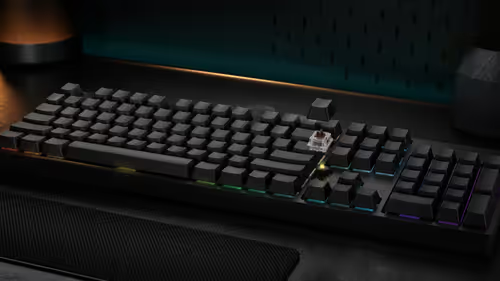
The Vulcan II XP adds hot-swappable switches, sound damping and gaming controls to a full-size wired board. SA buyers should compare feel before features.

Microsoft says Windows on Arm now has over 7,000 verified apps and games. SA buyers should still check each driver, game and work tool before switching.

Xbox Insiders can test disc-to-digital from 31 August 2026. Supported Xbox One and Series X discs gain a digital entitlement, but older discs, regions and title coverage still need exact checks.
ViewSonic's XG2738 pairs QHD QD-OLED with 240Hz and automatic panel care. SA buyers should compare warranty, brightness, ports and burn-in protection against today's R9,999-plus OLED shelf.

NVIDIA's final Windows 10 Game Ready driver is due in October 2026. SA gamers can keep using their GPU, but new game optimisations move on while critical security fixes continue quarterly.

JBL's new Quantum 520, 520X and 120 headsets cover wireless, Xbox-certified and wired use. SA buyers should compare connection, comfort and microphone needs before paying for a new badge.