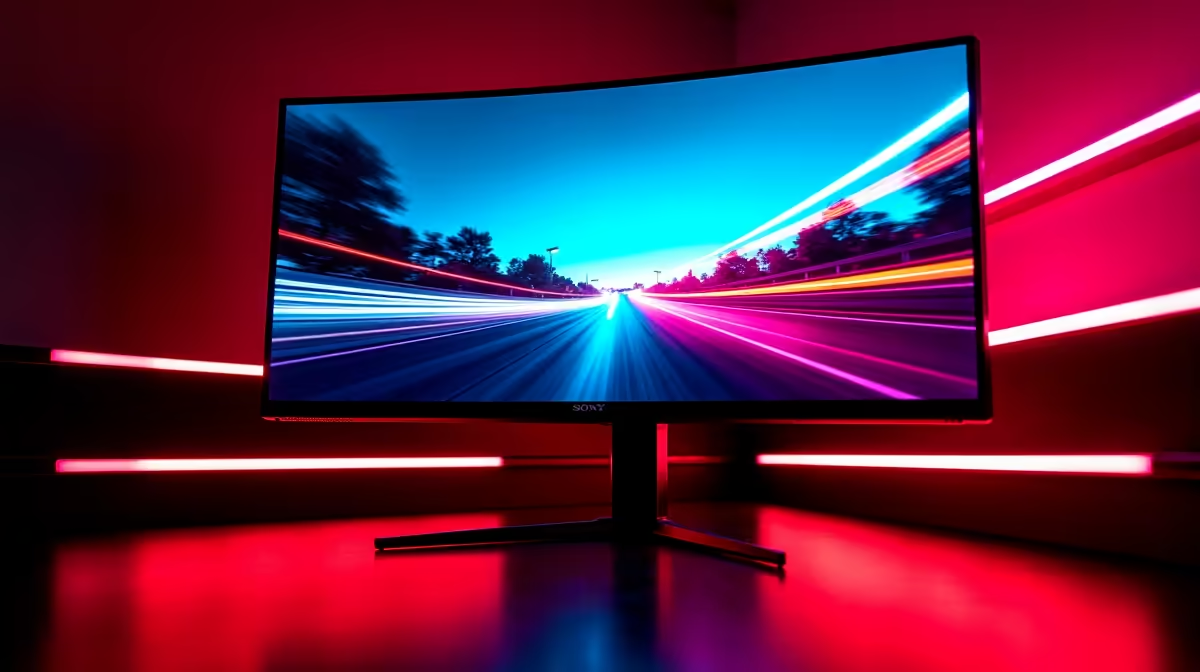
Fast-action games reveal everything a slow panel is hiding. Explosions streak, crosshairs trail, fast-moving enemies leave smudges behind them. Dropping in a monitor rated at 0.5ms pixel response time attacks that problem at its root by ensuring each pixel completes its transition before the next frame arrives.
Quick Answer
A 0.5ms response time clears pixels fast enough to prevent trailing smears in most games. Pair it with a 144Hz or higher refresh rate because the two work together. Faster pixels on a slow panel still produce blur from the sample-and-hold effect.
🔧 What Pixel Response Time Controls
Every pixel on your panel is a tiny shutter that opens and closes to match the incoming frame colour. On a monitor rated at 4ms or 8ms, some pixels are still mid-transition when the next frame lands. The residual colour from the previous position bleeds into the new frame as a visible ghost trailing the object.
At 0.5ms, the transition completes quickly enough that by the time the next frame paints, those pixels are ready with a clean state. One nuance worth knowing: manufacturers measure this in two ways. GtG (grey-to-grey) measures the raw pixel switching time between mid-range shades. MPRT (moving picture response time) factors in backlight strobing, which shortens the perceived blur period. A 0.5ms MPRT and 0.5ms GtG describe different things, so check which metric the spec sheet uses before comparing panels.
⚡ Why Refresh Rate Is the Other Half
A fast pixel response solves one type of motion blur, but not both. Sample-and-hold blur is separate. It occurs because a static image stays on the panel until the next refresh, and your eye tracking a moving object sees it against that frozen frame. Higher refresh rates shrink the hold time: 60Hz holds each frame for about 16.7ms, 144Hz for 6.9ms. The combination of 0.5ms transitions and 144Hz-plus refresh attacks both sources simultaneously, which is why those specs appear together in gaming monitor marketing.
🎯 Overdrive and Its Trade-offs
Most gaming monitors include an overdrive setting, sometimes labelled Response Time or Trace Free, that pushes pixels through transitions faster. This is often how 0.5ms figures are achieved. The catch is overshoot: excessive overdrive causes a bright halo to appear ahead of moving objects, called inverse ghosting, which can be more distracting than the original smear. The medium preset on most panels delivers most of the speed benefit without the overshoot. Test your monitor's settings in a fast scene and step down if halos appear ahead of objects rather than trails behind them.
Frequently Asked Questions
What causes the trailing ghost behind fast-moving objects?
When a pixel cannot complete its colour change before the panel draws the next frame, leftover colour bleeds into the fresh image as a smear. The faster the on-screen motion and the slower the pixel, the longer and more visible that trail becomes.
Does 0.5ms MPRT mean the same thing as 0.5ms GtG?
No. GtG measures raw pixel switching between two greyscale values. MPRT factors in how long backlight strobing keeps a given frame visible, so the perceived blur duration includes both. Both target cleaner motion but they are not directly comparable numbers across different panels.
Should I set overdrive to maximum for the fastest response?
Maximum overdrive almost always introduces inverse ghosting halos ahead of moving objects. The medium or balanced preset delivers most of the speed benefit without the overshoot. Test at medium and increase one step only if ghosting is still visible in fast scenes.
Do I need a new GPU to benefit from a 0.5ms display?
Not for the response time itself. To fully exploit 144Hz-plus refresh alongside it, the GPU needs to push frame rates into that range. An RTX 4060-class card handles 1080p gaming at 144 FPS in most titles, making it the practical pairing for a fast-response panel.
Ready to play without the trailing blur? Browse the gaming monitor range for fast-response IPS and TN panels built around 144Hz-plus refresh rates, suited to every SA gaming rig from budget builds upward.