Picking up a wireless microphone kit without understanding what each component does is how creators end up with a system that mostly works until the moment it needs to handle something specific. A wireless microphone system has four parts that each perform a distinct job, and knowing what they are also tells you where budget kits cut corners.
Quick Answer
Every complete wireless system includes a transmitter that captures and broadcasts your voice, a receiver that accepts the signal and feeds your recording device, a charging case that extends run time, and a set of adapter cables for different cameras and phones. Missing any one of them creates a gap in the chain.
🔧 The Transmitter: Where Your Voice Enters the System
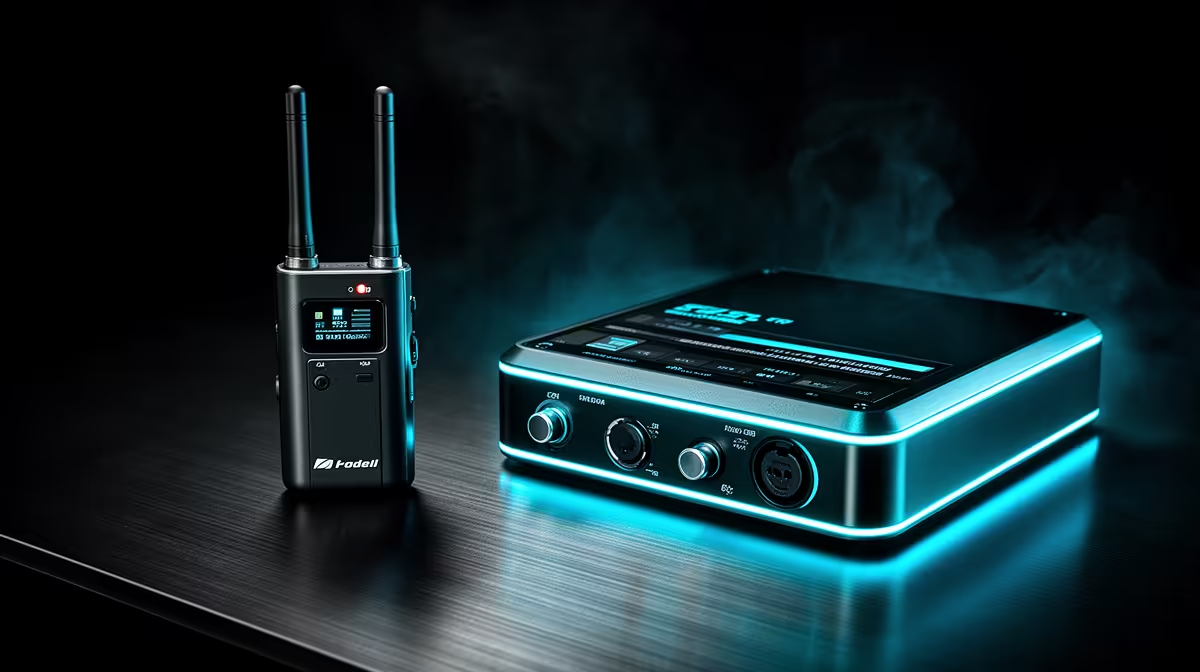
The transmitter is the unit that clips to the presenter. It contains the microphone capsule that picks up speech, an analogue-to-digital converter that processes the signal, and a radio module that broadcasts the result. Every other component in the system is downstream of what the transmitter captures, which makes capsule quality and placement the foundation of everything that follows.
Most current transmitters record at 24-bit depth and some add 8GB to 16GB of onboard memory, capturing a local backup track simultaneously with the wireless signal. If the radio link drops at a critical moment, the internal file is unaffected.
Placement matters. A transmitter clipped at the chest centre with the capsule pointing upward captures more consistent level than one buried under a lapel or twisted sideways.
🎯 The Receiver: Where the Signal Returns
The receiver demodulates the wireless signal and converts it back into audio your recording device can use. It connects to the camera's 3.5mm input, or to a phone via a USB-C or Lightning adapter, and outputs the clean audio without any radio transmission involved on that final cable run.
Receiver quality sets the noise floor of your final recording. A strong transmitter paired with a receiver that adds hiss during demodulation compromises the signal that arrived cleanly. The output preamp quality and interference shielding both determine whether the final recording sounds professional or consumer-grade.
Some receivers mount to the camera hot shoe; others clip separately and route via a short cable for more positioning flexibility.
🔌 The Charging Case: Not Just a Pouch
A passive bag would not need to be mentioned in a component breakdown, but a wireless system's charging case is active hardware. It holds a lithium cell sized to recharge both transmitters two to three times from empty, extending a 7-hour kit through a full shooting day without a wall socket.
Drop the transmitters back in between setups on a long Joburg corporate shoot or a Cape Town outdoor activation and they arrive at the next location charged. On some systems the case also pairs all units together at once, removing any manual frequency negotiation.
🎙️ Adapter Cables: The Chain to Your Recording Device
A wireless kit without the right output adapter is a system that cannot talk to your camera. Most kits include a 3.5mm TRS cable for cameras with a standard input, a USB-C cable for Android phones and recent laptops, and a Lightning adapter for Apple devices. Some premium kits add a TRRS cable for phones that use a combined headphone and microphone jack.
Windshields deserve to be counted alongside the cables as field essentials. Foam or furry covers over the transmitter capsule reduce wind interference by 10 to 20dB on a breezy outdoor shoot. A standard SA coastal shoot in summer wind without any windshielding produces a low rumble that competes with the speaker's voice across the entire recording.
Frequently Asked Questions
Can the transmitter function as a standalone recorder without the receiver connected?
On models with internal storage, yes. The transmitter saves a continuous audio file to its onboard memory regardless of whether the receiver is powered or in range. This backup track uses the same capsule and processing as the transmitted signal, so it is a genuine safety copy rather than a lower-quality fallback.
What does receiver gain adjustment do to the output signal?
It controls the level at the cable going into your camera. Too high and the camera input clips; too low and post-amplification raises the noise floor alongside the signal. Match the receiver output to the input sensitivity your camera manual specifies.
Why do some kits include only one adapter cable?
Budget kits typically include the 3.5mm TRS cable and assume camera use. If you record to a phone via USB-C, confirm the adapter is included or available separately before buying. Using an incompatible connection can damage the receiver port.
Are windshields counted as optional accessories?
Indoors in a controlled environment, yes, the windshield is optional. Outdoors, including any SA coastal or highveld location with ambient wind, it shifts from accessory to necessity. The foam cover on the capsule is the first line of defence against wind noise, and the alternative, removing it in post, is not fully effective once the low rumble has been recorded.
Ready to build a complete wireless system with no missing pieces?
Browse the wireless microphone kits at Evetech to find full-package systems that include every component your shoot actually needs from day one.