Quick Answer
A 420mm AIO uses two 210mm fans (or three 140mm fans in a 420mm frame) to cover more radiator surface area than any 360mm unit, making it the top choice for CPUs with TDPs above 200W. Key features to understand include radiator thickness, fan blade design, pump head type, coldplate material, and ARGB integration. Every one of these directly affects cooling capacity, noise floor, or visual output.
Radiator and Fan Configuration on 420mm AIOs 🌬️
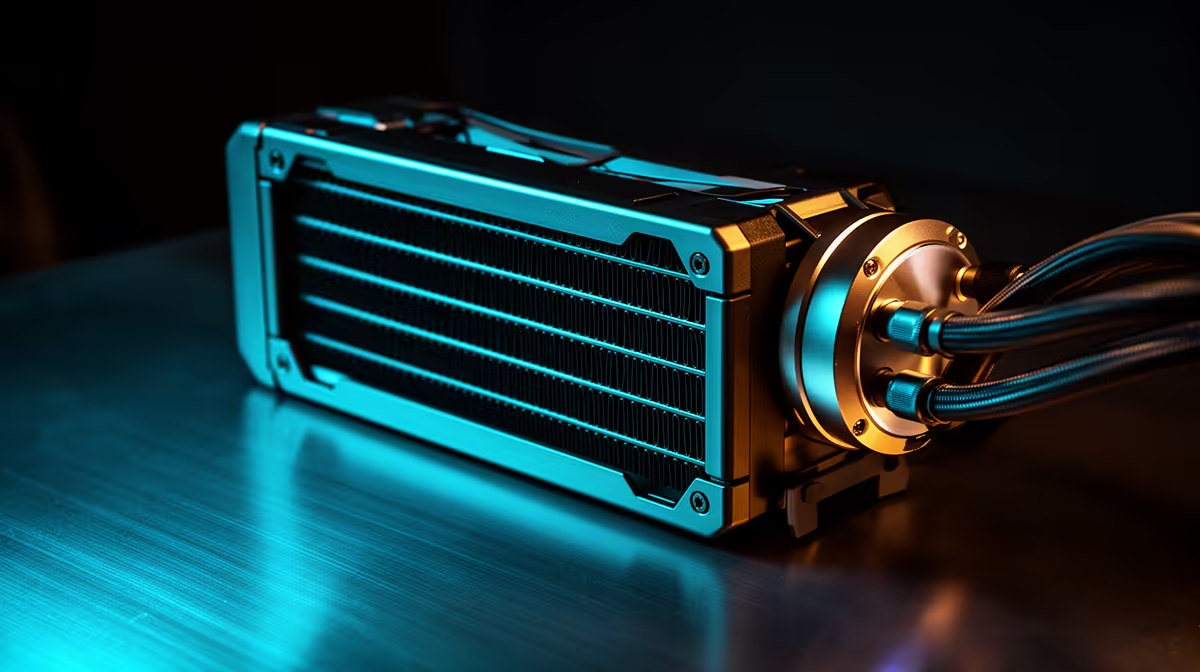
Most 420mm AIOs use a triple-140mm fan layout, with the radiator measuring 420 x 140mm. The radiator fin density is typically between 18 and 22 FPI (fins per inch), with thicker radiators at 27mm to 38mm providing more coolant volume and better heat soak capacity. Fans on 420mm units are usually 140mm high-static-pressure designs spinning between 500 and 1,800 RPM, delivering more airflow per RPM than 120mm fans due to the larger blade sweep. ASUS ROG Ryujin III 420, Corsair iCUE H170i, and Thermaltake Pacific CL420 are among the 420mm units currently stocked locally in South Africa, priced from around R3,500 to R5,500.
Pump Head and Coldplate Design ❄️
The pump head on a 420mm AIO typically uses a copper coldplate with a micro-fin or micro-channel structure that maximises contact surface area with the CPU IHS. Better coldplates use electroplated copper with a smooth mirror finish, which reduces thermal interface resistance between the IHS and coolant. Many flagship 420mm AIOs include Asetek 8th gen or custom in-house pumps rated for 60,000 to 70,000 hours. Premium models add an embedded LCD or AMOLED display on the pump head for real-time telemetry and aesthetic customisation. Ensure the pump head supports your current socket, specifically AM5 for Ryzen 9000 series or LGA1851 for Intel Core Ultra 200.
Noise Profile and Radiator Clearance Considerations 🔇
With three 140mm fans at low RPM settings, a 420mm AIO can operate virtually silently below 50% CPU load. The larger fans maintain high airflow at 600 to 700 RPM, which is acoustically far quieter than small fans at 1,200 RPM. The catch is case compatibility: a 420mm radiator with fans attached is approximately 445mm long and 165mm wide, requiring a full-tower or large mid-tower case with a dedicated 420mm panel mount. Cases supporting 420mm installation include the Lian Li O11 EVO XL, Phanteks Enthoo Pro II, and Fractal Design Torrent XL. Mid-tower cases rarely support 420mm, so confirm your case specification sheet carefully.
Verify 420mm Case Clearance Before Ordering ⚡
A 420mm radiator is 140mm wide rather than 120mm, meaning even cases listed as supporting 360mm often cannot accommodate a 420mm unit. Check your case's side panel interior width and radiator mounting rail dimensions specifically for 420mm compatibility before placing your order.
FAQ
Is a 420mm AIO significantly better than a 360mm for gaming?
For gaming-only workloads on CPUs up to 170W TDP, the difference is marginal, typically 3 to 5 degrees Celsius. The 420mm advantage is clear on CPUs above 200W TDP, such as the Intel Core i9-14900KS or Ryzen 9 9950X under sustained all-core rendering.
Can I fit a 420mm AIO in a standard mid-tower case?
Generally no. Most mid-towers max out at 360mm radiator support. A 420mm radiator requires a large mid-tower or full-tower with 140mm fan mounting rails for the radiator panel.
Do 420mm AIOs come with proper South African warranty support?
Units sold through authorised local channels include local warranty support. Confirm when purchasing that the unit is from an authorised local distributor to avoid grey-import warranty gaps.
Need maximum cooling for a flagship CPU build? Evetech stocks 420mm AIO coolers with full socket support and local warranty, with specifications listed on each product page to confirm case and CPU compatibility.