Quick Answer
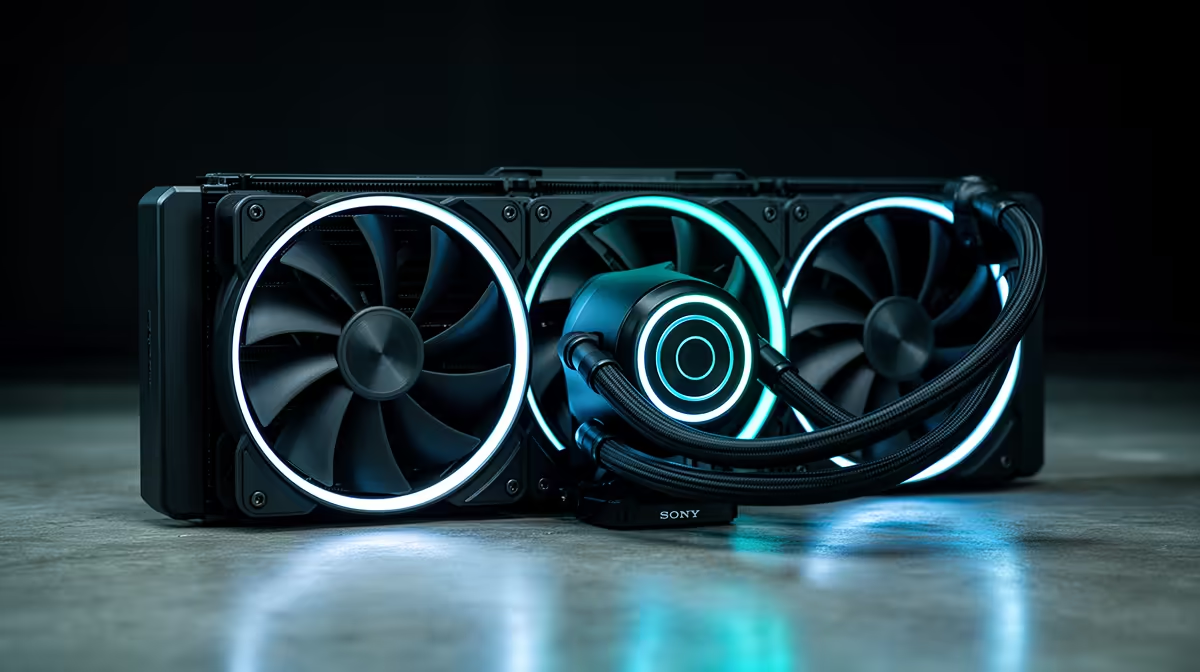
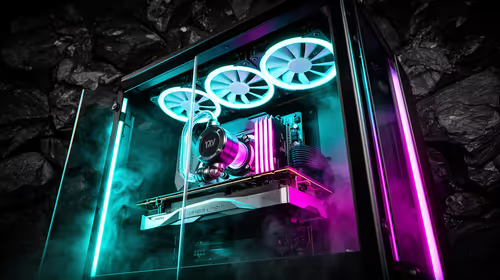
AIO (all-in-one) liquid coolers combine a pump block, flexible tubing, radiator and fans into a sealed unit. Radiator size is the primary cooling performance driver, with 360mm radiators outperforming 240mm units by 5°C to 10°C on high-TDP CPUs. Pump design, fan quality and mounting hardware determine long-term reliability.
Radiator Size and Its Real-World Thermal Impact 🌡️
A 120mm AIO uses one fan and one radiator segment and is suitable only for low-to-mid TDP CPUs. A 240mm unit pairs two 120mm fans and handles CPUs up to around 150W TDP comfortably. A 360mm unit with three 120mm fans is the current standard for high-end CPUs like the Ryzen 9 9950X (170W TDP) or Intel Core Ultra 9 285K (125W base, 250W peak). Some premium AIOs now offer 420mm radiators using three 140mm fans, which provide exceptional cooling headroom for overclocking. In South Africa, where summer ambient temperatures in Johannesburg frequently exceed 30°C, choosing a 360mm unit over a 240mm for a high-TDP build is more important than in cooler-climate markets.
Pump Block Design and CPU Contact 🔧
The pump is the heart of an AIO and the component most likely to limit its lifespan. Most modern AIOs use a combined pump-reservoir-cold plate block that mounts directly to the CPU. Cold plate quality matters enormously for heat transfer efficiency. Copper cold plates outperform aluminium in thermal conductivity. Some premium AIOs, including ASUS ROG Ryujin and NZXT Kraken models, use direct-die or diamond-shaped contact patterns that better conform to the slightly convex heat spreaders on modern CPUs. Pump speed is rated in RPM and directly affects coolant flow rate. Higher flow rates transfer heat from the CPU to the radiator faster, critical for burst workloads like game loading or rendering.
Fan Selection, Bearings and Acoustic Performance 🎵
The fans mounted on an AIO radiator determine both thermal performance and noise levels. AIO manufacturers supply fans tuned for static pressure rather than airflow, since pushing air through a radiator's dense fin stack requires static pressure to overcome resistance. The best AIO fans use fluid dynamic bearings (FDB) or ball bearings for longevity rather than the sleeve bearings found on budget units. ARGB lighting on AIO fans and pump heads is now near-universal at mid-range and above. AIO prices in South Africa range from around R1,200 for a 240mm basic unit to over R4,500 for a 360mm or 420mm premium unit from brands stocked at Evetech.
Orient Your Radiator for Best Airflow in Your Case ⚡
For a top-mounted 360mm radiator, position the AIO tubing exits at the rear of the radiator, not the front. This ensures hot air rises naturally out of the case and avoids coolant pooling near the pump when the system is vertical. Most AIO manufacturers include orientation guidance in their installation manuals.
FAQ
How long does an AIO liquid cooler typically last before the pump fails?
Quality AIOs from established brands are rated for five to seven years of continuous use. The sealed loop means the coolant does not evaporate or need replacing. Pump bearings are the most likely failure point, and most premium units use bearing designs rated to exceed the warranty period.
Is an AIO always better than a high-end air cooler for SA conditions?
Not automatically. A dual-tower air cooler like a Noctua NH-D15 competes with 240mm AIOs on thermal performance. For high-TDP CPUs in warm SA environments, a 360mm AIO has a clear advantage. For mid-range CPUs, a quality air cooler may be the more reliable long-term choice.
Does AIO coolant colour or type affect performance?
The pre-filled coolant in sealed AIOs is optimised for pump compatibility and anti-corrosion, not aesthetics. Performance differences between clear and dyed coolants in sealed units are negligible. Custom loop coolants are a separate category.
Trying to find the right AIO cooler for your CPU and case combination?
Browse Evetech's full range of AIO liquid coolers from 240mm entry units to 360mm and 420mm premium options.